

Researchers from McGill University and collaborating institutions have mapped the atmosphere of the brown dwarf SIMP 0136. They were assisted in this by the James Webb Space Telescope (JWST).
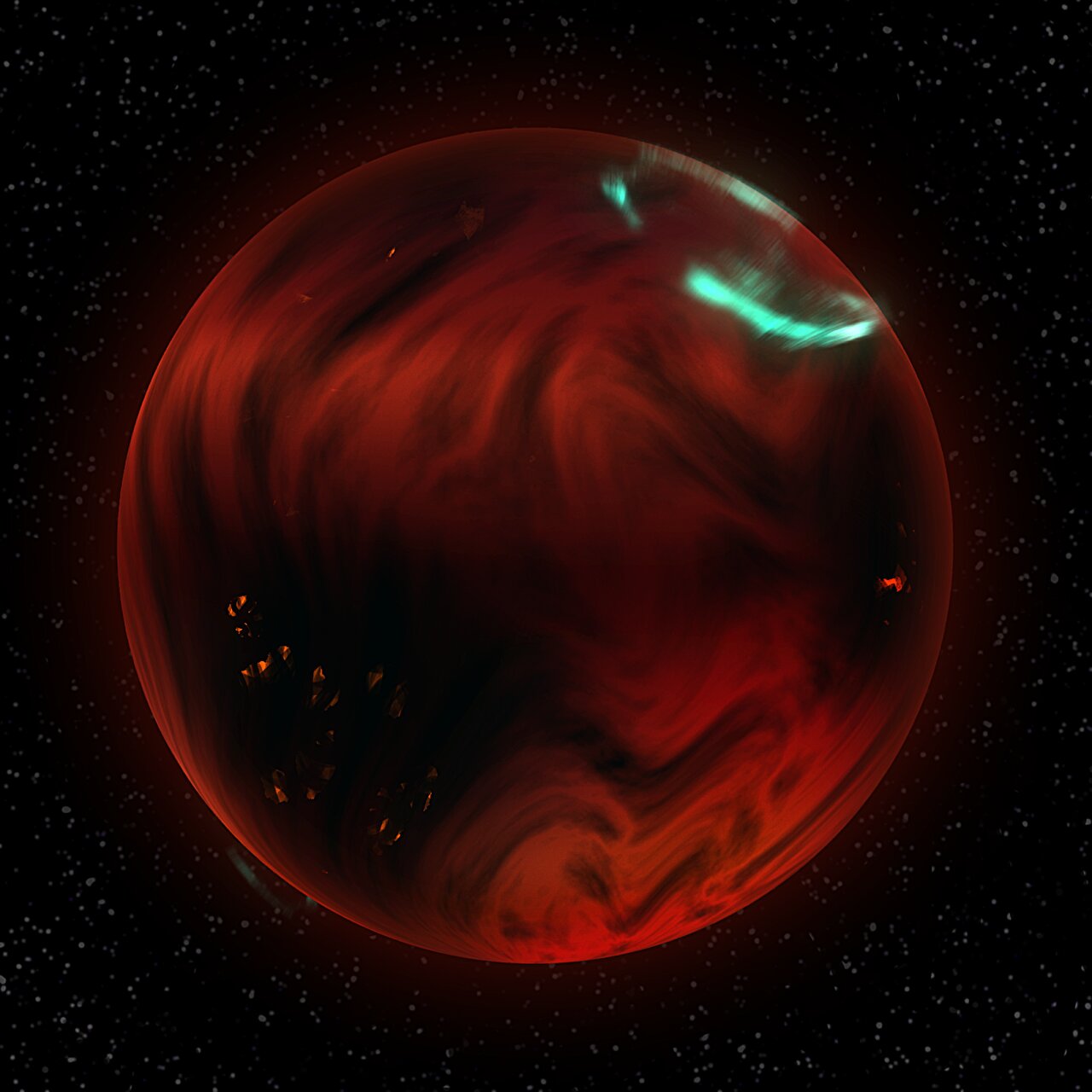
SIMP 0136 is located 20 light-years from Earth in the direction of the constellation Pisces. It does not orbit any star and has very curious characteristics — its mass is approximately 13 times greater than that of Jupiter. This places SIMP 0136 right on the border between gas giants and brown dwarfs.
Brown dwarfs are also called failed stars. Unlike gas giants, some thermonuclear reactions may occur in their interiors, but their masses are insufficient to trigger fusion reactions involving hydrogen. Therefore, after their formation, they cool down and their luminosity decreases.
Since SIMP 0136 is a free-floating object with no companions and does not orbit any other star whose light could interfere with observations, it is an ideal laboratory for studying atmospheres. A group of researchers decided to take advantage of this circumstance and used the JWST telescope.
Observations showed that SIMP 0136 rotates around its axis with a period of 2.4 hours. By analyzing minute fluctuations in brightness at different wavelengths, the team discovered that SIMP 0136’s light is formed by at least three distinct layers of atmosphere. Each layer contains clouds composed of different materials, such as forsterite (a rock) and iron, with different temperatures and chemical compositions.
Scientists suggest that numerous small irregular clouds with different temperatures and chemical compositions are scattered throughout SIMP 0136. Although they were unable to create a meteorological map, they determined that some layers of the atmosphere show clear signs of asymmetry between north and south. This asymmetry is important because it means that future attempts to map the atmosphere of this world will have to be carried out in two dimensions: longitude and latitude.
The study also showed that no single model can explain the observed data; only a combination of several atmospheric models can reproduce the spectrum. This discovery confirms theories that brown dwarfs and giant exoplanets have chaotic, rapidly changing weather similar to Jupiter’s bands, but much more turbulent.
According to Phys.org

