

The star system closest to our Solar System—Alpha Centauri—is located more than four light-years away. To the human mind, this number sounds abstract, but in reality it amounts to tens of trillions of miles of empty space. Using modern chemical rocket engines for such a journey seems almost impossible: the flight would take hundreds or even thousands of years. In fact, this would require the creation of “generational spacecraft” where people would be born and die over the course of centuries without ever seeing the destination of their journey.
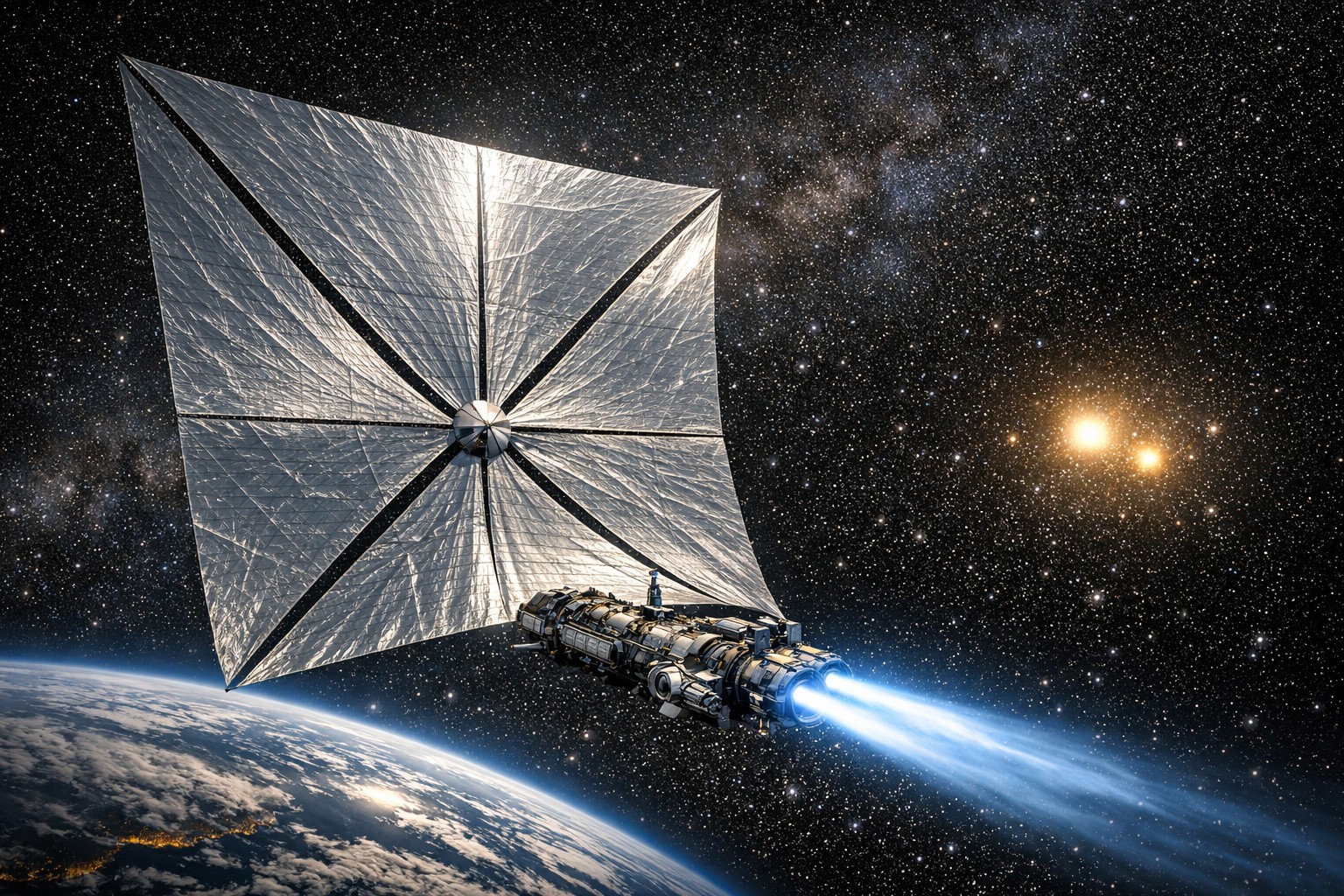
However, a new article published in the prestigious scientific journal Newton offers hope for a dramatic reduction in this timeframe. A team of researchers from Texas A&M University has demonstrated an innovative approach that allows objects to be moved and controlled from a great distance using only laser light.
Microscopic motors of the future
The key to success was the development by scientists of micron-scale devices known as “metajets.” These structures are smaller than the width of a human hair, but possess unique physical properties. Their surfaces feature intricate patterns—so-called metasurfaces.
Metasurfaces function like smart lenses: they alter the phase, amplitude, and direction of the light falling on them. When a laser beam strikes such a surface, the photons transfer their momentum to the object. Shoufeng Lan, an associate professor at Texas A&M University, compares this process to ping-pong balls bouncing off a racket.Each “impact” of a light particle propels the device forward. Although the force of a single photon is negligible, in a vacuum and under conditions of constant, intense radiation, the cumulative effect allows for the attainment of tremendous speeds.
Full maneuverability in three dimensions
The Texas team’s main scientific achievement was the realization of “full three-dimensional maneuverability.” Previously, optical manipulation allowed objects to be pushed only slightly in a single direction. The new metamaterials, however, are capable of complex maneuvers.
When illuminated by a standard laser beam, these autonomous devices can move sideways and rise vertically at the same time. This is the world’s first demonstration of remote 3D control of a micro-object without any mechanical contact. This flexibility is critical for space missions: the spacecraft must not only travel forward but also adjust its course, avoid collisions with interstellar dust, and precisely enter the orbit of its target star.
The most exciting aspect of this technology is its scalability. The force acting on an object depends not on its physical size, but on the power of the laser beam and the efficiency of the metasurface. This means that a concept validated on microscopic samples can be applied to massive space structures.
Researchers believe that in the future, powerful laser systems located on Earth or in near-Earth orbit will be able to accelerate large spacecraft equipped with solar sails.According to calculations, such a system is capable of accelerating the probe to relativistic speeds. In that case, the journey to Alpha Centauri would take about 20 years—a timeframe that is quite feasible for a single generation of scientists.
Earlier, we wrote about NASA’s top 5 most ambitious space projects.
According to interestingengineering.com

