

New research from Penn State University in collaboration with NASA shows that the powerful radio signals we send into space to communicate with our spacecraft (primarily those serving Mars) are actually escaping into interstellar space as an unaccounted-for signal loss. Mars does not shield all signals, so they travel along aligned Earth-Mars trajectories, creating predictable paths along which such signals can be traced.
Scientists analyzed two decades of logs from NASA’s Deep Space Network (DSN) — satellite communication systems in California, Spain, and Australia — and found that if an outside observer receives a signal in the direction where Earth and Mars are aligned, there is approximately a 77% chance that it can be detected. These transmissions can be received as far as 23 light years away, and the transmissions themselves are most often within the plane of Earth’s orbit, meaning their path is directed along the plane of our Solar System.
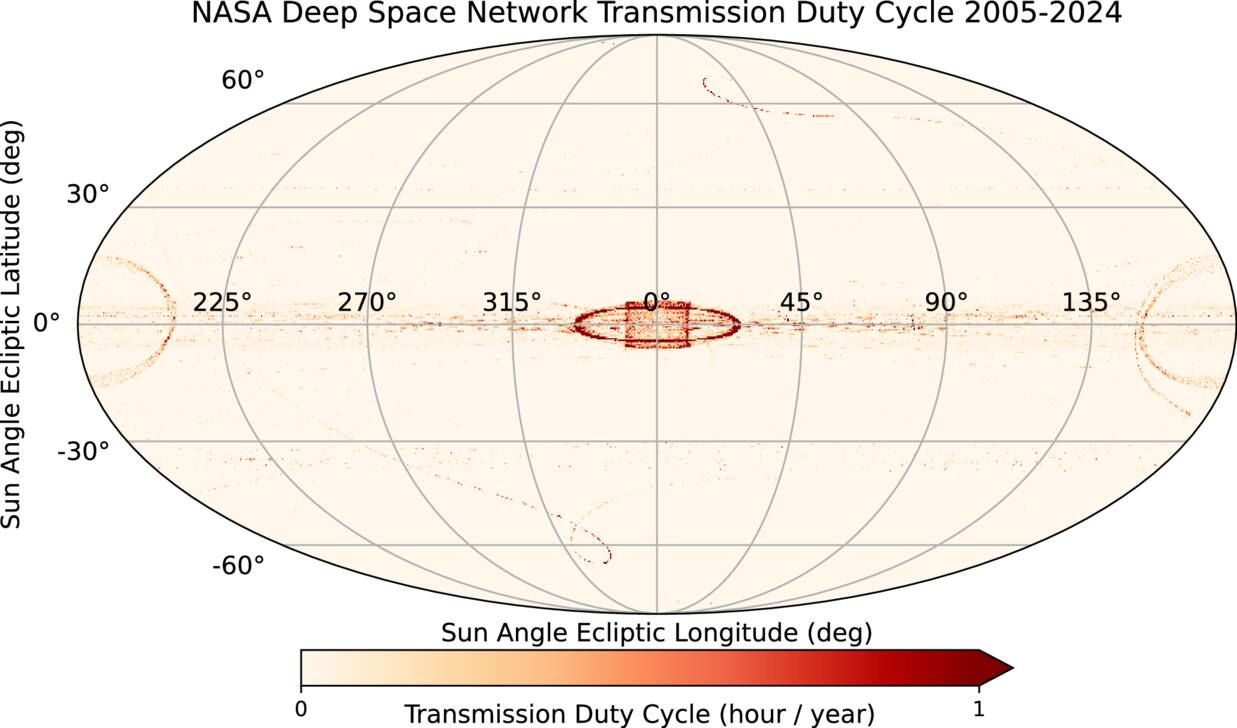
The authors of the study have managed to create a map that shows where and when our signals become most distinct to an outside observer. This opens up a new approach for SETI strategies: instead of large-scale, random surveys of the sky, it is worth focusing on moments when planets align in potentially interesting systems — this increases the probability of detecting extraterrestrial technosignatures.
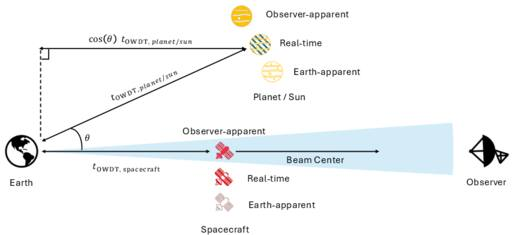
This study proposes a new method for searching for extraterrestrial life: instead of randomly scanning space, scientists can specifically track certain star systems at moments when planets such as Mars align with Earth. This focused approach significantly increases the chances of detecting technosignatures — potential evidence of the existence of advanced civilizations.
In addition, knowledge about the directions of outgoing signals helps to plan new methods of communication and space missions. For example, if in the future we aim the signal specifically at a certain sector of the Galaxy to test the reaction, it will be more effective and safer than sending signals randomly.
This study expands our understanding of technosignatures not only as intentionally sent messages, but also as unconscious “evidence” of our presence. This approach is consistent with the modern expansion of the concept of technosignature in astronomy: it refers not only to artificial laser signals, but also to ordinary radio emissions that accidentally result from the technical activities of civilization.Want to know where interstellar visitors to our Solar System come from, and whether one of them might be a potential alien spacecraft rather than a comet? Read the article “Interstellar objects: natural bodies or extraterrestrial spacecrafts?” We explain that the wave of sensational news has increased interest in comet 3I/ATLAS, but at the same time we provide a reasoned analysis of its origin: both as a natural object and, hypothetically, as an artificial one.
According to iopscience, thetimes, interestingengineering

