

The European Space Agency has published a series of new images obtained by the Mars Express spacecraft. They show a region whose geological history holds memories of the Red Planet’s turbulent past.
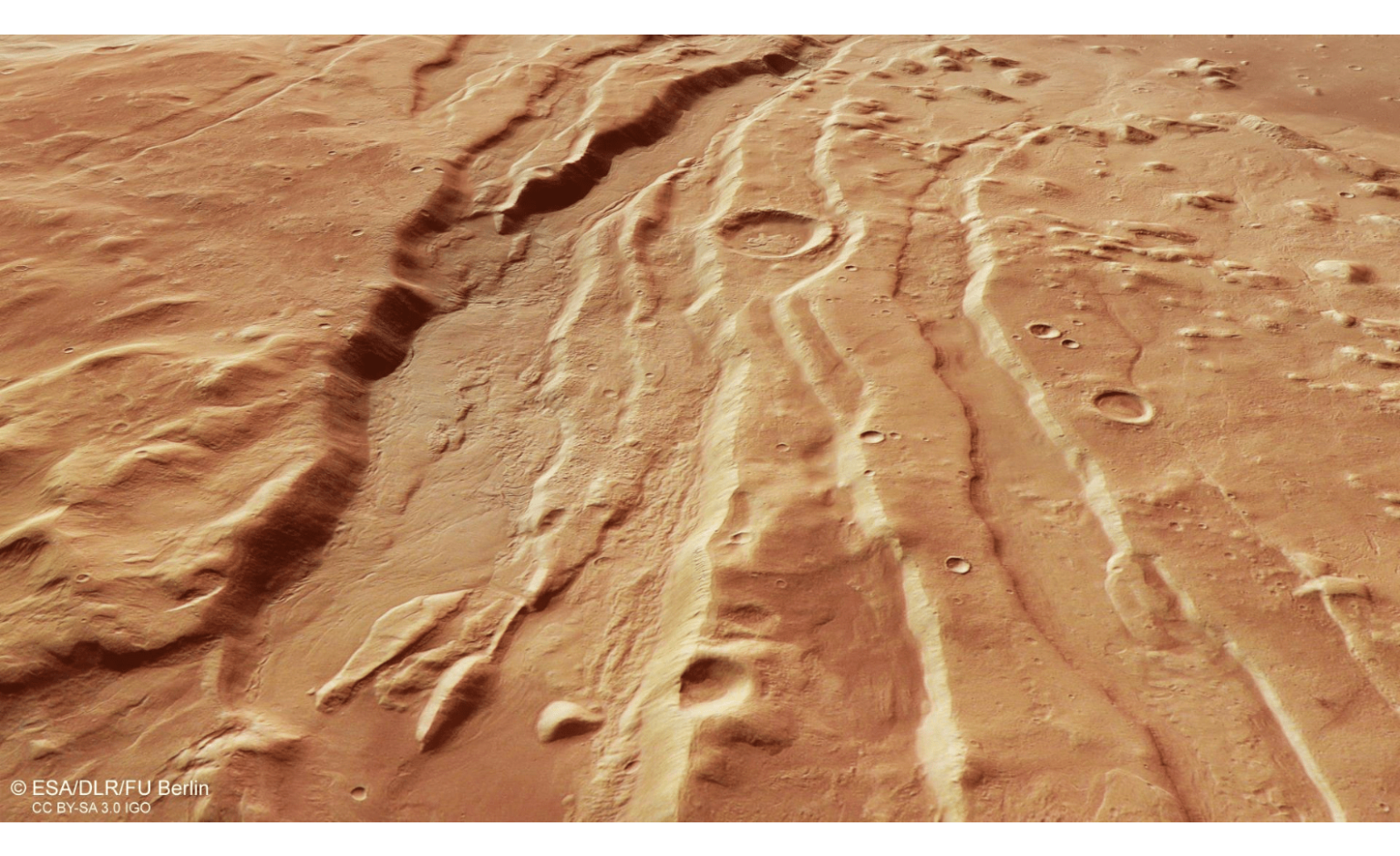
Modern Mars is a cold and desert world where, at first glance, no significant geological processes are taking place. But this was not always the case. Over billions of years of its existence, the Red Planet has gone through periods of water bodies, eruptions of giant supervolcanoes, and numerous glaciation cycles. All of them left distinctive marks on its surface.
One of the most striking examples demonstrating the tumultuous past of Mars is the Acheron Fossae region. It is located 1,200 km from Olympus Mons, the largest volcano in the Solar System, whose formation directly influenced the appearance of this area. Acheron Fossae is a surprisingly diverse mix of rugged and smooth terrain, covered with ancient faults, craters, and solidified lava. In April, Mars Express already photographed its eastern part. Now the vehicle returned to it to show the western edge, where the landscape is equally diverse: deep cracks, valleys, and winding channels carved out and filled by slowly moving streams of ice and rocks.
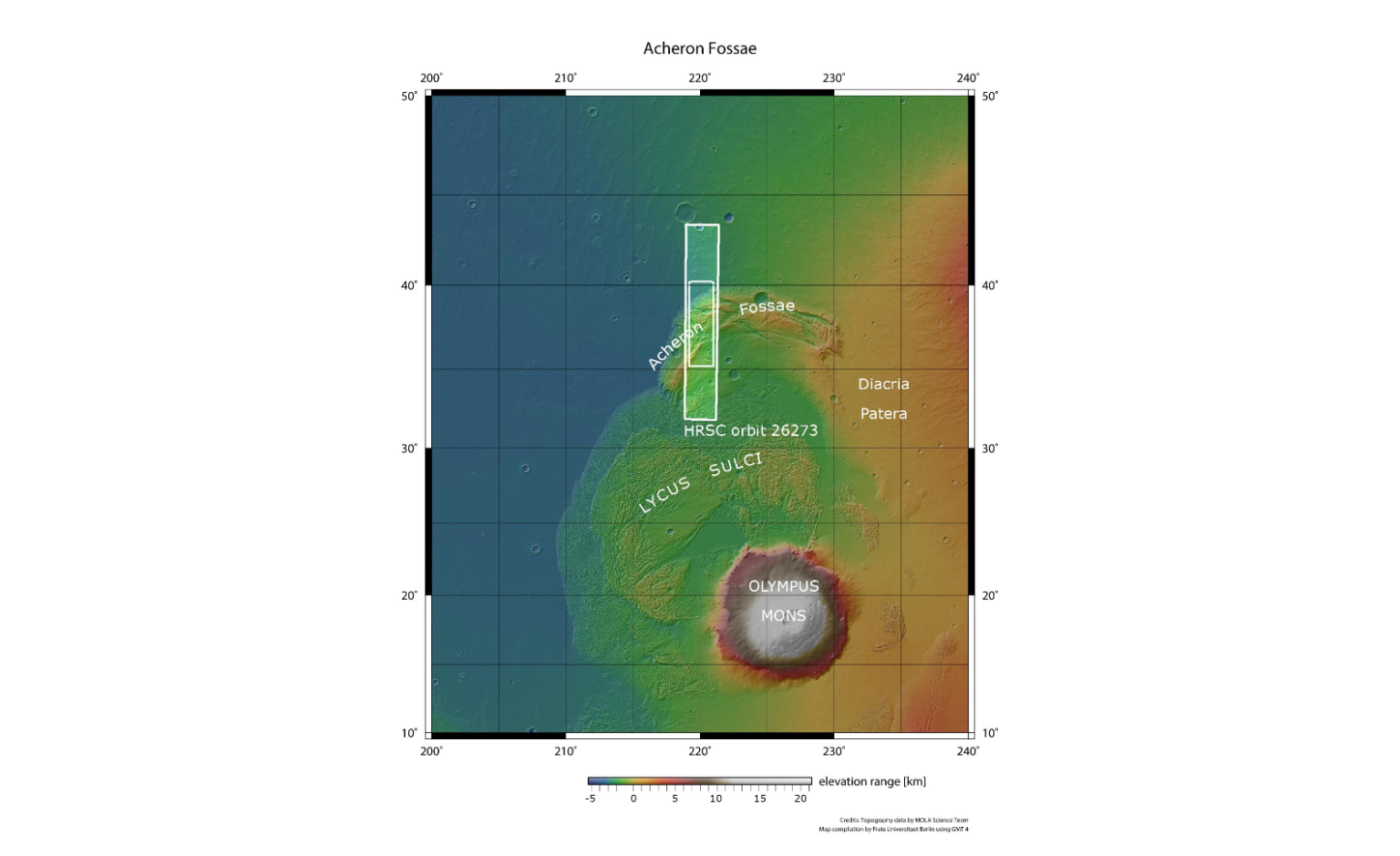
According to scientists, this structure emerged more than 3.7 billion years ago, when Mars was most geologically active, as a result of hot material rising beneath the Martian crust associated with the formation of supervolcanoes. This rise in molten rock stretched and tore the surface, creating cracks and valleys kilometers deep, some of which are hundreds of kilometers long.
After their formation, these valleys continued to transform. Now their bottom is relatively flat, with soft, winding lines reminiscent of a flowing river. It is believed that these valleys were once filled with a slow, viscous flow of ice-rich rock, very similar to the rock glaciers found on Earth.
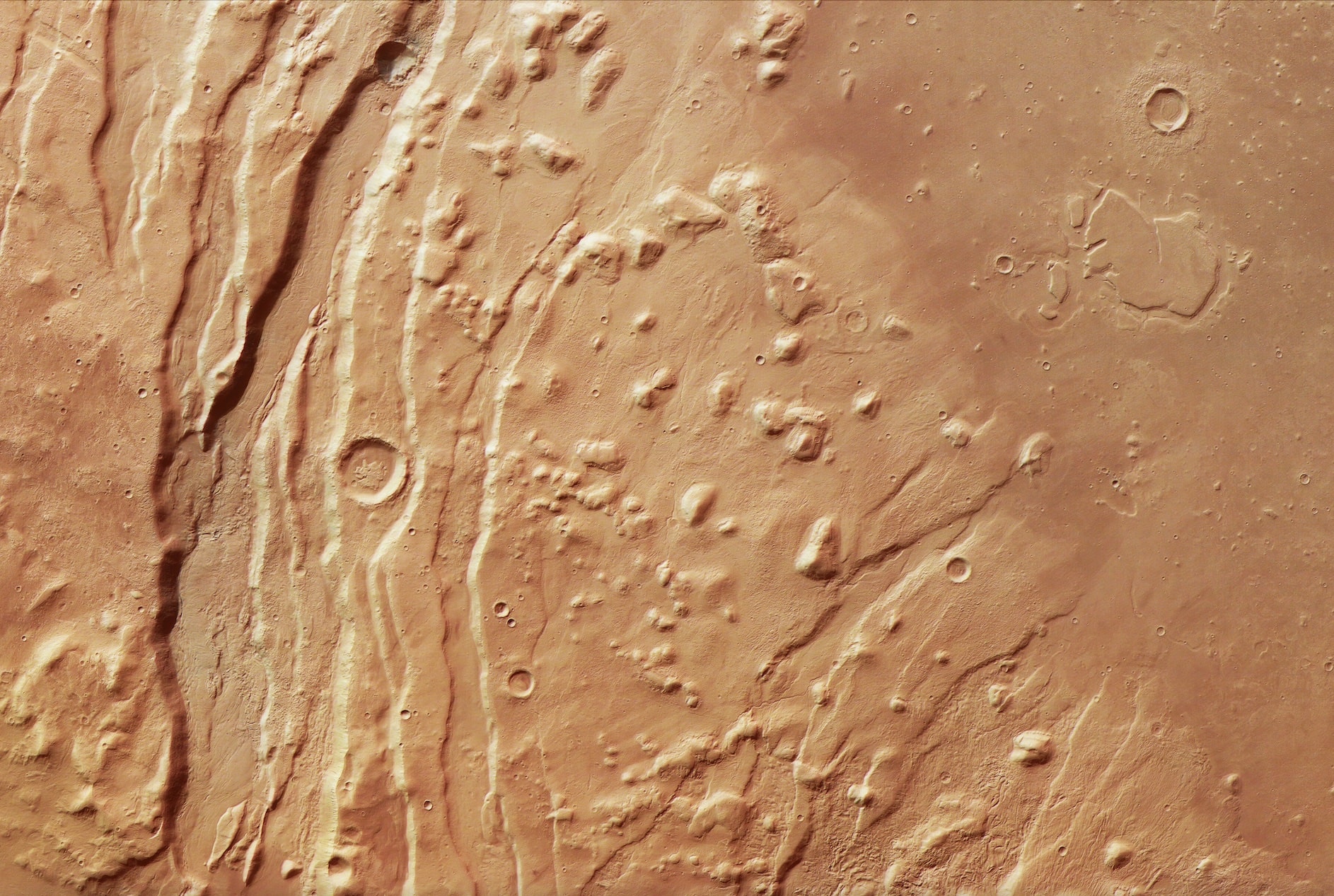
Rock glaciers are very sensitive to climate change and are therefore good indicators of how the planet’s climate has changed over time. Here, they point out that this region of Mars experienced alternating periods of cooling and warming, freezing and thawing.
These temperature fluctuations are caused by the tilt of Mars’ axis of rotation. Unlike Earth, whose axis maintains a relatively stable and moderate tilt thanks to the stabilizing influence of the Moon, Mars’ tilt varies significantly over time. This leads to alternating warm periods and ice ages, resulting in ice periodically advancing toward the planet’s equator and then retreating back to the poles.
Although our Earth also experiences similar fluctuations, they are much stronger on Mars. Over the past 10 million years, Mars’ tilt has fluctuated between 15 and 45 degrees, while Earth’s tilt has varied between 22 and 24.5 degrees. These regular shifts, known as Milankovitch cycles, play an important role in our planet’s climate, but their influence is more subtle than on Mars.
According to ESA

