

California startup Reflect Orbital has come up with a bold plan: to launch thousands of mirror satellites into orbit to illuminate solar power plants at night. The goal is to increase the production of green energy. However, this idea has caused a wave of outrage among astronomers and environmentalists, who warn of catastrophic consequences for science and wildlife.
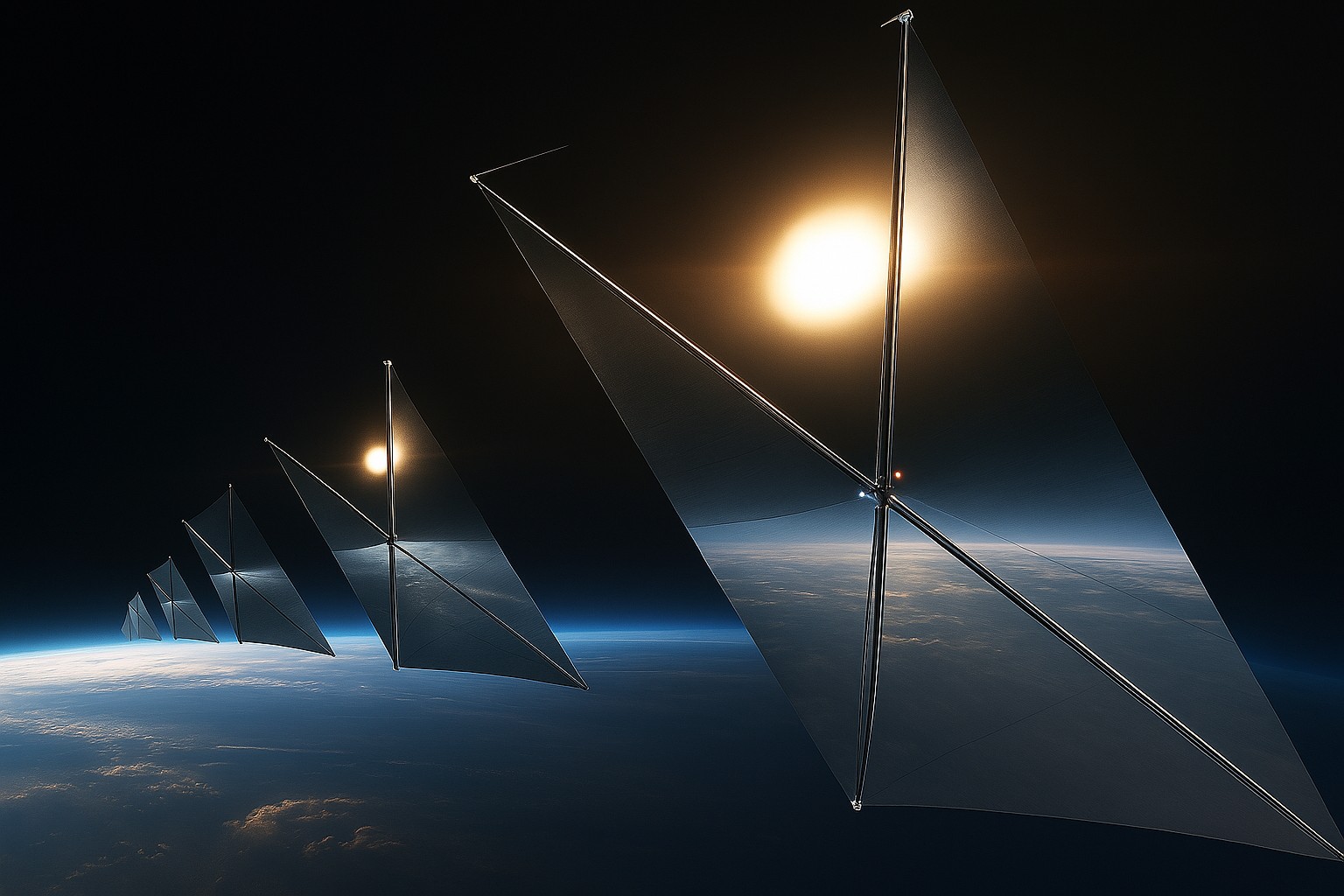
The Reflect Orbital concept is reminiscent of using a mirror to reflect sunlight. The company plans to launch a fleet of 4,000 satellites into orbit by 2030. The first demonstration device, called EARENDIL-1, with a mirror area of more than 300 m², could appear as early as 2026. Once in space, the satellites will redirect sunlight to Earth, extending the “working day” for solar panels.
The idea has already received approval and funding, including a $1.25 million contract from the US Air Force. However, the scientific community regards it with deep skepticism and concern.
Threats to science and nature
Experts point out that practical implementation is much more difficult. Astronomers Michael Brown and Matthew Kenworthy explain that due to the great distance from the Sun, the reflected beam is greatly scattered. The brightness of such a “night sun” from a single satellite will be 15,000 times weaker than actual midday light. To achieve even 20% of the Sun’s brightness, about 3,000 satellites would be needed for just one region. And since they move in orbit, more than 4,000 devices are needed for continuous illumination, scientists note.
An additional threat is posed by the man-made factor. In the event of a collision with space debris, the mirror could lose control. “You will get a giant beacon that will uncontrollably illuminate the Earth in random regions,” warns astrophysicist Siegfried Eggl.
Astronomy may become the main victim of this ambitious project. Artificial lighting of the night sky will make it much brighter, making it impossible to observe faint objects.
“It will be like having a full moon every night, and it will be devastating for our science,” says Eggl.
Wildlife faces equally serious consequences. Light pollution is already growing rapidly, disrupting the natural rhythms of animals. Artificially extending the day can disrupt circadian rhythms, physiology, and behavior patterns in countless species, from insects to birds.
Reassessment of negativity
Reflect Orbital has announced its intention to conduct an environmental impact assessment. The company’s application to the US Federal Communications Commission is still under review. The scientific community hopes that regulators will listen to their arguments before paving the way for a new, unpredictable challenge for all life on the planet.
Earlier, we reported on how an astronaut showed the beauty of the cosmic threat in orbit.
According to theconversation.com

