

A team of researchers from the University of Zurich has challenged our understanding of the internal structure of Uranus and Neptune. They may be rockier and less icy than previously thought.
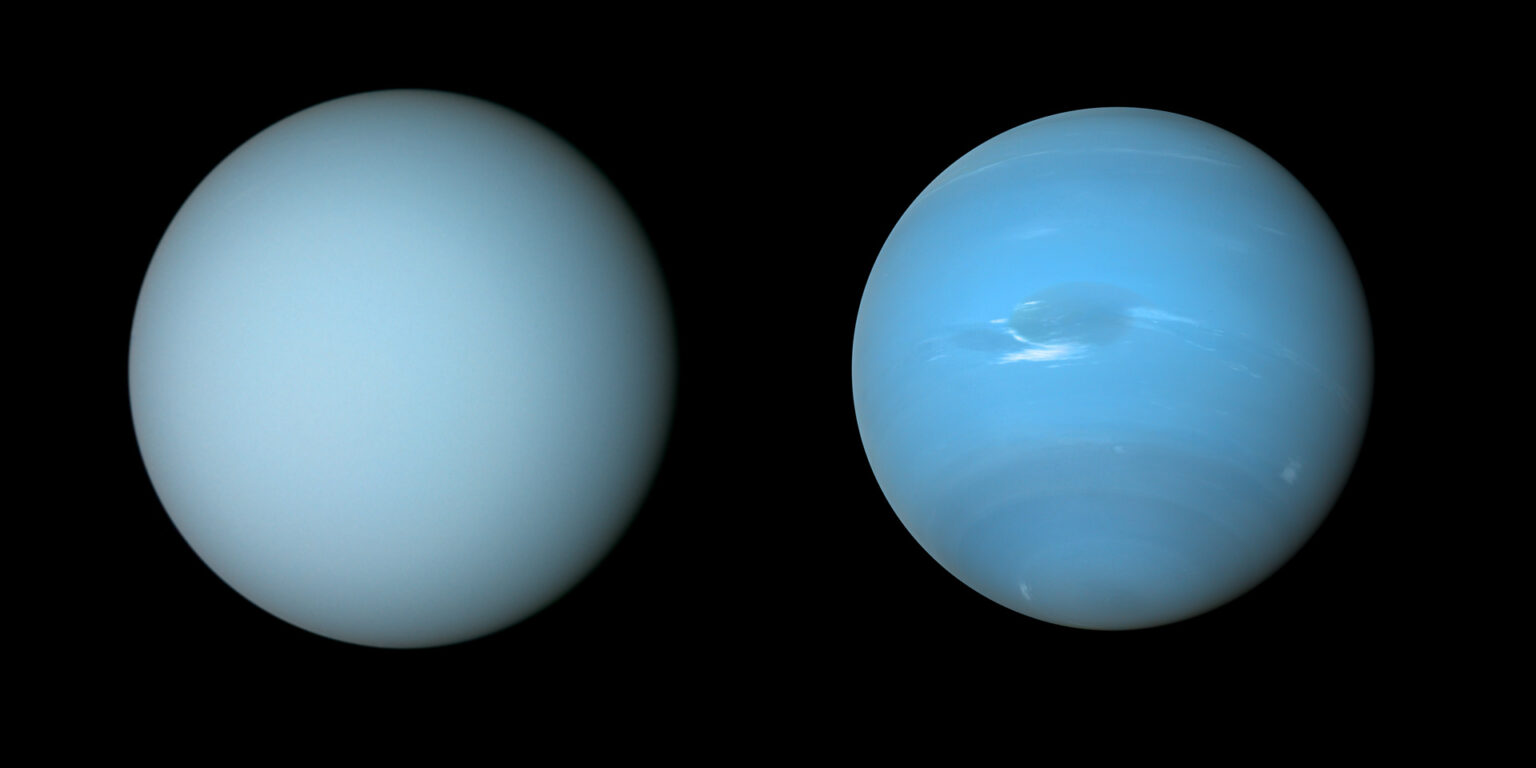
The planets of the Solar System are usually divided into three groups based on their composition: four rocky planets (Mercury, Venus, Earth, and Mars), two gas giants (Jupiter and Saturn), and finally, two ice giants (Uranus and Neptune). However, the last category may need some clarification. The results of a study conducted by scientists at the University of Zurich suggest that Uranus and Neptune may be more rocky than icy. This interpretation is also consistent with the discovery that the dwarf planet Pluto is predominantly rocky in composition.
The team developed a unique process for modeling the internal structure of Uranus and Neptune. “The classification of ice giants is overly simplistic, as Uranus and Neptune are still poorly understood,” explains Luca Morf, a graduate student at the University of Zurich and lead author of the study. “Physics-based models were too saturated with assumptions, while empirical models were too simplistic. We combined these two approaches to obtain models of internal structure that are both agnostic, or unbiased, and physically consistent.”
Completely new range of possibilities
Using their model, the team discovered that the potential internal composition of the Solar System’s “ice giants” is not limited to ice (usually represented by water). Both planets could be either rich in water or rich in rock.

The study also opens up new perspectives on their magnetic fields. While Earth has distinct north and south magnetic poles, the magnetic fields of Uranus and Neptune are more complex and have more than two poles. “Our models have so-called ‘ionic water’ layers that generate magnetic dynamos in places that explain the observed non-dipole magnetic fields. We also found that Uranus’ magnetic field originates from deeper layers than Neptune’s magnetic field,” explains Ravit Helled, one of the study’s participants.
Necessity of new space missions
Although the results are encouraging, some uncertainty remains. This is because physicists still do not fully understand how materials behave under the extreme pressure and temperature conditions found at the center of the planet, and this could affect the accuracy of the modeling.
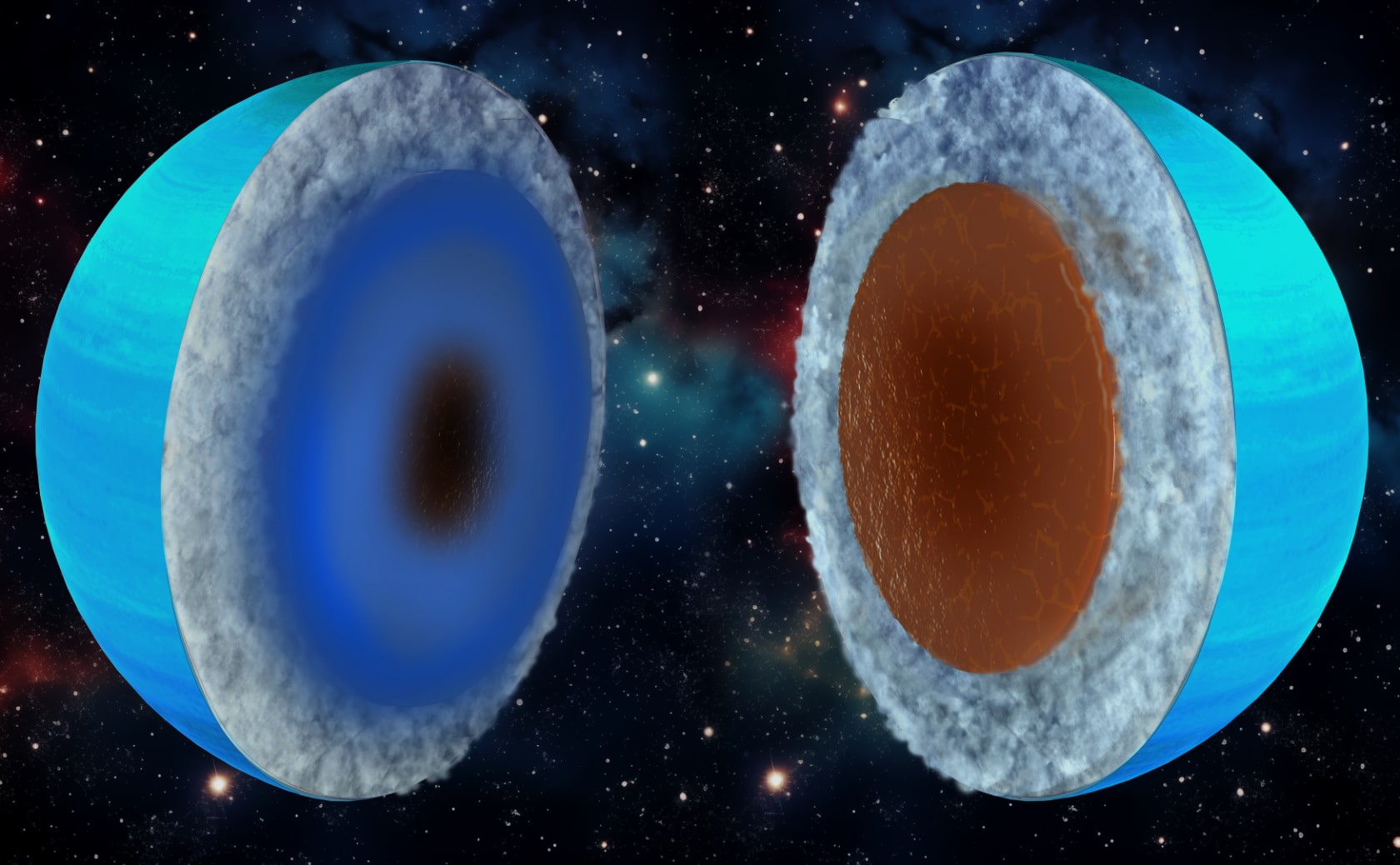
According to the team, despite the uncertainties, their model also opens the door to new potential scenarios for the planet’s interior composition, challenging decades-old assumptions. Both Uranus and Neptune could be rocky giants or ice giants, depending on the model assumptions. Current data is insufficient to distinguish between the two planets, so we need special missions to Uranus and Neptune that can reveal their true nature.

