

While studying the movements of stars in an ancient globular cluster, scientists accidentally stumbled upon an unusual gap in the brightness distribution of red dwarfs on the stellar diagram. Within a certain range of luminosity for red dwarfs, there was a noticeable gap, indicating processes taking place deep within these stars, thousands of light-years away from us.
Why were red dwarfs overlooked?
To classify stars and track the stages of their evolution, astronomers use the Hertzsprung–Russell diagram. On this diagram, the luminosity of stars is plotted against their color, which reflects their surface temperature. One of the most striking features is the band of main-sequence stars that runs diagonally across the diagram.
In 2018, while analyzing data from ESA’s Gaia space telescope, scientists noticed a narrow diagonal section within this band where stars are noticeably scarce. The gap is located in the red dwarf region. It is linked to changes in the internal structure of these stars, as in red dwarfs with masses ranging from 0.34 to 0.36 solar masses, fuel accumulation at the core can trigger an energy flare that destabilizes their structure. The stars temporarily change in size, luminosity, and temperature, and since only a small fraction of them go through this process at any given time, a noticeable gap forms in the diagram.
Globular clusters as a laboratory
Researchers at the Space Telescope Science Institute (STScI) in Baltimore decided to investigate whether the same gap exists in the globular cluster. The advantage of such clusters is that all the stars in them formed at roughly the same time and under the same conditions, and therefore have similar histories and chemical compositions. This greatly simplifies comparisons and increases the accuracy of the results.
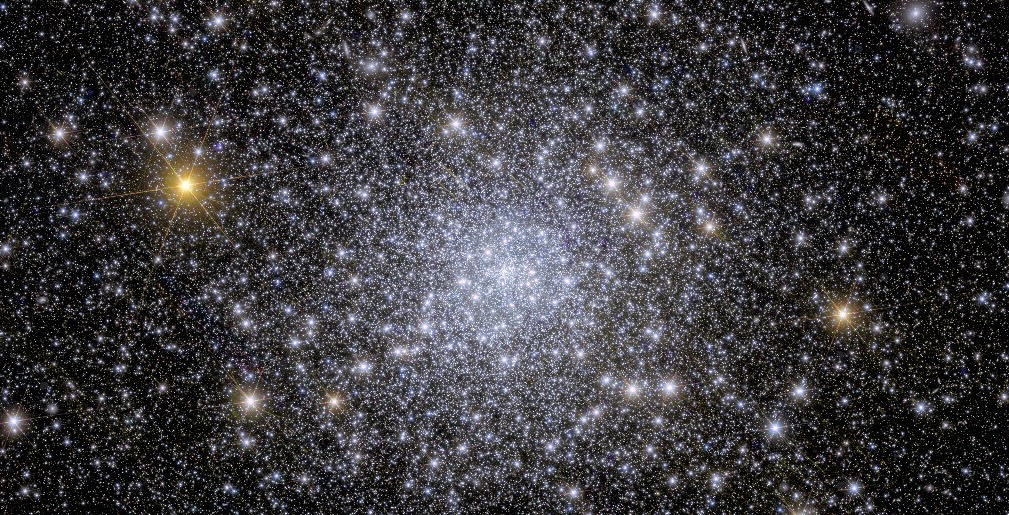
Using ESA’s Euclid space telescope and NASA’s Hubble Space Telescope, the team studied NGC 6397—one of the closest globular clusters to Earth. It is located about 8,000 light-years away in the southern constellation of the Altar and contains hundreds of thousands of stars. The cluster’s age is estimated at 13.4 billion years. The same gap in the diagram, previously detected while observing neighboring younger stars, has also appeared here, among the cluster’s much older stars.
A new way to measure distances
The discovery has practical significance. Since the gap occurs at precisely defined stellar masses, astronomers can use the exact luminosity at that point as a reference for measuring the distance to the cluster. This opens the door to much more accurate calculations of cosmic distances.
To obtain these results, the team used tools for precise measurements in extremely dense star fields, developed at STScI for the Hubble Space Telescope over more than two decades. Combined with Euclid’s wide field of view, these tools made it possible to clearly identify the gap. The authors of the study hope that further observations using Euclid and the Nancy Grace Roman Space Telescope will allow them to better characterize this feature in other globular clusters as well. The results have been published in the journal Astronomy & Astrophysics.
According to phys.org

