

Using ESO’s Very Large Telescope (VLT), astronomers obtained an image of a shock wave around the dead star RXJ0528+2838. The discovery left them puzzled. According to current understanding, objects like this should not have such structures around them.
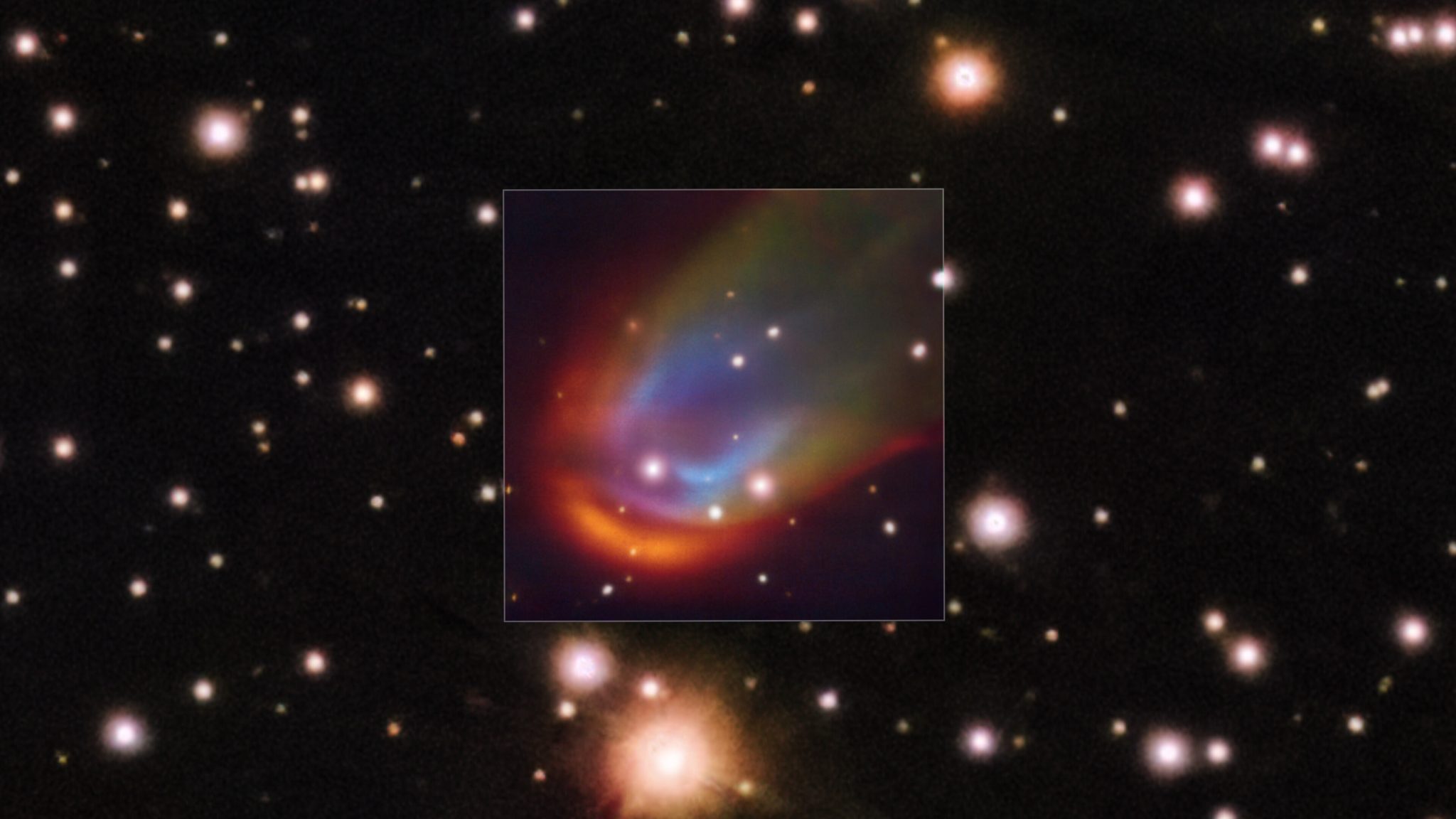
RXJ0528+2838 is located 730 light-years from Earth. It is a white dwarf: the core of a dead star that has exhausted its hydrogen fuel supply and shed its atmosphere.
A normal sun-like star orbits around the white dwarf. In such binary systems, matter from the companion star is transferred to the white dwarf, often forming a disk around it. Some of this material then falls onto the white dwarf, while some is ejected into space, forming powerful jets. But RXJ0528+2838 shows no signs of a disk, making the origin of the jet and the nebula formed around the star a mystery.
The team first noticed a strange nebula around RXJ0528+2838 in images taken with the Isaac Newton Telescope in Spain. Recognizing its unusual shape, they studied it in more detail using the MUSE instrument on the VLT.
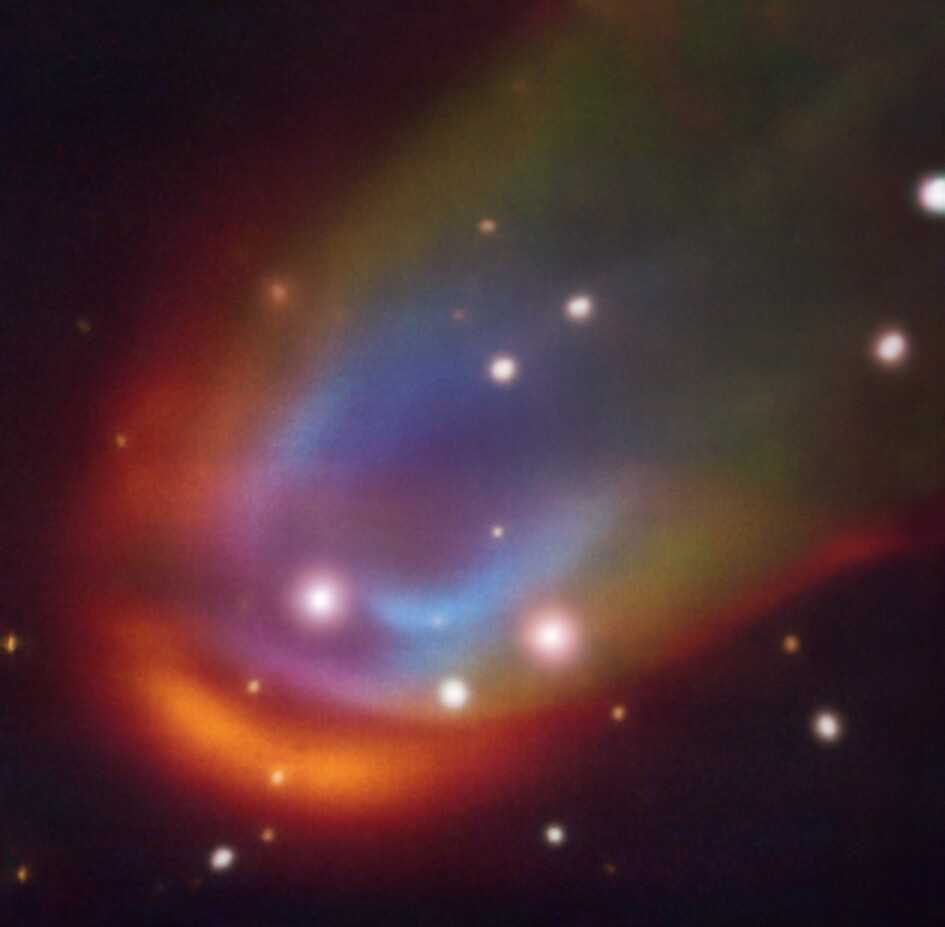
The shape and size of the shock wave suggest that the white dwarf has been emitting a powerful stream for at least 1,000 years. Scientists do not know exactly how a dead star without a disk can sustain such a long-lasting stream, but they have a hypothesis.
It is known that this white dwarf has a strong magnetic field, which is confirmed by MUSE data. This field directs material stolen from a neighboring star directly onto the white dwarf without forming a disk around it. “Our discovery shows that even without a disk, these systems can cause powerful flows, revealing a mechanism that we do not yet understand. This discovery challenges the standard picture of how matter moves and interacts in these extreme binary systems,” explains one of the study’s authors, Christian Knigge.
Current results point to a hidden energy source, probably a strong magnetic field, but this “mysterious engine,” as the authors of the disclosure figuratively call it, has yet to be investigated. The data show that the current magnetic field is strong enough to power a shock wave lasting several hundred years, so it only partially explains what astronomers are observing.
To better understand the nature of such streams, astronomers need to study many more binary systems. The Extremely Large Telescope, currently under construction in the Atacama Desert, will help them do this.
According to ESO

