

On December 6, NASA lost contact with the MAVEN (Mars Atmosphere and Volatile EvolutioN) spacecraft orbiting Mars. Prior to this, telemetry showed that all systems were operating normally.
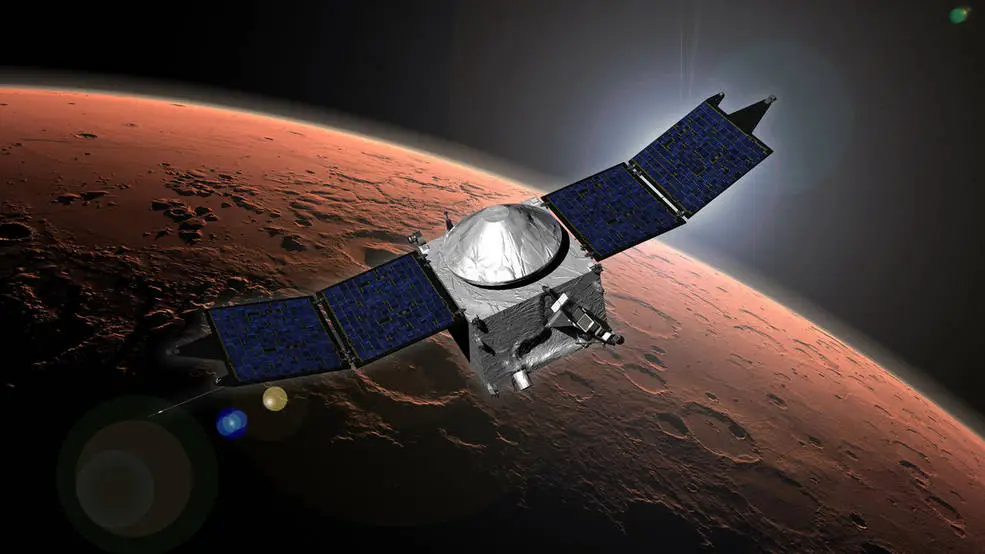
The MAVEN mission was launched in 2013. Its main objective was to study the current state and evolution of Mars’ atmosphere and, in particular, the mechanism of its loss under the influence of solar wind. Understanding the reasons for the loss of the atmosphere gives scientists insight into the history of the Red Planet’s atmosphere and climate, liquid water, and its suitability for life.
MAVEN successfully accomplished this task, showing that Mars loses approximately 100 grams of its atmosphere every second. This figure increases significantly during powerful solar flares. The spacecraft was also used to study polar auroras and comets approaching Mars. In particular, MAVEN captured an image of the interstellar comet 3I/ATLAS.
Another important task of the spacecraft was to relay data collected by rovers back to Earth. NASA considered it an important part of the Martian infrastructure that would be needed to support future missions.
Now these plans are in doubt. On December 6, NASA unexpectedly lost contact with the spacecraft. This happened when MAVEN went behind Mars and was out of sight of ground stations. After the spacecraft went behind Mars, NASA’s Deep Space Network could no longer receive the spacecraft’s signal.
According to an official NASA statement, telemetry received prior to the incident indicated that all MAVEN systems were operating normally. The mission team is currently analyzing the data they have and trying to understand what caused the communication failure.

