

The international community of astronomers has released findings that could mark the beginning of a major reevaluation of our understanding of the universe. A team of scientists, including John Blakeslee of NSF NOIRLab, has presented the most accurate measurements to date of the expansion rate of the universe. However, rather than putting an end to long-standing debates, the new figures have only intensified the so-called Hubble tension – a paradoxical discrepancy that hints at the existence of physical processes about which we still know nothing.
Two truths about one universe
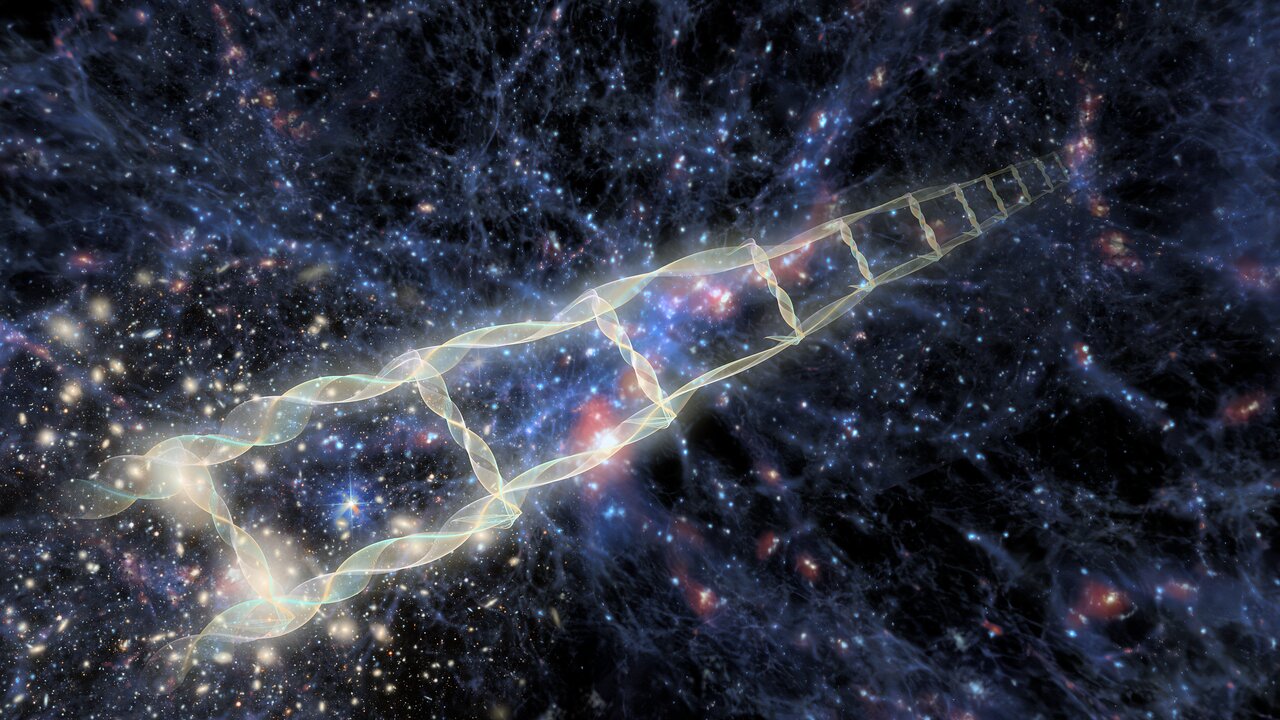
Today, there are two main strategies in cosmology for determining the rate of the universe’s expansion. The first method is “local.” Scientists measure the distances to stars and nearby galaxies by observing how fast they are moving away from us. This is comparable to measuring a car’s speed directly using its speedometer.
The second method is the “relic” approach. Researchers look deep into the past by analyzing the cosmic microwave background radiation – the “echo” of the Big Bang. Using the standard cosmological model, they calculate what the expansion rate should be today.
In theory, both approaches should lead to the same result. But the reality is different. Local observations consistently show a velocity of about 73 km/s per megaparsec. At the same time, calculations based on the early universe yield a figure of ≈67 km/s per megaparsec. This difference seems insignificant, but for modern science, it is critical: it cannot be attributed to statistical error or instrument inaccuracy.
The accuracy barrier has been overcome
To definitively verify whether this discrepancy stems from measurement errors, the H0 Distance Network (H0DN) collaboration has developed a fundamentally new approach. The results of their work, published in the journal “Astronomy & Astrophysics,” are based on the integration of decades of observations into a single, transparent system.
The team created what they call a “network of distances.” Instead of relying on a single tool or method, the researchers combined data from several independent techniques:
- Cepheids are variable stars whose brightness changes according to a regular pattern.
- Red giants are old stars with a known maximum luminosity.
- Type Ia supernovae are powerful cosmic explosions that serve as “standard candles.”
- Specific types of galaxies.
This multi-step analysis allowed the researchers to test the methods one by one. If even one of them had failed, the overall system would have detected it immediately. However, the results proved to be extremely robust. The new value of the Hubble constant has been set at 73.50 ± 0.81 km/s per megaparsec. This means that the measurement accuracy has, for the first time, surpassed the 1% threshold.
The role of observatories
The success of the study was made possible by the capabilities of NSF NOIRLab. The analysis utilized a dataset from ground-based and space-based observatories. The Cerro Tololo Inter-American Observatory (CTIO) in Chile and the Kitt Peak National Observatory (KPNO) in Arizona played a key role.
In addition, the scientists utilized resources from the International Gemini Observatory, which enabled them to obtain ultra-sharp infrared images of distant objects. Combining data from CTIO, KPNO, and space telescopes has laid the groundwork that effectively rules out the possibility of a “random error” in local measurements. If the figure 73.5 is correct, then the error lies not in the telescopes but in our theories.
Where did astrophysicists go wrong?
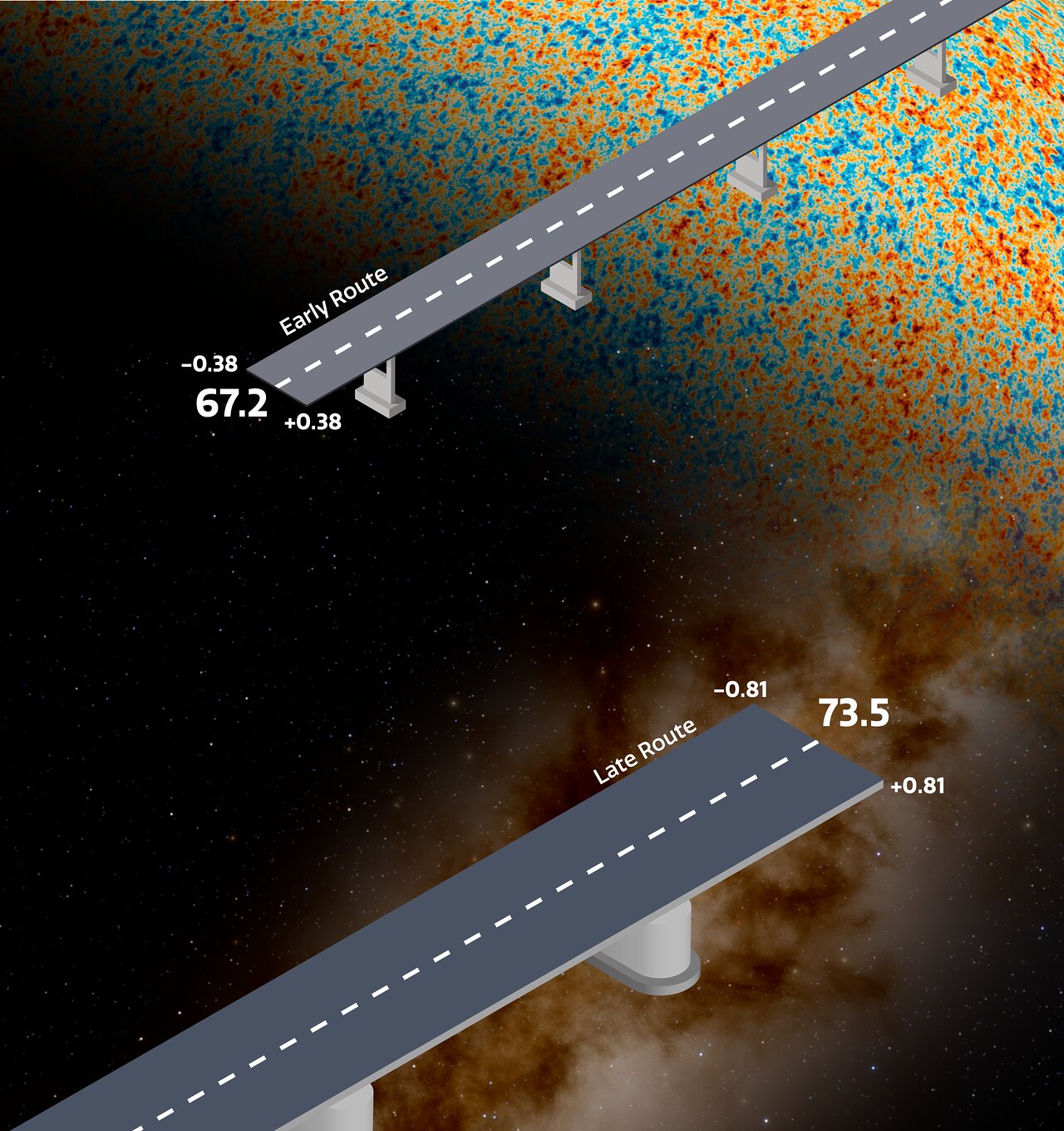
The Hubble tension is not just a dispute over numbers. It is a sign that the standard cosmological model, the Lambda-CDM model – which has been considered unshakable for decades – may be incomplete. If the early universe expanded more slowly than we observe today, then something has changed between “then” and “now.”
Scientists suggest several scenarios:
- The nature of dark energy. It may not be a constant and may vary in strength over time.
- New particles. The existence of unknown types of neutrinos or dark radiation that influenced the expansion during the first few million years.
- Modified gravity. Einstein’s laws of gravity likely need to be revised on vast cosmic scales.
As the authors of the report “The Local Distance Network” noted, we are standing at the threshold of “new physics.” What we once considered a constant has turned out to be a dynamic enigma.
The future in the crosshairs of new telescopes
The measurement network that has been developed is an open architecture. This means that any new observation can be instantly integrated into the system to refine the results. The next major step will be the launch of full-scale operations at the Vera C. Rubin Observatory. Thanks to its ability to map the sky at unprecedented speeds, it will be able to detect thousands of new supernovae and variable stars, which will allow us to further reduce the margin of error.
Every new gigabyte of data brings us closer to answering the big question: why does the universe behave the way it does, and what forces are actually driving its endless expansion? Today, we know one thing for sure: space is far more complex than we imagined just ten years ago. And the Hubble tension is not a problem to be solved, but a clue to be unraveled.
Earlier, it was reported that the Milky Way may be located on the edge of a vast void.
Provided by noirlab.edu

