

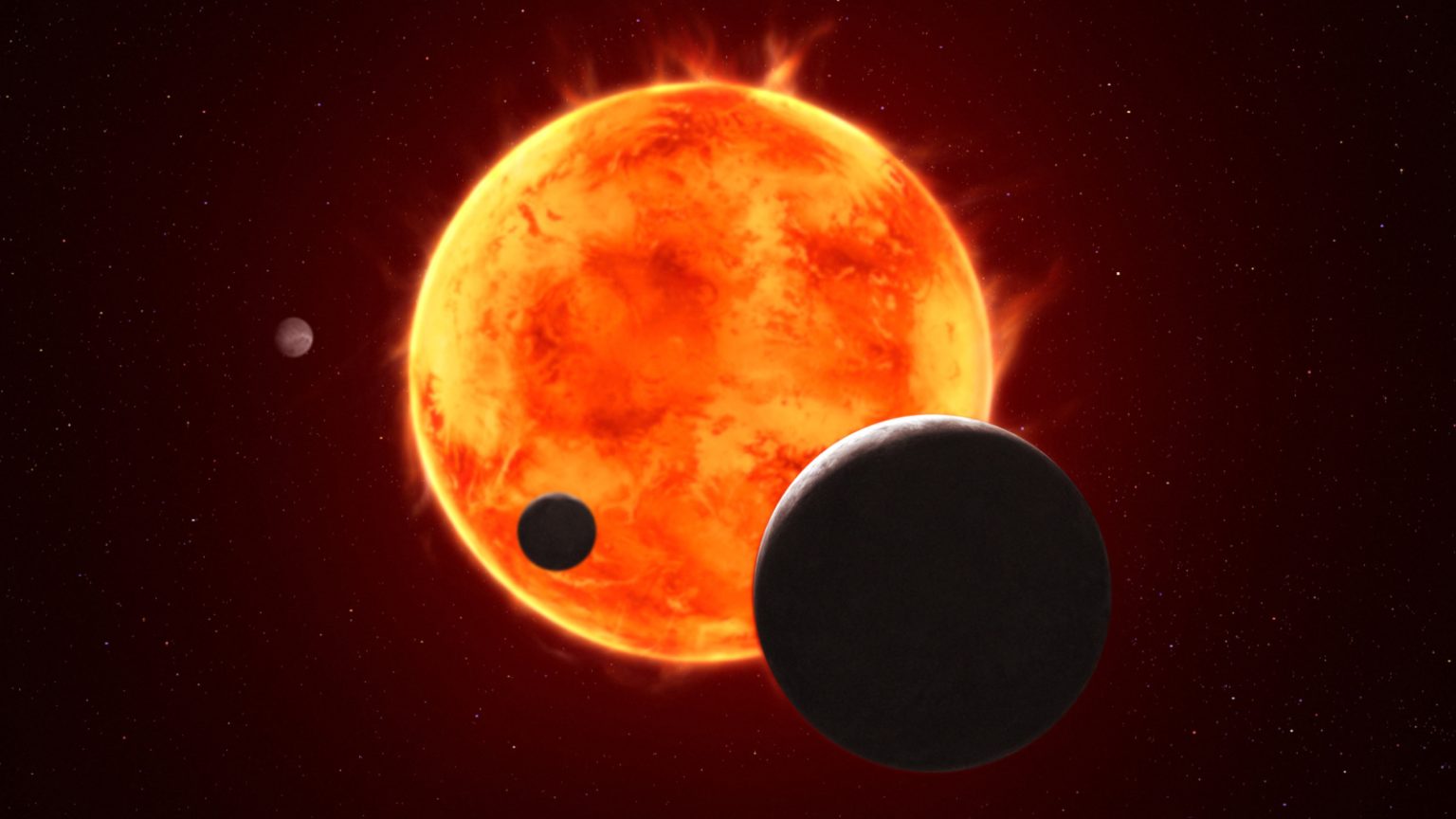
Many exoplanets orbit so close to their star that its radiation forces them to evaporate intensely. This process affects the star’s magnetic field, which in turn affects the lines in its spectrum.
Evaporating planets
An article was recently published in Monthly Notices of the Royal Astronomical Society in which the authors claim to have found a new method for detecting exoplanets. It will be useful in cases where the planet is hidden by the light of its star.
This makes it very difficult to detect small planets. That is why there are so many gas giants on the list of confirmed worlds, especially those located close to their star. However, scientists have noticed that many of these planets are actively losing mass due to evaporation.
This affects both the worlds themselves and the star. The functioning of its magnetic field is disrupted, which is reflected in the emission lines in the spectrum. By studying the patterns of these changes, they can be used not only to confirm the existence of exoplanets, but also to determine the parameters of their orbits and sizes.
Discovery of planets
In fact, scientists have already tested this method and proven its effectiveness. It was used in the Diffuse Matter Planets Project (DMPP). It is a study of 24 stars and includes more than 10 observations of the radial velocity of each of them using the High Accuracy Radial velocity Planet Searcher (HARPS) and Echelle SPectrograph for Rocky Exoplanets and Stable Spectroscopic Observations instrument (ESPRESSO) spectrographs. Astronomers also compared the frequency of planet appearances with other major radial velocity studies, taking into account differences in orbital assumptions.
Researchers have discovered seven new planets in five different star systems and have also been able to refine the orbital parameters— in particular, the rotation periods and masses of the planets — for several already known systems. All of the newly discovered planets are significantly larger than Earth and have orbital periods of 63 days or less (six of them less than 37 days).
The team claims that their method has led to much higher detection rates than other radial velocity studies. DMPP is approximately 40% more effective solely in terms of observations per planet detection. At the same time, the authors note that this indicator is calculated based on the standard integration time for each observation in the above-mentioned review.
The frequency of planets with periods less than 50 days and masses between 3 and 10 Earth masses was 83%. For planets with masses between 10 and 30 Earth masses, the frequency was 27%, and for masses between 30 and 100 Earth masses, it was 13.9%. The team notes that the results suggest that our galaxy may be teeming with nearby evaporating planets, especially around certain types of stars.
According to phys.org

