

In 1964, the distinguished astrophysicist Nikolai Kardashev published a seminal work in which he proposed a universal method for classifying extraterrestrial civilizations. This system, designed to facilitate the search for extraterrestrial intelligence (SETI), was based on a single key indicator: total energy consumption.
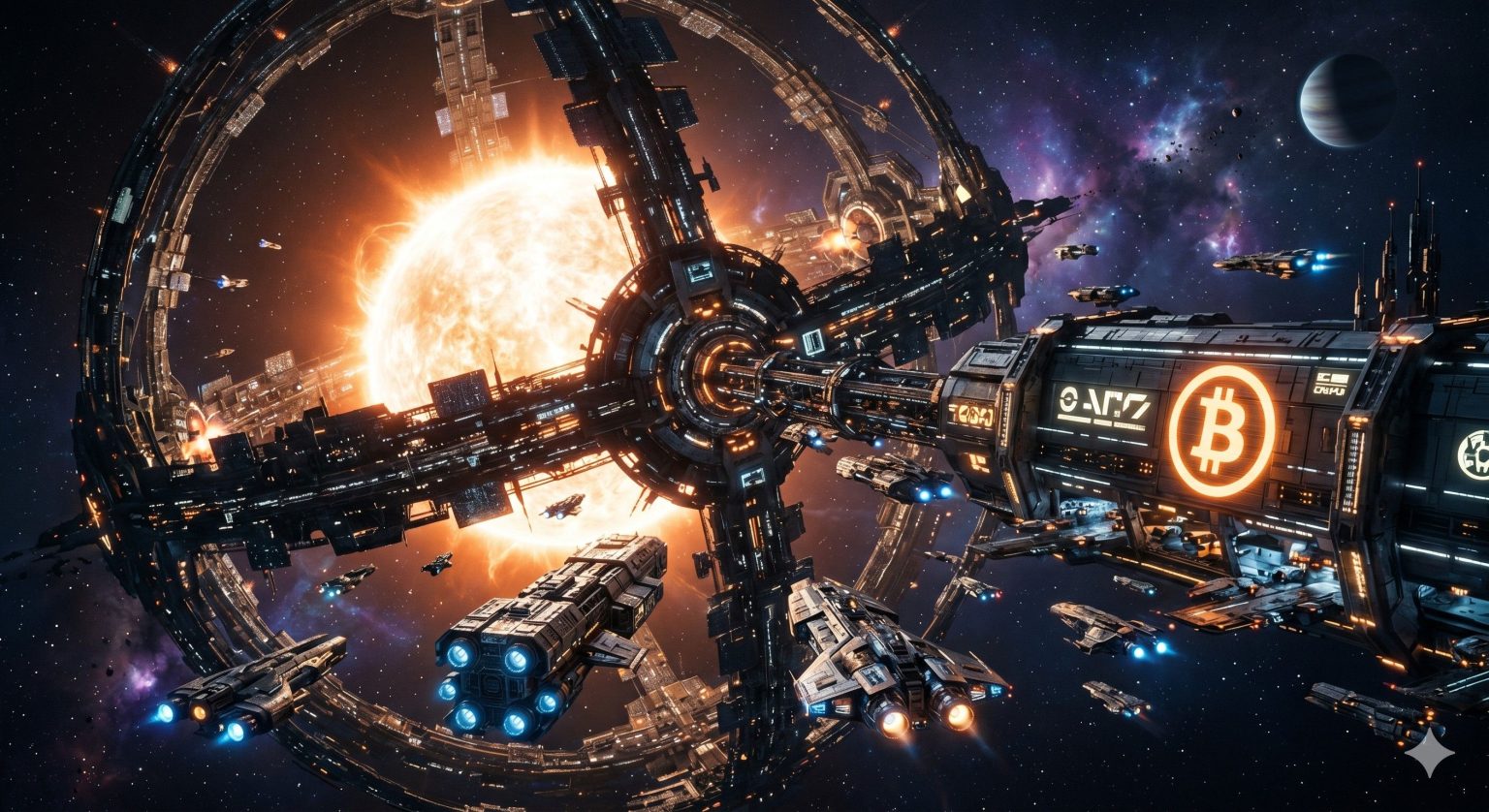
Kardashev identified three hypothetical categories:
- Type 1 (Planetary): a civilization capable of harnessing all the energy of its home planet.
- Type 2 (Stellar): a civilization that controls all the energy of its star, for example, by constructing a Dyson sphere.
- Type 3 (Galactic): a supercivilization that operates with the resources of an entire galaxy.
Despite its popularity, this scale had a fundamental flaw—the so-called “Kardashev Scale.” Measuring progress solely through exponential growth in energy consumption is too simplistic an approach. Astrophysicist Sebastian Gurovich notes: The Kardashev Scale, which measures power in watts, records only the amount of energy consumed but completely ignores the quality of its use. A civilization that simply radiates heat into space will receive the same high status as one that directs energy toward complex mathematical calculations.
From the Antikythera Mechanism to Cryptography
The current state of development is characterized by the sheer volume and complexity of the information generated. This principle has been at work ever since humanity created the Antikythera Mechanism—the first analog computer of antiquity, which converted mechanical motion into astronomical knowledge.
This same trajectory was continued by Charles Babbage’s machines, Alan Turing’s concepts, and modern application-specific integrated circuits (ASICs). Carl Sagan had previously proposed expanding the Kardashev Scale to include the concept of “information possession,” but historically, these models did not account for energy losses.
Kardashev’s own predictions have also failed to stand the test of time. He estimated that, with energy consumption growing by 1% annually, humanity would reach Type II status in 3,200 years. However, an analysis of the global energy sector over the past 60 years shows that such an extrapolation is flawed.
KSN Model
Gurovich developed the Kardashev–Sagan–Nakamoto (KSN) model to address this issue. It shifts the focus from raw energy consumption to the efficiency of information generation. Over the past few decades, global energy consumption has tripled, but our ability to convert that energy into information has grown by an impressive 14 orders of magnitude in just the last 15 years.
The KSN model is based on the laws of thermodynamics, specifically the Landauer limit, which defines the theoretical minimum energy required to store a single bit of information. Approaching this limit represents not only a computational milestone but also a fundamental thermodynamic milestone for any civilization.
Bitcoin as the ideal cosmic standard
To test his theory, Gurovich used the Bitcoin blockchain and ASIC chips as a global benchmark. Unlike abstract calculations, the Bitcoin network’s Proof-of-Work algorithm is the world’s only publicly accessible, transparent system whose hash rate is constantly updated and audited.
Using statistical modeling, specifically Monte Carlo methods, the scientist demonstrated that the old exponential graphs produced completely unrealistic timescales. Instead, linear models suggest a timescale of approximately 1.6 quadrillion (1.6 × 10¹⁶) years, which far exceeds the Sun’s own lifespan.
Solving the Drake Equation
The KSN-ASIC model provides scientists with a new mathematical framework for assessing the future. This discovery has a direct impact on the famous Drake equation, specifically on its most enigmatic parameter—L, which denotes the lifespan of a technological civilization.
Understanding how efficiently a species uses resources allows us to predict its fate. Are civilizations prone to self-destruction due to the depletion of the planet, or are they capable of optimizing their processes and achieving thermodynamic stability? In a world where the Doomsday Clock stands at 85 seconds to midnight, the answer to this question is key to humanity’s very survival.
We have previously discussed how reliable scientific and popular publications on the search for extraterrestrial life are.
According to phys.org

