

For the first time in history, an international research team has successfully captured the movement of a spiral structure around a young star. It is believed to be the place where a planet will soon form.
To date, astronomers have discovered around 6,000 exoplanets. It is assumed that, like the planets of the Solar System, they have developed in protoplanetary disks, which are rotating disks around young stars.
The spiral structure formed by the gravitational influence of the protoplanetary disk is considered an important factor in the process of planet formation. They form inside the spiral either by combining solid particles present in the disk, which eventually grow to the size of planets, or by the spiral breaking up into separate fragments.
The problem is that such spirals can also be created by massive planets in the early stages of their formation. Thus, the presence of a spiral does not mean that a new planet will soon form in the system.
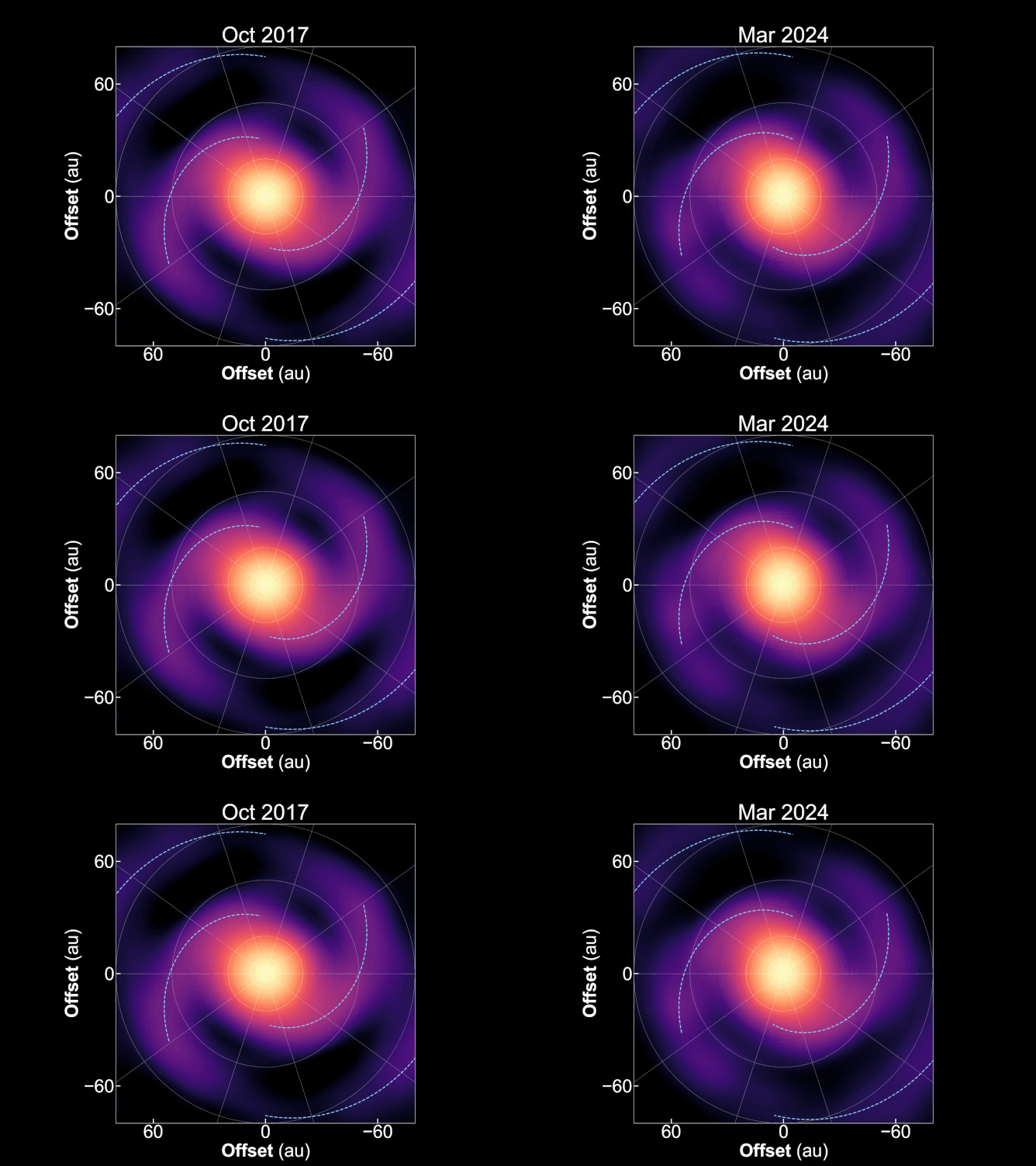
To solve this problem, scientists resorted to modeling. It showed that if the spiral is created by an existing planet, it will retain its shape and rotate with it. Otherwise, it will spin around itself and eventually disappear.
To verify this, scientists selected the protoplanetary disk around the star IM Lupi, located 515 light-years from Earth. They combined images of it obtained by the ALMA radio telescope between 2017 and 2024, creating an animation of its movement. Subsequent analysis showed that the spiral was not created by an already formed planet. Thus, we are looking at a protoplanetary disk on the verge of giving birth to a new planet.
According to Tomohiro Yoshida, head of the research team, his colleagues plan to conduct similar observations of other protoplanetary disks in the future. This will enable the creation of a documentary film demonstrating the formation of the planetary system.
Earlier, we talked about how ALMA photographed a giant dying star.
According to ALMA

