

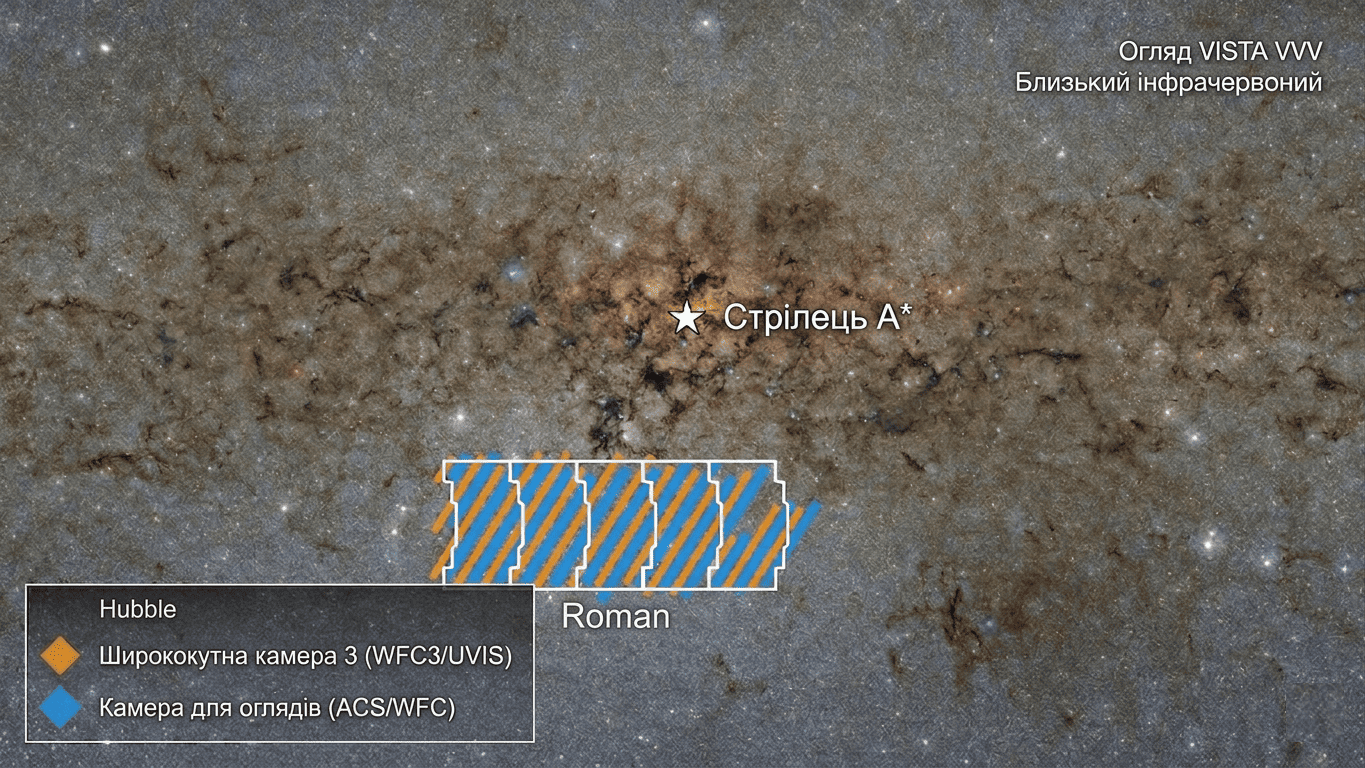
Hubble has completed a large-scale survey of the central region of our galaxy. These data will serve as a baseline for the Nancy Grace Roman Space Telescope, which is set to launch into orbit this autumn and begin its own survey of the same regions of the sky.
Millions of stars and the microlensing method
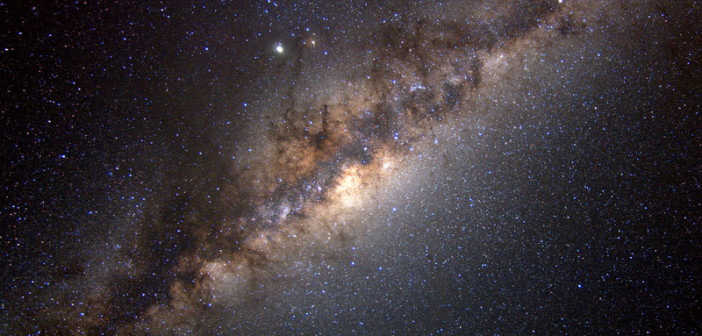
Astronomers have long known that the galactic bulge—a dense, bulging region surrounding the Milky Way’s core—is teeming with stars, planets, and free-floating objects. The Roman Space Telescope will conduct the first systematic survey of this region, taking an image every 12 minutes over the course of six 72-day observation seasons.
The primary search method is microlensing: when a massive object in the foreground bends the light from a distant star, allowing us to see planets, isolated neutron stars, and even black holes the size of our Sun.
Starting point
To interpret future observations correctly, we need to know what these objects look like before the lensing event. That is why, in the spring of 2025, the team launched a large-scale survey using the Hubble Space Telescope. It is larger than any previous survey of this type, each of which took years to complete.
“If, two years from now, an event occurs during our long-term observation of Roman, we’ll be able to look back and say: that was the red star, that was the blue one, and the event happened when the red star was in front of the blue one,” explains study co-author Jay Anderson of the Space Telescope Science Institute.
Exact masses instead of ratios
Hubble data will allow us to measure the masses of objects directly. Microlensing alone provides only a ratio between a star and its planet. But if we have images taken before or after the event, we can obtain precise individual values with much greater confidence.
“Instead of estimating the mass ratio, we can now say with confidence: this is a planet with the mass of Saturn orbiting a star with 0.8 times the mass of the Sun,” says project leader Sean Terry of the University of Maryland, College Park.
Cloud catalog and map
The Hubble survey has already yielded a new catalog of 20 to 30 million point sources. Roman will expand this to 200–300 million objects and produce some of the deepest images of any region of the sky.
At the same time, the data will help create maps of dense dust regions where gas and dust clouds absorb or scatter light—so we know where the telescope can “see” and where it cannot. All survey data is now available in the Mikulski Archive for Space Telescopes.
According to nasa.gov

