

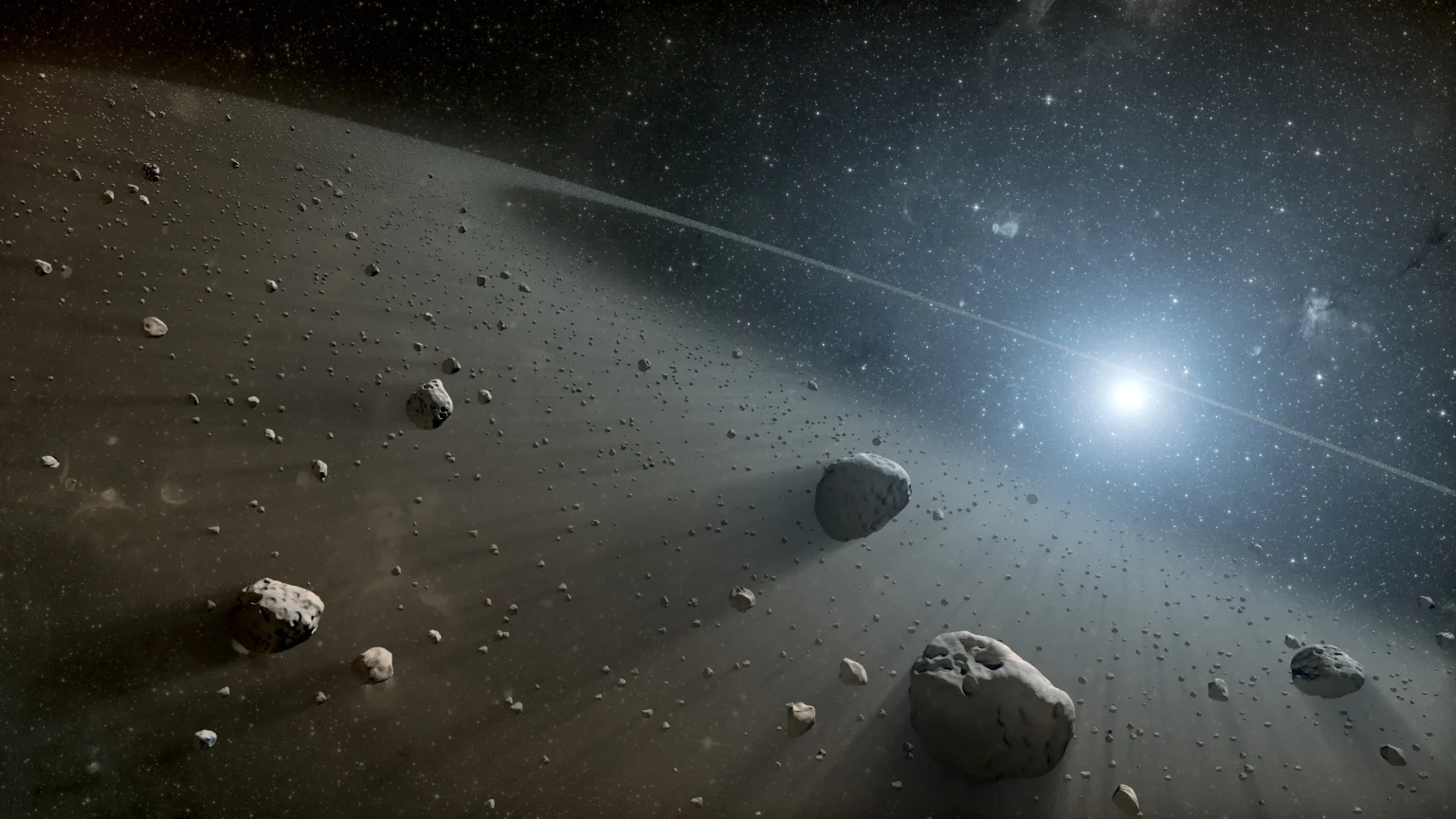
An international team of scientists from São Paulo State University (UNESP, Brazil) has discovered a potential threat that has gone largely unnoticed until now. These are asteroids that orbit Venus, but due to their specific location in the sky, they are virtually impossible to see with ground-based telescopes.
“These objects are not located in the classic asteroid belt between Mars and Jupiter, but much closer — in resonance with Venus,” explains astronomer Valerio Carruba. “They orbit the Sun once in the same amount of time as the planet. However, due to their position, they remain invisible, although in the distant future they may pose a real threat to Earth.”
The danger lies in the instability of their orbits. Asteroids can remain on safe trajectories near Venus for a long time, but approximately once every 12,000 years, they transition into a new configuration during which they are capable of crossing Earth’s orbit.
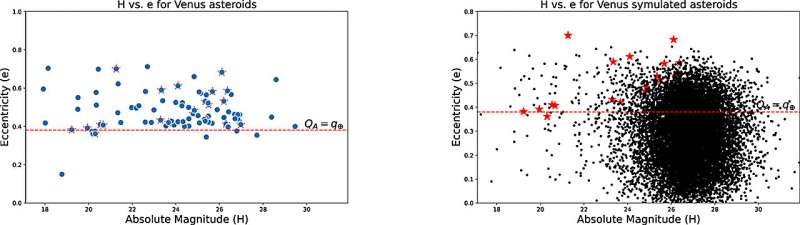
According to researchers, Venusian asteroids originated in the main belt between Mars and Jupiter. Subsequently, under the influence of Jupiter and Saturn’s gravity, their orbits shifted closer to the Sun. There, they temporarily became “stuck” in resonance with Venus.
To date, astronomers know of only 20 such objects. Almost all of them have elongated orbits, which sometimes allows them to be detected. However, computer models show that there are actually many more such asteroids, and most of them move in less elongated orbits that are hidden by the bright light of the Sun.
Researchers have modeled scenarios in which individual asteroids could approach Earth at dangerously close distances. If such an object with a diameter of 300 meters collides with our planet, it will form a crater several kilometers wide and release energy equivalent to hundreds of megatons of explosives.
“A hit in a densely populated area would have catastrophic consequences. This is a scenario that cannot be ignored,” Carruba emphasizes.
The situation is complicated by the fact that even modern instruments are practically powerless. For example, Vera Rubin’s telescope in Chile can only see such objects for a few weeks a year and only when they rise high enough above the horizon. The rest of the time, they literally “disappear” in the glare of the sun.
Therefore, scientists have high hopes for space missions. NASA is already working on the Neo Surveyor spacecraft, and China is planning to launch the Crown mission. They will be able to “peek” into areas that are inaccessible to ground-based telescopes and reveal this hidden world to us.
The study was published in the journal Astronomy & Astrophysics.

