

The European Space Agency (ESA) has published an image taken by the Proba-2 satellite. It shows the ring of fire observed in the sky over Antarctica on February 17, 2026.
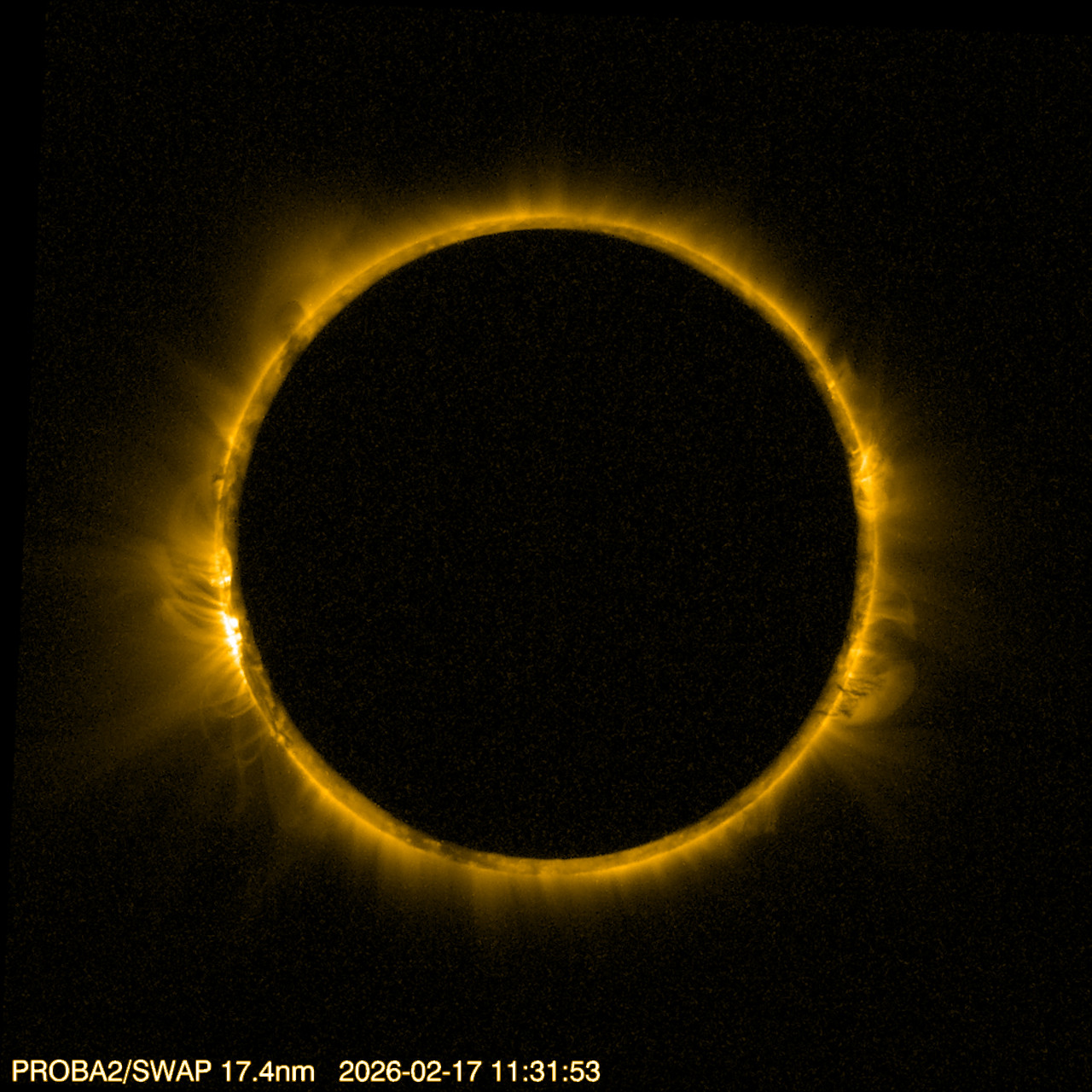
On February 17, 2026, the Moon was directly between the Sun and Earth. Since it was at the apogee of its orbit at that moment, it was unable to cover the entire solar disk. As a result, a so-called ring of fire formed in the sky.
Unfortunately, due to geography, almost no one was able to see this celestial show live. The annular phase of the eclipse was only observed in Antarctica, where it was witnessed by several dozen polar explorers.
Nevertheless, we can get an idea of what the eclipse looked like thanks to satellites. The ESA’s Proba-2 spacecraft observed the eclipse at least four times, including the ring of fire phase.
This is precisely what is shown in the image published by ESA. The photograph was taken on February 17 at 11:31 a.m. UTC. The SWAP instrument was used to obtain the image. It takes images in the extreme ultraviolet range at a wavelength of 17.4 nanometers.
A total solar eclipse will occur in August, which will be visible to many more people. Its maximum phase will be observed in Greenland, Iceland, and Spain. You can find out more about this and other eclipses in 2026 in our article.


