

Researchers used data from orbital spacecraft to map watersheds on Mars. Once upon a time, liquid flowed through these channels, creating the conditions necessary for life. But it is quite possible that it still remains on the red planet.
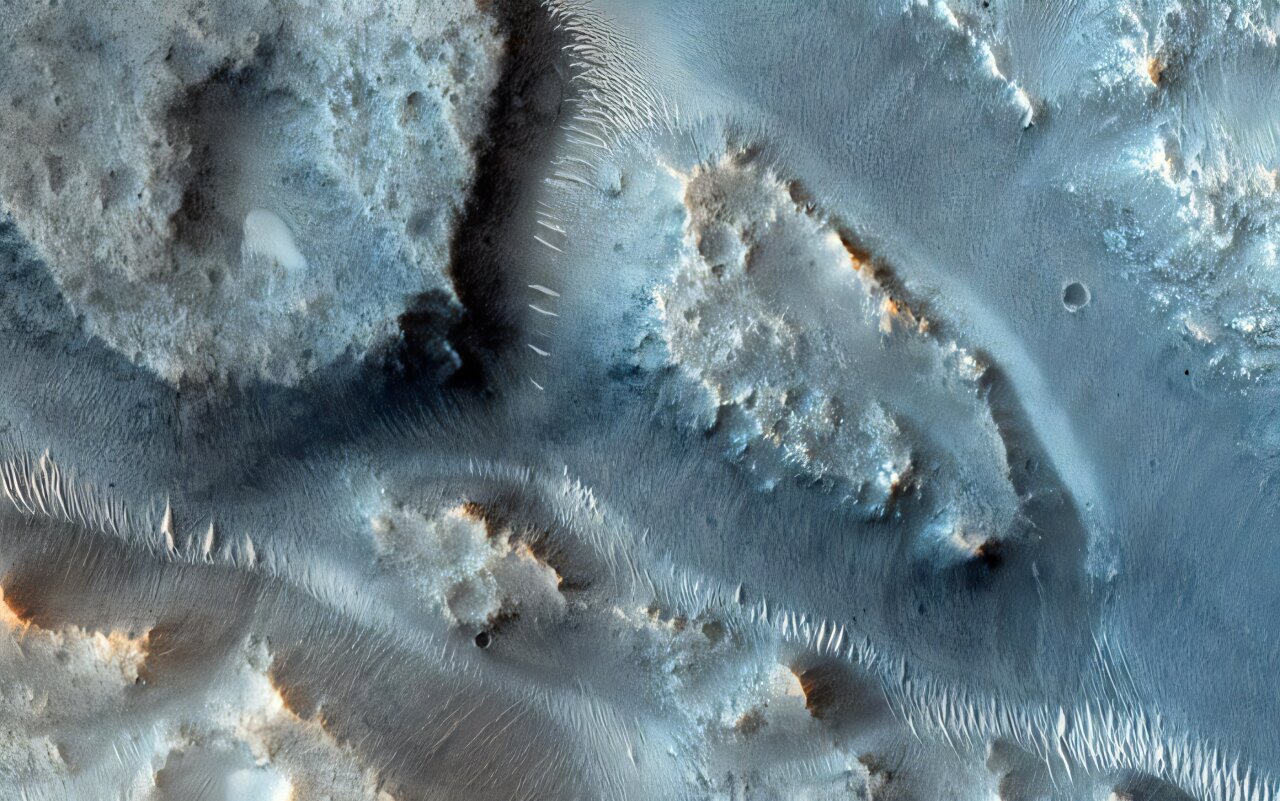
Map of watersheds on Mars
Once upon a time, Mars had liquid water, and there was so much of it that it flowed across the surface for thousands of kilometers and formed watersheds—a system of reservoirs that collected liquid from the surface and transported it to the northern basin, where it is believed there used to be an ocean.
Individual elements of this system were discovered by scientists many years ago, but the only map that would allow us to see how water flowed across the surface billions of years ago still does not exist. However, researchers from the University of Texas at Austin have recently made a significant step in this direction. In their paper, published in the journal Proceedings of the National Academy of Sciences, they mapped the 16 largest drainage systems of ancient Mars.
They used two sets of data from the MOLA laser altimeter on the Mars Global Surveyor spacecraft and the CTX camera on the Mars Orbiter. The first of these spacecraft operated in Martian orbit between 1997 and 2006. The second is still exploring the planet. The researchers processed their data using the ArcGIS Pro geographic information system and obtained data on drainage systems covering an area of more than 105 km2.
Where is the Martian water?
Scientists believe that the systems they mapped collected 28,000 km of water, which accounted for approximately 42% of all precipitation that fell on Mars in ancient times. In addition, the mapped systems account for 28% of all identified river sediments. And they are quite diverse: clays, sulfate minerals, carbonates, and hematite. The water bodies that made up a single watershed system are just as diverse.
And yet, compared to Earth, this is not impressive. But it should be remembered that scientists are still debating the role of water in Mars’ past. Because everyone agrees on only one thing: at the very beginning, about 4.5 billion years ago, the red planet was relatively warm and humid.
However, opinions differ greatly on what happened next, ranging from the assertion that water flowed there for only a few million years and only occasionally, to the claim that the hydrosphere finally disappeared only 2 billion years ago. In addition, it is quite possible that liquid water has not disappeared completely, but is hidden beneath the planet’s surface.
According to phys.org

