

Scientists from the University of Hawaii’s Institute for Astronomy have uncovered the turbulent past of a distant red giant by listening to its celestial “song.” Minor fluctuations in the star’s brightness suggest that it may have collided and merged with another star at some point.
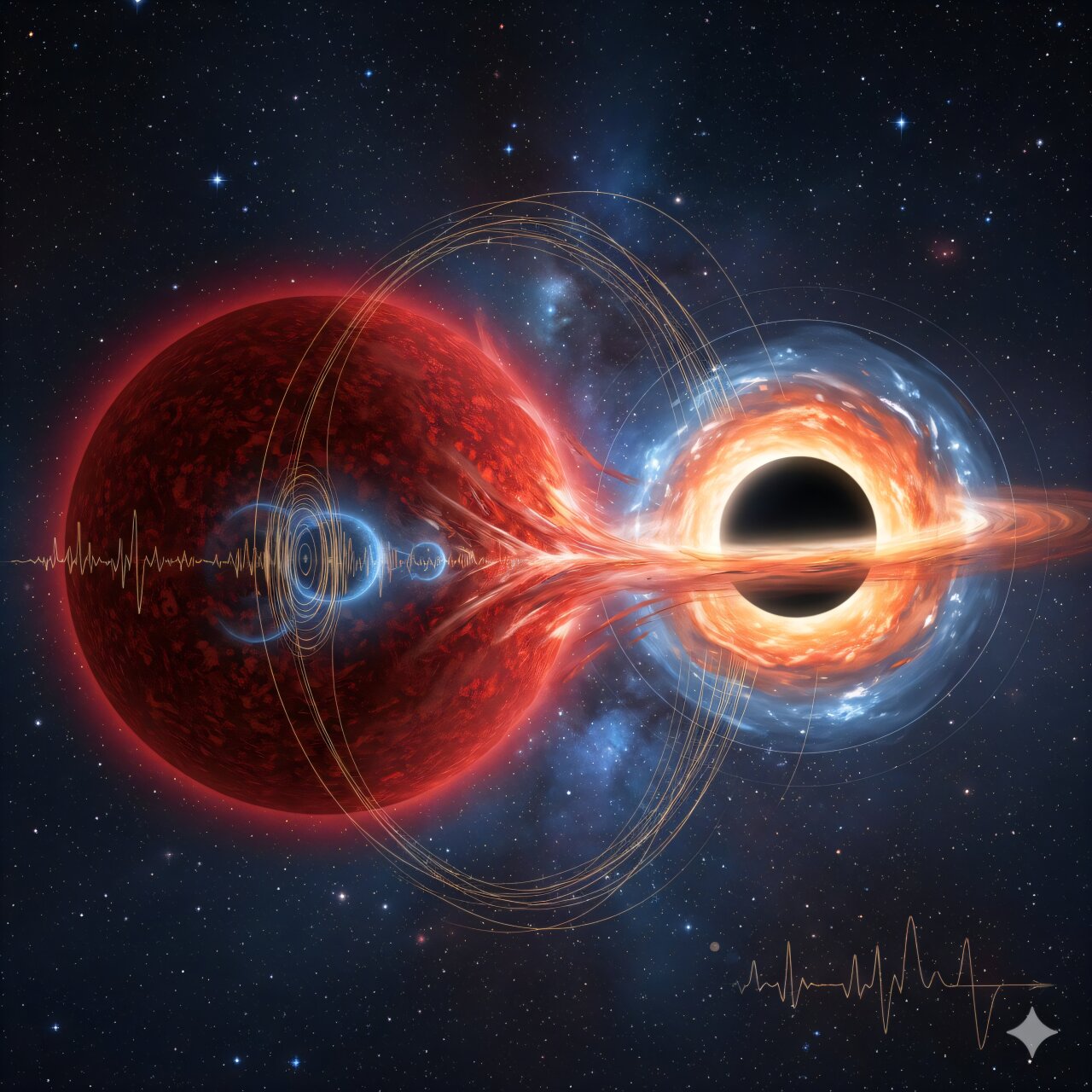
The discovery was made during the study of the Gaia BH2 star system. It is located 3,800 light-years from Earth and consists of a stellar-mass black hole and a red giant orbiting it. After analyzing data collected by the TESS spacecraft, astronomers detected faint “stellar earthquakes” passing through the star.
Just as seismic waves reveal the inner layers of the Earth, these stellar oscillations gave scientists a rare opportunity to look beneath the surface of the star, allowing them to measure the properties of its core with remarkable accuracy. The team’s findings were published in The Astronomical Journal.
The biggest surprise was the star’s composition. It is rich in heavy alpha elements, which is a characteristic feature of old stars. However, when scientists studied its oscillations, they discovered that it is actually only about 5 billion years old, which is too young for it to have such chemical characteristics.
Another mystery was the star’s orbital period. Observations by ground-based telescopes showed that it rotates around its axis at a speed of one revolution every 398 days. This is much faster than expected for an isolated red giant of its age.
The combination of relatively young age, high rotation speed, and a large number of heavy elements indicates that this star did not evolve in isolation. It probably acquired additional mass from a companion, either as a result of a merger or by absorbing material during the formation of a black hole.
The team also investigated Gaia BH3, another system consisting of a black hole and a metal-poor giant star. Although models predicted that this star should exhibit clear oscillations, none were detected. This indicates a need to update current theories about extremely metal-poor stars.
Both Gaia BH2 and BH3 are systems with inactive black holes. This means that they do not feed on their companion stars and therefore do not emit X-rays. They were found thanks to precise measurements of the stars’ movements, which indicated the presence of invisible massive companions.
Earlier, we reported on how a doomed star would help uncover the mystery of missing red supergiants.
According to Phys.org

