

A recently launched Spanish military communications satellite has been hit by what its operator described as a “space particle.” This could jeopardize the spacecraft’s mission.
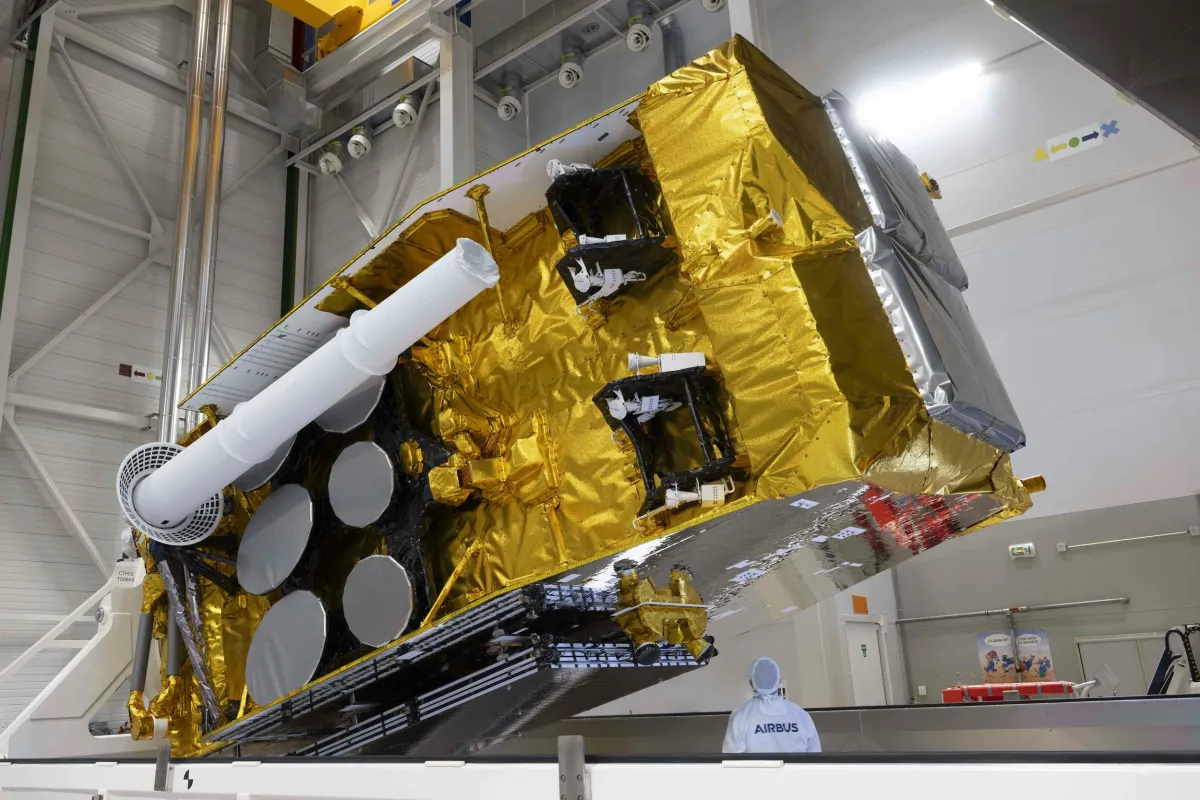
The damaged spacecraft was built by Airbus. It was one of two satellites launched last year by Hisdesat to provide secure communications for the Spanish Ministry of Defense and allied governments. Both satellites use Airbus Eurostar Neo satellite platforms and are equipped with reconfigurable X-band antennas and steerable Ka-band antennas, which were developed in part with technical support from ESA.
SpainSat NG 2 was launched on October 23 using a Falcon 9 rocket. The 6,100 kg satellite was placed into a super-synchronous transfer orbit with an apogee of over 60,000 km. Due to its unusual characteristics, the mission required “full” use of the Falcon 9 without returning the first stage to Earth.
On January 2, Indra Group, the majority owner of Hisdesat, announced that SpainSat NG 2 had been “hit by a space particle” while maneuvering to its final position in geostationary orbit. The company provided few details, including the exact time of the incident. It only reported that the impact occurred when the spacecraft was at an altitude of about 50,000 km.
The altitude at which the incident occurred is significantly higher than geostationary orbit. This suggests that a collision with space debris is unlikely. Instead, the spacecraft may have been struck by a micrometeorite. Another possibility is that the “space particle” refers to an interaction with charged particles. As a rule, in such cases, this refers to solar activity. However, according to data from the NOAA Space Weather Prediction Center, the Sun has not produced any powerful flares in recent days and its activity has been moderate.
In its statement, the company said it was analyzing the available data to determine the extent of the damage and expressed its readiness to replace SpainSat NG II as soon as possible if necessary. However, replacing a large geostationary communications satellite, especially one carrying a specialized payload, can take several years.
Earlier, we reported on the crash of South Korea’s first private rocket.
According to Spacenews

