

The Smile spacecraft launched on May 19 at 04:52 BST / 05:52 CEST (00:52 local time) and set off to study Earth’s magnetosphere. It has been protecting us from streams of charged particles from the Sun for nearly four billion years. Now, for the first time in the history of scientific research, it will be imaged in the X-ray spectrum.
Launch of the Vega-C rocket carrying the Smile spacecraft from the Guiana Space Centre in French Guiana, May 19, 2026. Source: ESA
Successful start
The Vega-C rocket lifted off from the spaceport at 04:52 BST / 05:52 CEST (00:52 local time). The first signal from the spacecraft was received by an ESA ground station in New South Wales, Australia, at 6:48 a.m.—less than an hour after launch.
A minute later, Smile deployed its solar panels. This meant that the spacecraft could now generate its own power from sunlight and was ready for operation—the launch was declared a success.
What is Smile?
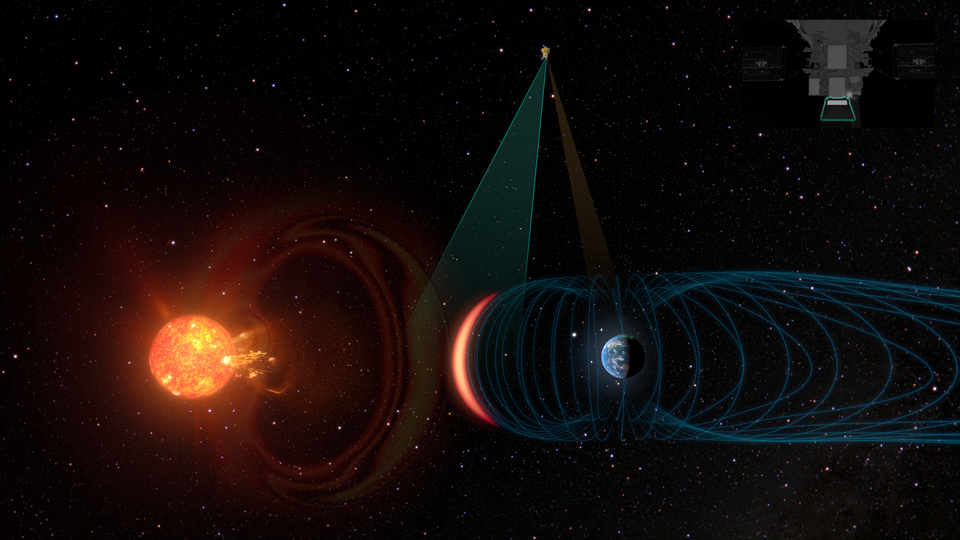
Smile (Solar Wind Magnetosphere Ionosphere Link Explorer) is a joint mission of the European Space Agency (ESA) and the Chinese Academy of Sciences (CAS). The spacecraft is equipped with two main cameras: an X-ray camera, which will show where and how the solar wind strikes the magnetic shield, and an ultraviolet camera, which continuously observes the auroras at the North Pole.
A unique feature of the mission is the duration of the observation. Smile will observe the aurora for 45 consecutive hours. No previous spacecraft has done this for longer, and the first-ever ultraviolet image of a complete ring of aurora around the North Pole was captured back in 2008.
Overview of the Smile mission—the first spacecraft to image Earth’s magnetic shield in the X-ray range. Source: ESA
Orbit and work plan
Smile will enter a special, highly elongated orbit. Over the North Pole, the spacecraft will ascend to an altitude of 121,000 km to collect data, and over the South Pole, it will descend to 5,000 km to transmit the data back to Earth. It will be able to reach this orbit in about a month, which will require 11 engine maneuvers.
Full-scale data collection will begin in July, when the team deploys the antenna booms, removes the protective covers from the cameras, and verifies that all systems are functioning properly. By comparing X-ray and ultraviolet images in real time, researchers will be able to see for the first time how the magnetosphere reacts to the solar wind directly during events.
International team
Hundreds of people in Europe and China worked on the spacecraft for seven years. The main payload module was assembled by Airbus Defence and Space in Spain, while the X-ray camera was developed at the University of Leicester in the United Kingdom in collaboration with several other universities and laboratories.
In total, the project brought together organizations from 14 European countries. ESA’s financial contribution amounts to 130 million euros, which is about 28 euro cents per European citizen.
According to esa.int

