

The rotor blades that will lift the next-generation Martian helicopters to unprecedented heights have reached a historic milestone—they have successfully broken the sound barrier. During tests at NASA’s Jet Propulsion Laboratory (JPL) in California, engineers demonstrated that the tips of the blades can accelerate to speeds exceeding Mach 1 without adversely affecting their structural integrity.
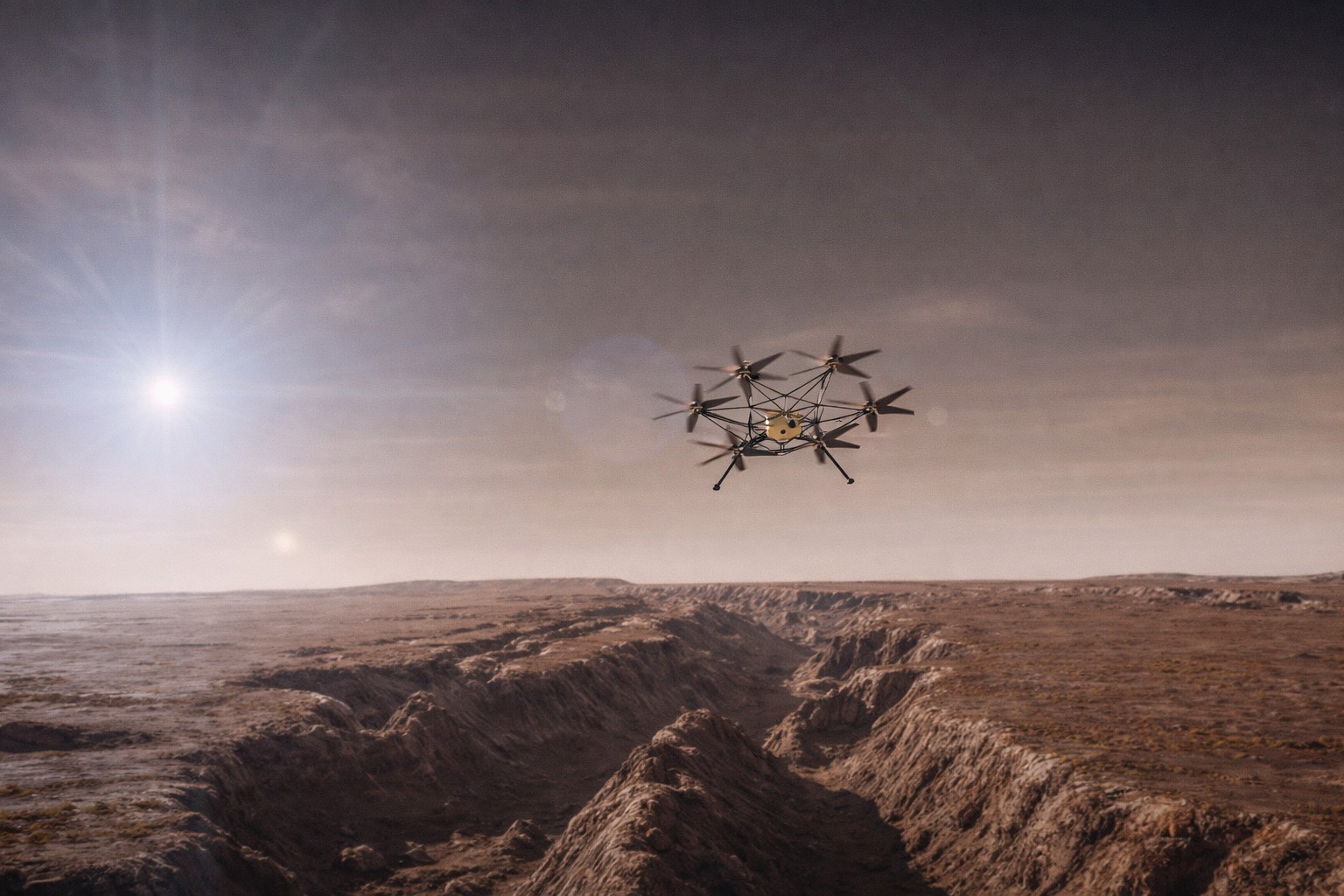
The experiments, consisting of 137 launches, were conducted in a special pressure chamber that accurately simulated the harsh environmental conditions of the Red Planet. The data collected will enable the development of aircraft capable of carrying significantly heavier payloads, transforming them from simple reconnaissance drones into fully-fledged scientific stations.
Speed of sound on Mars
Flying on Mars is one of the most challenging engineering feats in the history of space exploration. According to Al Chen, head of the Mars Exploration Program at JPL, although the previous Ingenuity rover performed exceptionally well, much more is expected of the new generation of drones.
The main challenge lies in the atmosphere: its density is only 1% of Earth’s. To generate sufficient lift in such a thin atmosphere and overcome the planet’s significant gravity, engineers have to take aggressive measures. And while on Earth, rotors simply need to “push” the dense air without approaching the sound barrier, on Mars the blades must be accelerated to supersonic speeds. It’s worth noting that due to the cold atmosphere, which is rich in carbon dioxide, the speed of sound on Mars is about 869 km/h, whereas on Earth it’s approximately 1,223 km/h.
From the pioneering Ingenuity to the powerful SkyFall
The legendary Ingenuity helicopter, which made its first controlled flight in April 2021, was a pioneer. It was a technology demonstration that did not carry heavy scientific instruments on board. To avoid unpredictable aerodynamics during sudden Martian winds, its rotor speed was deliberately limited to 2,700 rpm, which was about Mach 0.7.
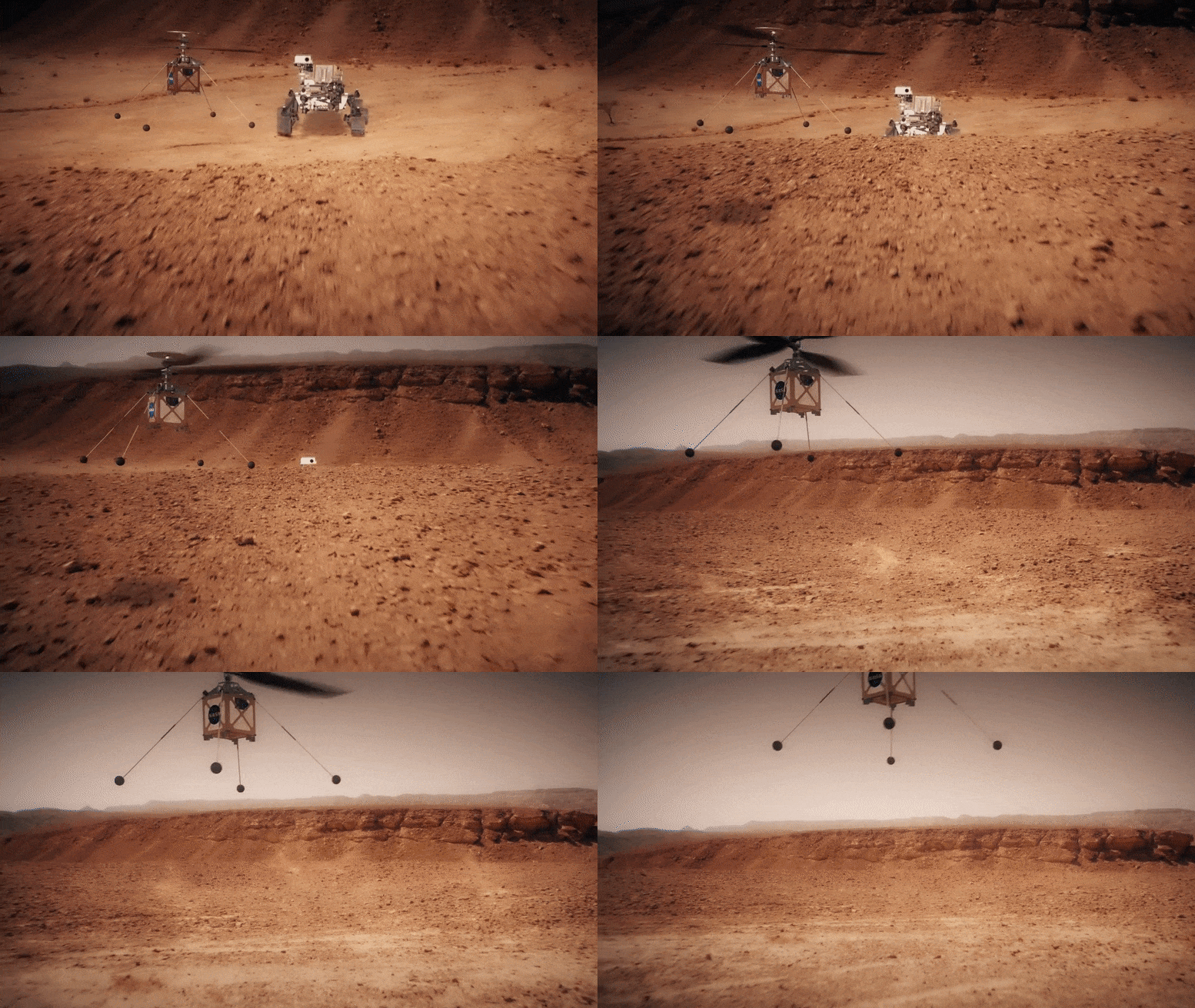
However, future missions will require greater performance. The agency’s SkyFall project calls for the delivery of three new helicopters to Mars in December 2028. Through low-altitude aerial reconnaissance, they will collect data to support future missions involving both humans and robots.
Extreme tests in a simulator
To test AeroVironment’s new rotor designs, a team of engineers led by Jaakko Karras placed a three-bladed propeller in a space simulator. The air was pumped out of the chamber and replaced with carbon dioxide.
The tests were so risky that the chamber walls were lined with sheet metal in case the blades broke apart. Watching from a safe distance, the team recorded the results:
- At 3,750 rpm, the blade tips reached a speed of 0.98 Mach.
- After adding an artificial headwind, the tip speed rose to an impressive Mach 1.08.
- Subsequently, a longer, two-bladed rotor for the SkyFall was also tested. Thanks to its dimensions, it reached supersonic speeds as early as 3,570 rpm.
AsShannah Withrow-Maser, an aerodynamicist at NASA’s Ames Research Center, notes, the team had hoped to reach at least Mach 1.05, but the results exceeded their expectations.
Breaking through this sonic barrier has increased the Martian helicopter’s lift capacity by 30%. This extra thrust opens up the possibility of equipping new helicopters with heavy batteries for extended flights and state-of-the-art scientific sensors. Data analysis is ongoing, but it is already clear that the next generation of Martian helicopters will be a true technological marvel.
We previously reported on how the Dragonfly drone would fly on Titan thanks to a nuclear battery.
According to phys.org

