

Creating a planet similar to Earth is an incredibly delicate cosmic task. It requires a precise balance: enough mass for an atmosphere, the right distance from a star to keep water in a liquid state. And then there is the mysterious ingredient: radioactive elements. It is these elements that, by heating young planets, prevented them from turning into barren ocean worlds or gas balls.
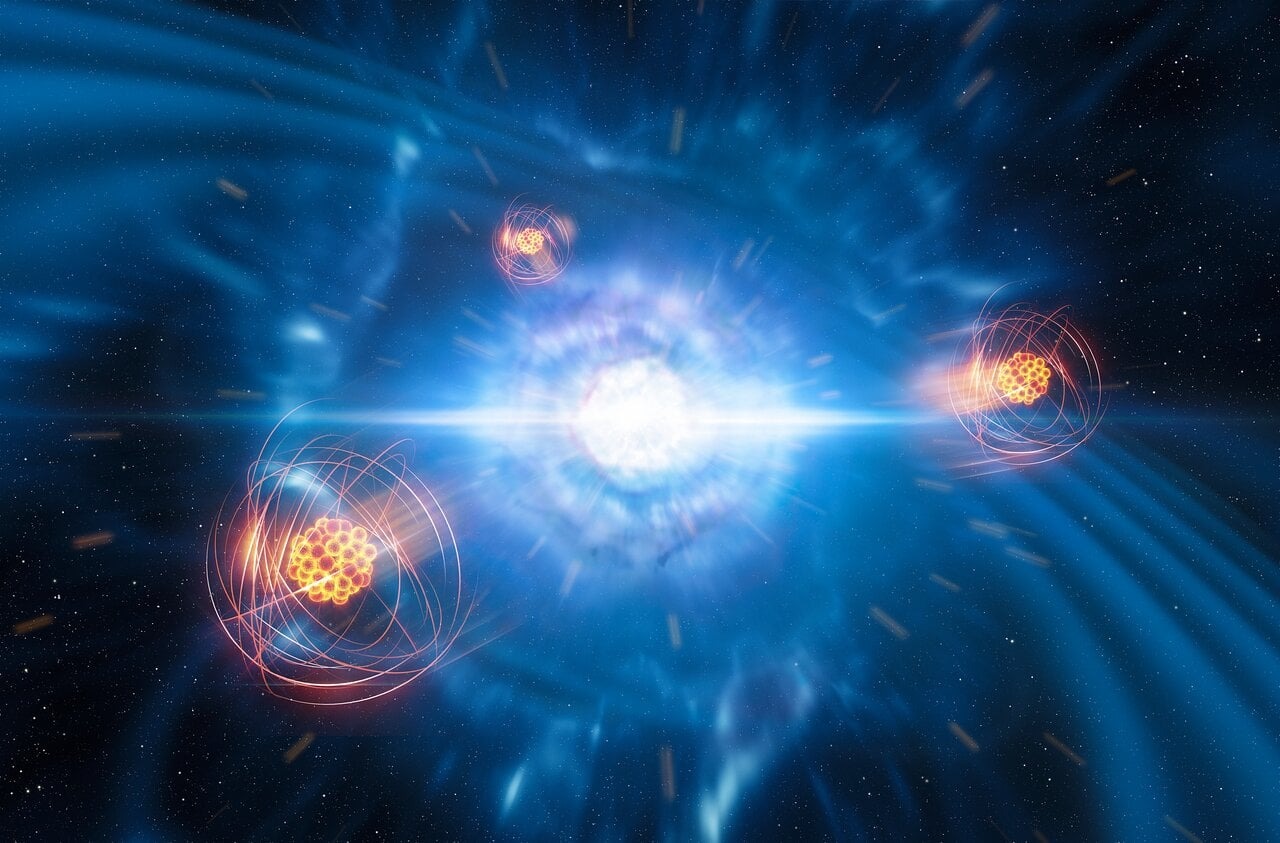
Short-lived radioisotopes such as aluminum-26 played a key role. Their half-life is less than 5 million years. They decayed intensively in the early Solar System, releasing heat. Their traces have been found in meteorites, which makes the hypothesis more likely.
But where did they come from? It was believed that they came to us from a supernova explosion. However, such a powerful explosion would have scattered or destroyed the protoplanetary disk from which planets are formed. This would make the history of our Earth extremely rare.
Not an explosion, but rays
The latest research offers an elegant solution. The young Solar System did not survive a direct explosion from its neighbor. Instead, it was subjected to intense bombardment by cosmic rays from a supernova that flared up at a safe distance—within one parsec (about 3.26 light-years). These rays, bombarding the matter of the protoplanetary disk, could have created exactly the amount of radioactive isotopes that we see in meteorites.
Earth is not unique
This model radically changes our understanding. Stars similar to the Sun are often born in clusters where supernova explosions are relatively common. If the disk does not need destructive shock waves to be “infected,” but only a stream of cosmic rays, then many young systems could have received the very “ingredients” needed to form rocky planets. This means that the conditions that led to the emergence of Earth may be much more common in the universe.
Thus, the destructive power of a supernova plays an unexpected role as a creator: its radiation could have been the magic ingredient that provided the heat and proper evolution of protoplanets, paving the way for the emergence of worlds similar to ours.
According to Universe Today

