

NGC 5134 is a galaxy located very close to the Milky Way — just about 65 million light-years away. Recently, the James Webb Space Telescope captured images of gas and dust moving within it.
Capabilities of the James Webb Space Telescope
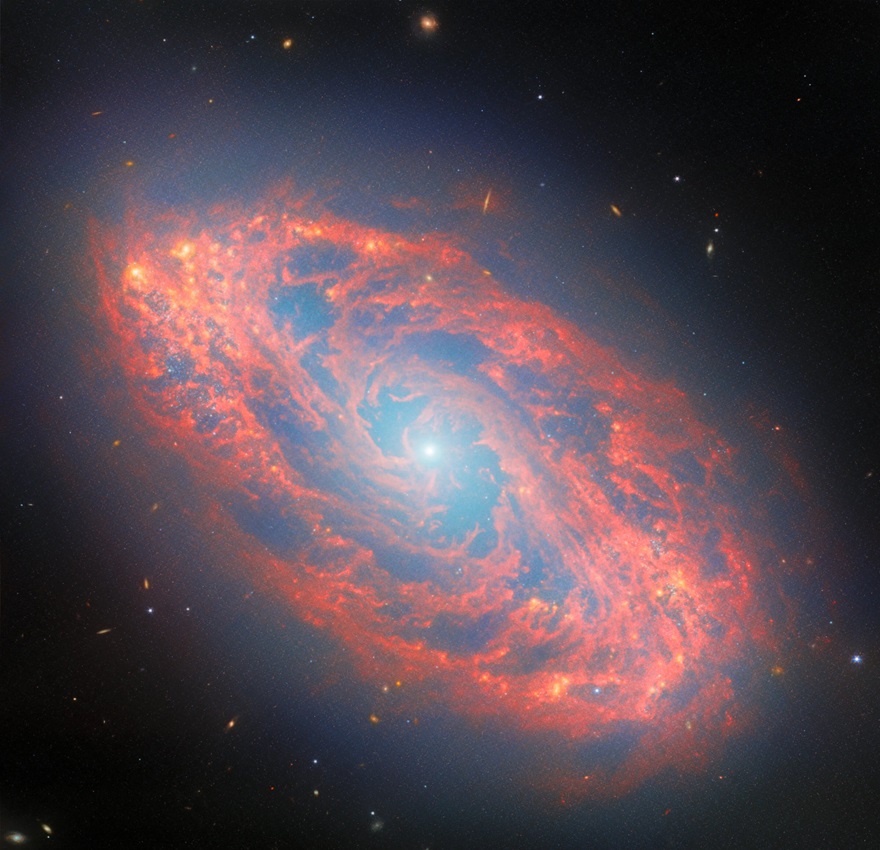
Two powerful instruments on the NASA/ESA/CSA James Webb Space Telescope have combined to create this colorful view of the galaxy. This spiral galaxy is called NGC 5134 and is located 65 million light-years away in the constellation Virgo. Although 65 million light-years may seem like an enormous distance — the light that the James Webb Space Telescope captured to create this image has been traveling toward us from NGC 5134 since shortly after the extinction of the Tyrannosaurus rex — NGC 5134 is actually quite close compared to other galaxies. Thanks to the galaxy’s relative proximity, Webb can capture incredible details of its tightly wound spiral arms.
Webb’s Mid-InfraRed Instrument (MIRI) captures mid-infrared light emitted by warm dust shrouding the interstellar clouds of NGC 5134, revealing clumps and filaments of dust and gas. Some of this dust consists of complex organic molecules known as polycyclic aromatic hydrocarbons, which contain interconnected rings of carbon atoms and allow astronomers to study the chemistry taking place in interstellar clouds. Webb’s Near-InfraRed Camera (NIRCam) detects short-wavelength near-infrared light, primarily from stars and star clusters scattered throughout the galaxy’s spiral arms.
Circulation of gas and dust in the galaxy NGC 5143
Altogether, the data from MIRI and NIRCam paint a picture of a galaxy in constant flux and change. The gas clouds blown along the spiral arms of NGC 5134 are star-forming regions, and each star that forms draws gas from the surrounding cloud to fuel star formation in the galaxy. When stars die, they return some of that gas back to the galaxy. Large stars, with masses exceeding about eight times that of the Sun, do so in spectacular, catastrophic supernova explosions that scatter stellar material over hundreds of light-years.
Stars similar to the Sun also shed some of their material, though more gradually; these stars will expand into bubbling red giants before shedding their atmospheres and ejecting them into space. Whether the gas is ejected by explosive supernovae or peaceful red giants, it can subsequently become part of new stars.
Studying star formation in nearby galaxies
This exchange between gas and stars is the focus of the observational program for which these images were taken. The goal of this program is to study 55 galaxies in the nearby Universe that are actively forming new stars and have been observed across a wide range of wavelengths. New data from the James Webb Space Telescope provide deep insights into individual star clusters and star-forming clouds and have already been used to study the life cycle of tiny dust grains, the shapes and properties of star-forming clouds, the connections between interstellar gas and dust, and the process by which new stars form.
By using the Webb Telescope to study the infrared light from nearby galaxies, such as NGC 5134 — where stars and gas can be seen in detail — astronomers can apply their knowledge to galaxies that are too distant to observe up close — such as those scattered across the background of this image, which look more like dots.
According to phys.org

