

In a study published in March 2026 in The Astrophysical Journal, Patrick M. Shober analyzed millions of meteor observations collected by all-sky camera networks located in Canada, Japan, California, and Europe, and discovered a small, recently formed cluster. The 282 meteors tied to this cluster tell the story of an asteroid that came a little too close to the Sun.
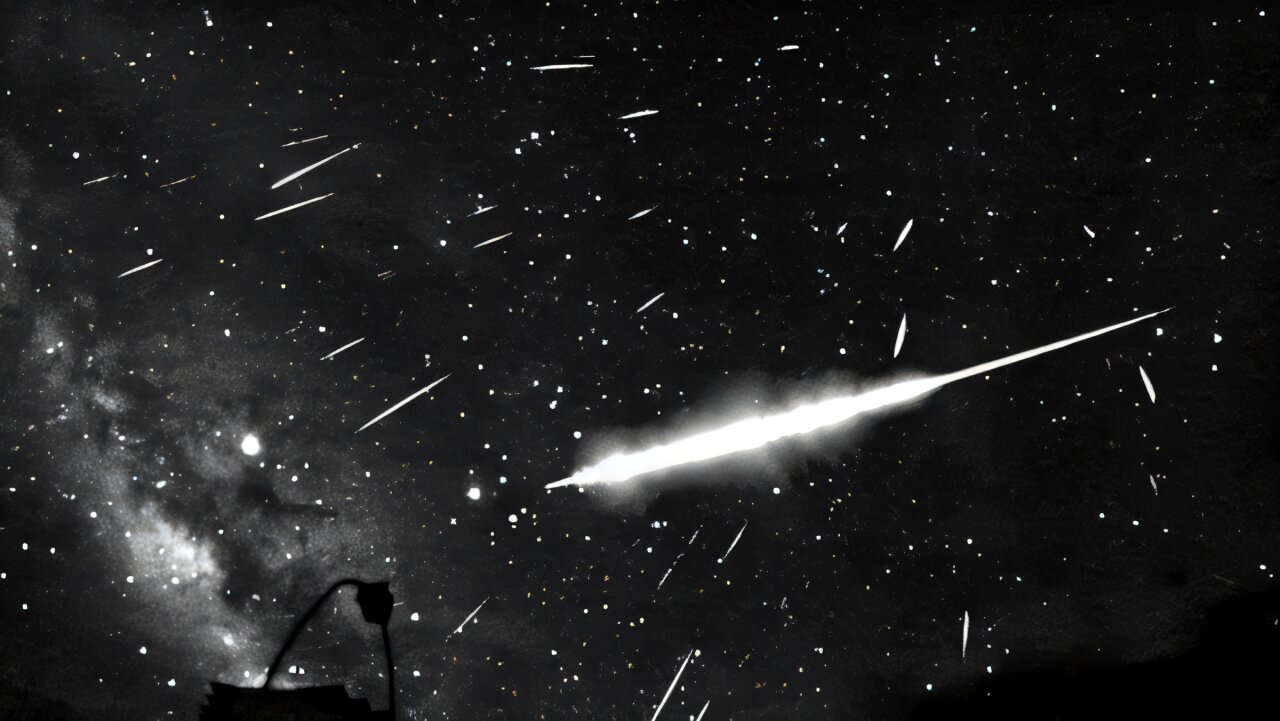
How are meteors formed?
When a piece of space rock the size of a grain of sand enters our atmosphere, it heats up almost instantly, causing its outer layer to vaporize and turn into an electrically charged gas. The entire fragment begins to glow—this is what we call a meteor.If an object is larger—for example, the size of a boulder—and brighter, it is called a bolide or fireball. On average, these objects enter our atmosphere at speeds exceeding 15 miles per second. For fine dust or objects the size of a grain of sand, the entire process lasts only a fraction of a second, after which they disappear completely.
Most of these sand-grain-sized fragments in the Solar System originate from comets—cold, icy objects from the outer regions of the Solar System. When comets pass close to the Sun, their icy components turn into gas, releasing tons of dust. That is why comets are often called “dirty snowballs,” and they appear blurry in telescope images.
Asteroids, on the other hand, are remnants of the early Solar System that formed closer to the Sun. They are dry and rocky and contain no ice, which gives comets their characteristic tails.
“Active” asteroids
Astronomers refer to an asteroid or comet as “active” when it emits dust, gas, or large fragments. This activity is caused by the effects of certain external forces on objects in space, such as solar heat, minor collisions, or the rapid rotation of asteroids, which leads to their disintegration.
Understanding and identifying this activity helps scientists better understand how these objects change over time. In the case of comets, the main factor is the sublimation of ice—a process during which solid ice turns directly into gas, bypassing the liquid phase. However, in the case of asteroids, the causes of their activity can vary greatly.
For example, during NASA’s OSIRIS-REx mission—which was launched into space to study an asteroid named Bennu—activity was detected on its surface; the primary causes cited include thermal stress and minor impacts.
Other reasons for asteroid activity include their fragmentation due to excessive rotation, tidal forces that tear asteroids apart during close encounters with planets, or the release of gas.
Scientists usually look for signs of activity using telescopes. Astronomers may look for a “tail” or a blur around the object. This tail is a clear sign that there is gas and dust surrounding the body. But there is another way to look for signs of activity: meteor showers.
Meteor showers help locate hidden asteroids
The most famous active asteroid is 3200 Phaethon. It is the parent body of the Geminid meteor shower, which can be observed every year in mid-December. During its previous close approaches to the Sun, Phaethon ejected a vast amount of dust and large debris. Subsequently, this debris from Phaethon was scattered throughout its orbit, leading to the formation of the modern Geminid meteor shower.
Every observable meteor shower occurs when the Earth passes through one of these streams of debris. Consequently, if astronomers can detect meteor showers, they can use them to search for active objects in space.
At first, the fragments breaking off from an asteroid or comet move close together. Imagine squeezing a single drop of food coloring into a flowing stream of water: at first, the dye remains in a dense, concentrated cloud. But as it flows, the water’s swirling currents pull at the dye, causing it to spread out and fade.
In space, the gravitational forces of passing planets act in a similar way to these currents. They affect individual meteorite fragments in slightly different ways, causing the once-tight stream to gradually drift apart until it completely dilutes into the background dust of our solar system.
Discovery of a new asteroid breaking apart into pieces
In a study published in March 2026 in the Astrophysical Journal, scientists used millions of meteor observations to identify recent, previously unknown activity among near-Earth asteroids. They managed to identify one distinct cluster of 282 meteors that stood out in particular.
What makes this discovery so fascinating is that we are, in essence, watching a hidden asteroid break apart into small pieces. This recently confirmed meteor shower follows an extreme orbit that is nearly five times closer to the Sun than Earth’s orbit.
Judging by the way these meteors break apart as they enter our atmosphere, we can conclude that they are quite fragile, but more durable than materials found in comets. This discovery suggests that intense solar heat is literally cracking the asteroid’s surface, burning off the gases trapped inside and causing it to disintegrate. This was likely the main reason for Phaethon’s activity in the past and the primary factor behind the wide variety of meteorites found on Earth.
The importance of meteor observations
Why is it so important to detect a hidden, disintegrating asteroid? Observing meteors is a highly sensitive method that allows us to study objects that remain completely invisible to traditional telescopes.
In addition to solving astronomical mysteries, analyzing these fragments helps us understand the physical evolution of asteroids and comets in our solar system. More importantly, this makes it possible to detect hidden populations of asteroids approaching Earth—and this is vital information for protecting the planet.
The asteroid responsible for the new meteor shower remains unknown. However, NASA’s NEO Surveyor mission, scheduled for launch in 2027, offers a promising solution. This space telescope, designed to protect the planet and detect dark, dangerous asteroids approaching the Sun, will be the ideal tool for identifying the source of a meteor shower.
According to phys.org

