

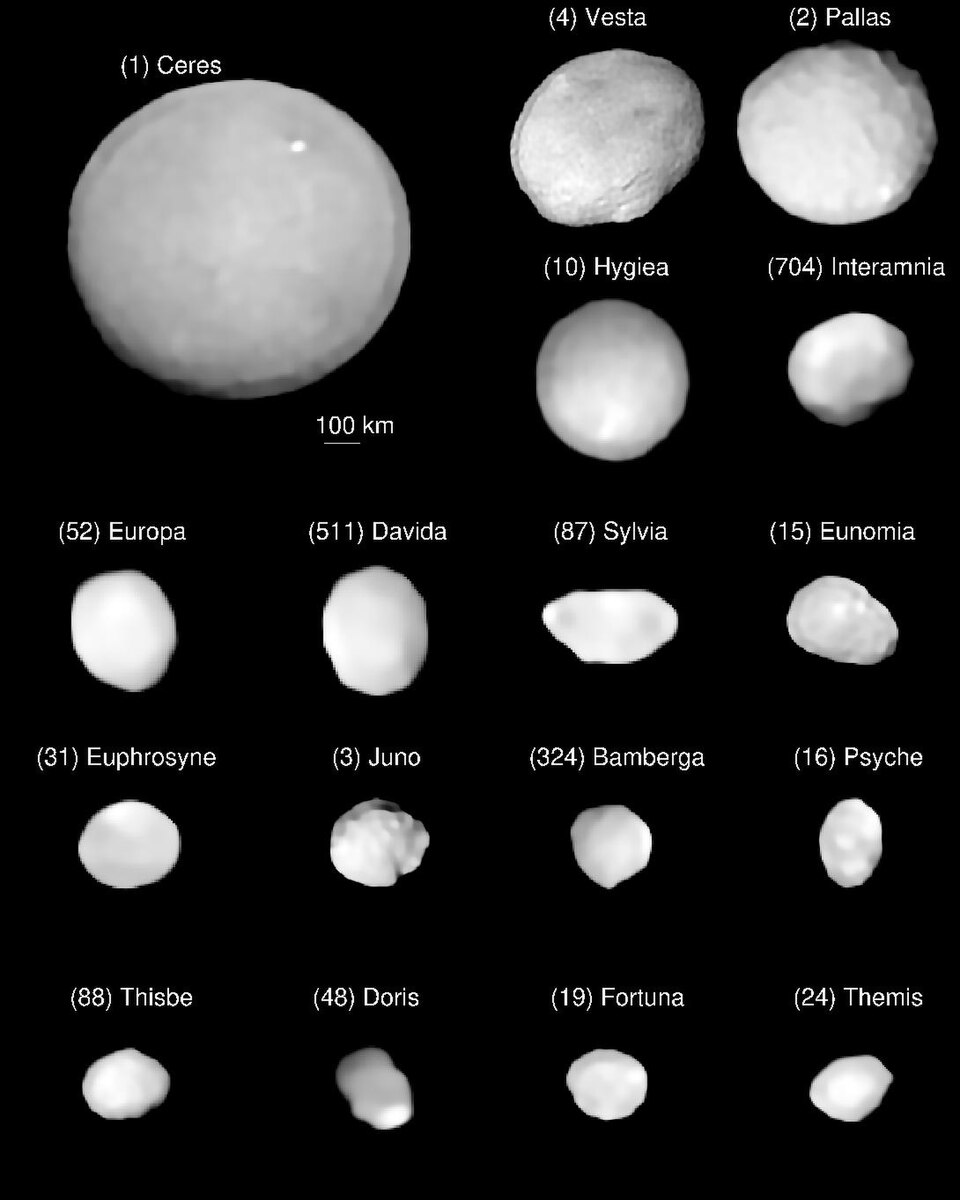
People usually imagine asteroids as rocks several kilometers in diameter. And this is true for most of them. However, in the Main Belt between Mars and Jupiter, you can find true giants whose size is comparable to that of some countries on Earth. Here are the ten largest of them.
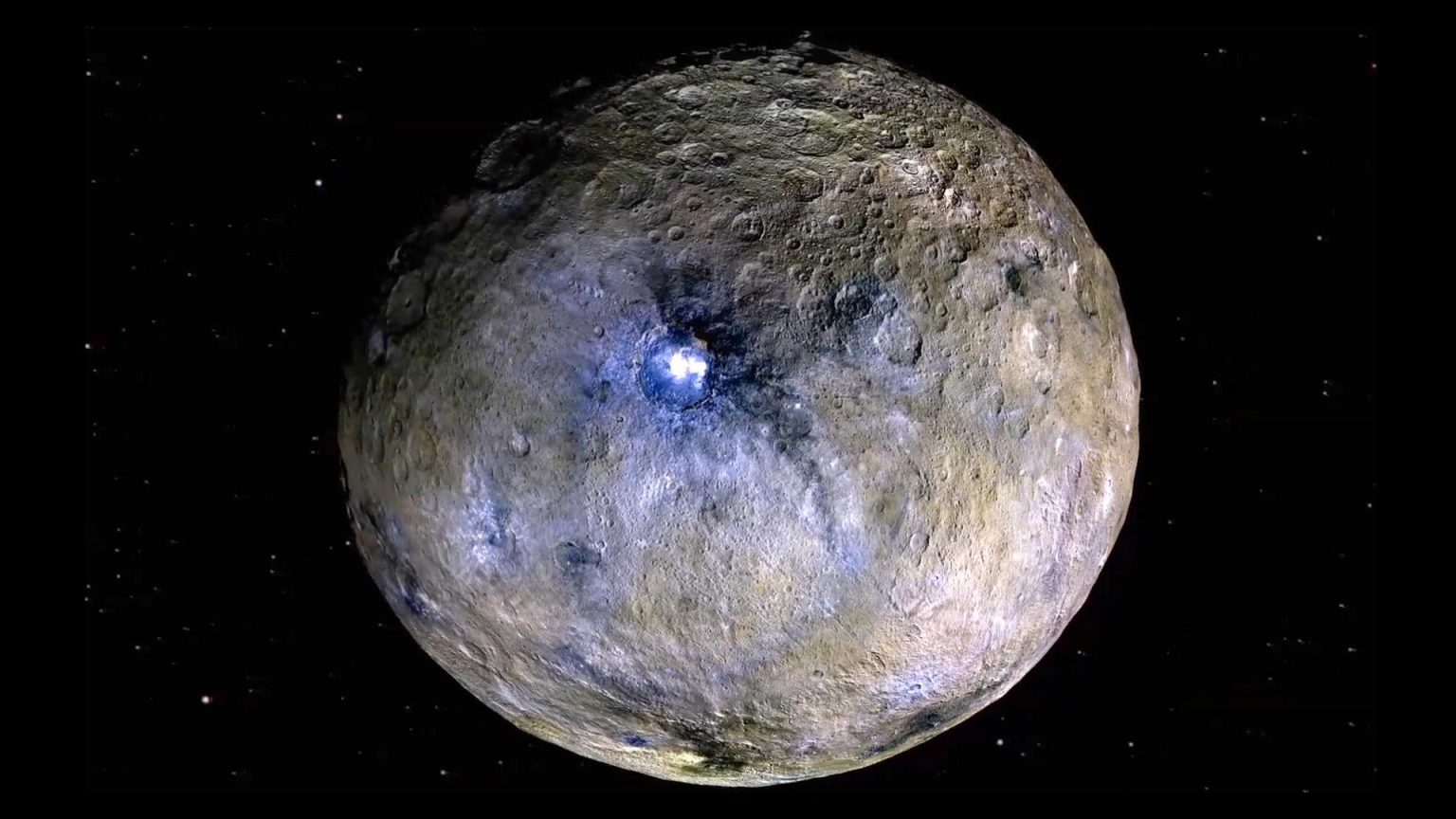
The largest objects in the Main Asteroid Belt
The Main Asteroid Belt lies between the orbits of Mars and Jupiter. It contains millions of asteroids. Most of them remain unknown due to their size and distance from Earth. Therefore, their total number is an estimate based on statistical data.
After all, the first asteroids were discovered just over 200 years ago. However, all the truly large rocks in this part of the Solar System are already known to us. So, we can compile a list of the largest ones.
That said, one clarification is in order. The largest object in the Main Belt – and the first to be discovered by astronomers – is called Ceres. For many decades, this nearly perfect sphere with a diameter of 942 km was considered the largest asteroid. However, in 2006, astronomers revised the classification of celestial bodies and introduced the concept of a “dwarf planet.” Pluto is most often mentioned in this context, as it was “downgraded.” However, the same thing happened to Ceres, which, on the contrary, was “upgraded” to a dwarf planet due to its spherical shape. Therefore, it is not included in today’s list.
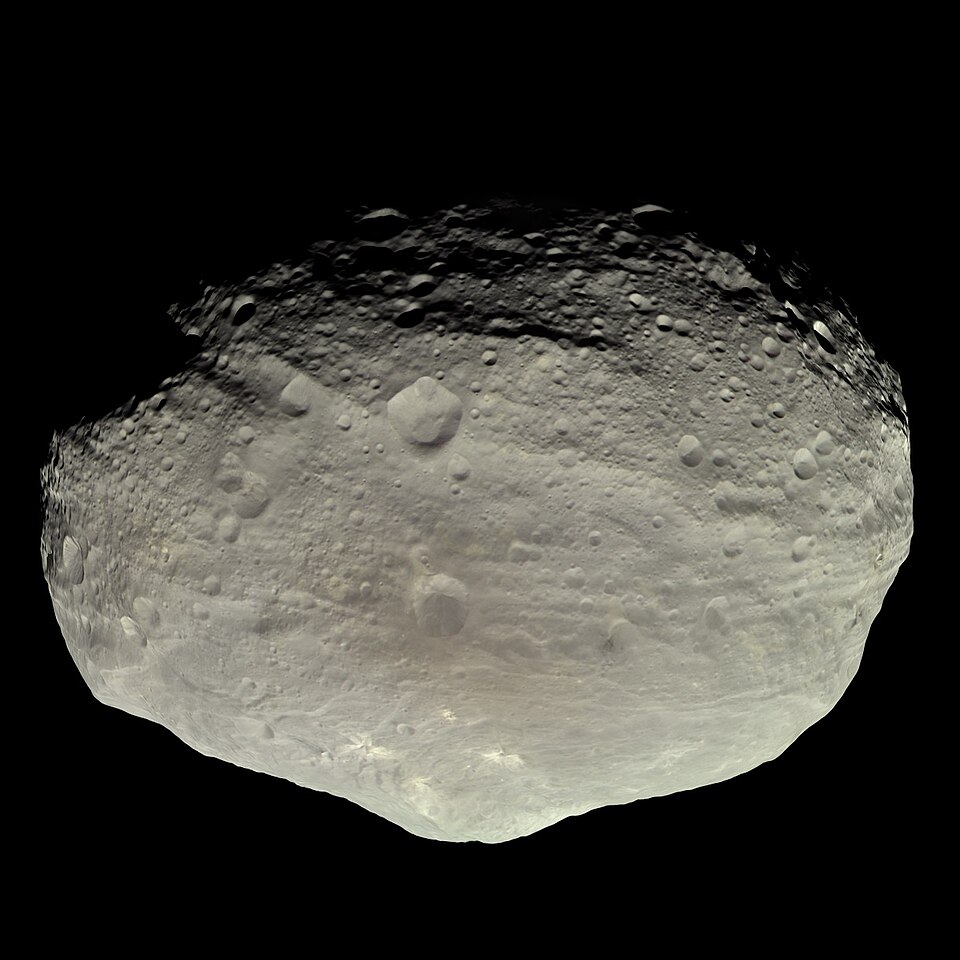
1. Vesta
In the absence of Ceres, Vesta is the largest asteroid in the main belt. This object, named after the ancient Roman goddess of the hearth, was one of the first to be discovered, back in 1804.
Vesta has an irregular shape. Its dimensions are 578×560×458. If its shape were slightly less asymmetrical, it could be classified as a dwarf planet, just like Ceres. The debate over which category it belongs to continues to this day.
There are quite a few craters on Vesta. The largest of them – Rheasilvia – is located at the asteroid’s south pole. Its diameter ranges from 475 to 500 km, which means it is quite comparable in size to the planet itself. In the center of the crater is a peak with a diameter of 180 km and a height of 22 km. It is the highest mountain in the solar system after Olympus Mons.
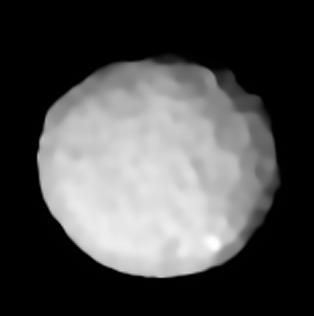
2. Pallas
The second-largest asteroid in the main belt after Vesta is Pallas. In fact, this celestial body, named after the goddess of victory, was the second to be discovered after Ceres. And for a long time, it was believed that it was slightly larger than Vesta.
In fact, Pallas has a diameter of 512 km. Its surface has a lower albedo than Vesta’s and is more heavily cratered than the two previously mentioned bodies. It is believed that it underwent gravitational segregation, meaning that all the heaviest elements are concentrated closer to the core, while the lighter ones are located near the crust.
It is also interesting to note that spectroscopic studies have revealed the presence of hydrated materials on Pallas’ surface. This suggests that at some point in its history, it came into contact with liquid water.
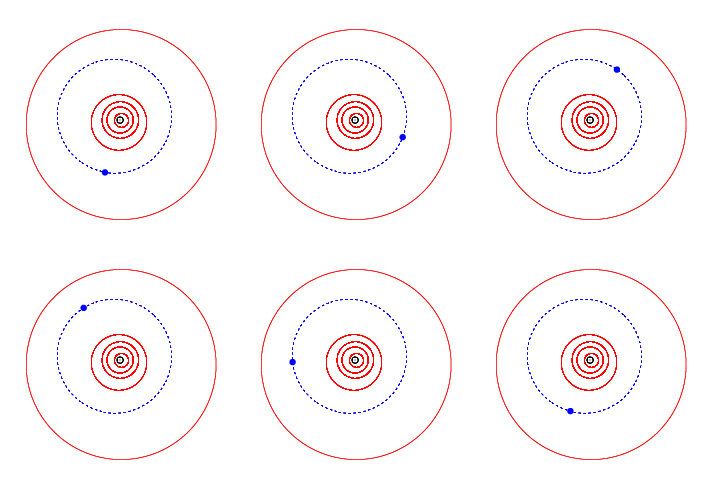
3. Hygiea
The third-largest asteroid in the Main Belt is Hygiea, named after the ancient Roman goddess of health. This object has a diameter of 431 km. Its orbit lies slightly farther from the Sun than that of other large asteroids. The average distance from our star is 3.1 AU, compared to 2.3 AU for Vesta and 2.7 AU for Pallas.
Hygeia is nearly spherical in shape and is the largest of the carbonaceous asteroids. Its surface is quite dark and contains a large amount of carbon compounds. Because of its dark surface, Hygiea is difficult to observe from Earth, which is why it was discovered nearly 50 years after Ceres. It takes 5.56 Earth years to complete one orbit around the Sun.
4. Interamnia
No matter how inconspicuous Hygiea may seem, it is nowhere near Interamnia, which ranks fourth among the largest asteroids in the Main Belt. This object’s albedo is only 0.074, meaning it is essentially black.
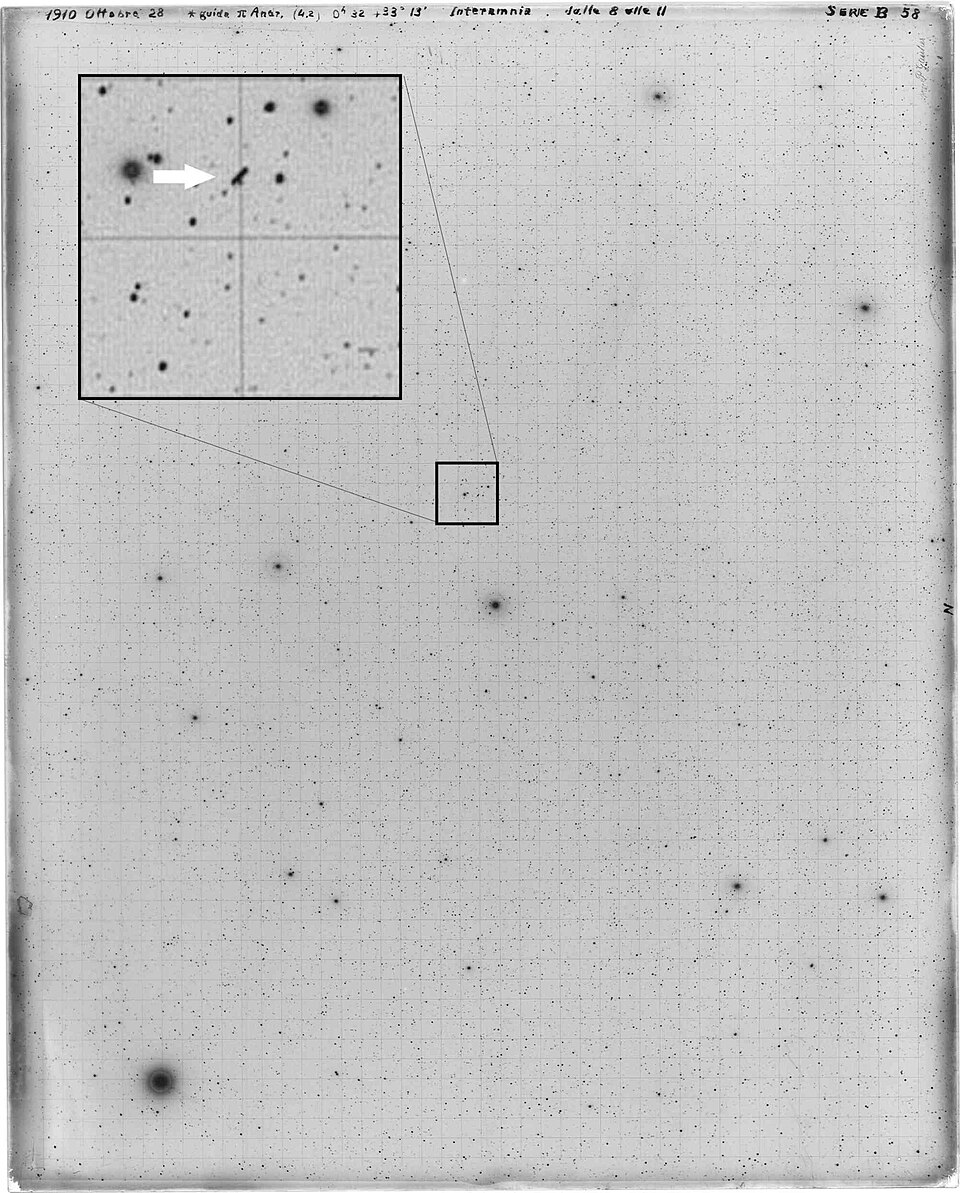
That is why Interaminia, which has an irregular shape and measures 349 × 339 × 274 km, was discovered much later than other large asteroids. Astronomers from the Italian city of Teramo did not discover it until 1910. The name itself is a reference to the ancient name of that city.
It is also interesting to note that the perihelion – that is, the point in Interamnia’s orbit closest to the Sun – lies on the opposite side of the Sun relative to the corresponding points in the orbits of Ceres, Vesta, Pallas, and Hygiea.
5. Europa
The fifth-largest asteroid in the Main Belt is Europa. It is named after the daughter of the Phoenician king who, according to myth, was abducted by Zeus, and is one of Jupiter’s largest moons. This can lead to confusion, especially since Jupiter’s moon is larger and was discovered much earlier.
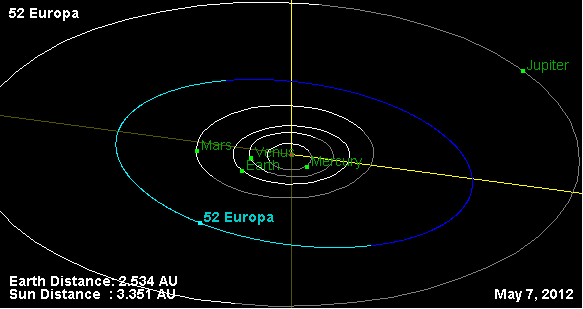
The asteroid Europa has a diameter of 302 km. Its average distance from the Sun is 2.8 AU. It is a carbonaceous asteroid and may belong to the same family as Hygiea. Hydrated minerals have also been found on it.
6. Davida
The asteroid Davida was discovered in 1903 by the American astronomer Raymond Dugan and named after David Todd, a professor of astronomy at Massachusetts College. It measures 357 × 294 × 231 km and has an average distance from the Sun of 3.168 AU.
Davida is a dark, irregularly shaped asteroid. However, a giant crater with a diameter of 150 km has been identified on its surface. This massive rock is extremely dense, accounting for about 1.5% of the total mass of the Main Belt.
7. Sylvia
The asteroid Sylvia, the seventh-largest in the Main Belt, measures 385 × 265 × 230 km. It was discovered in 1866. It is characterized by an extremely low density: 1.2 g/cm³. This suggests that there must be huge cavities inside it.
There are two different theories as to why this asteroid was named as it was. Some say that it was named after the wife of the famous astronomer and science popularizer Camille Flammarion. In reality, however, this space rock was named in honor of Rhea Silvia, the mother of Romulus and Remus, the mythical founders of Rome.
8. Cybele
Cybele is a dark, carbonaceous asteroid from the outer part of the asteroid belt. It has a fairly elongated orbit. Its average distance from the Sun is 3.4 AU. The dimensions of this irregularly shaped celestial body are 302 × 290 × 232 km.
Cybele was discovered in 1861. It was named after the Phrygian goddess of agriculture. In turn, this asteroid gave its name to an entire family of asteroids that share a common origin.
9. Eunomia
Eunomia, which ranks 10th among the largest asteroids in the Main Belt, measures 357×255×212 meters. It was discovered in 1851 and named after one of the daughters of Zeus and Themis, the goddesses of law and order.
Eunomia was discovered relatively early because it is a fairly bright silicate asteroid with a high albedo. It is retrograde, meaning it rotates in the opposite direction to the Sun.
10. Juno
Juno rounds out the top ten largest asteroids in the Main Belt. In terms of when it was discovered, it is actually the third-largest after Ceres and Vesta. However, its actual dimensions – 320 × 267 × 200 km – are not all that impressive.
The reason Juno was discovered as early as the beginning of the 19th century is that it is a silicate asteroid with a relatively high albedo. It was named after Jupiter’s wife, the goddess of marriage.

