

NASA researchers have reported on a soil sample taken by the Perseverance rover, dubbed “Sapphire Canyon”. It may contain traces of ancient microbial life.
Source: NASA/JPL-Caltech/MSSS
The discovery was made in 2024 during a study of the formation called Bright Angel. It consists of a set of rock deposits from an ancient river valley 400 meters wide, which was carved out by streams of water that once rushed into the crater Jezero.
The rover’s scientific instruments have discovered that the sedimentary rocks of this formation consist of clay and silt, which on Earth are excellent at preserving traces of microbial life. They are also rich in carbon, sulfur, oxidized iron (rust), and phosphorus.
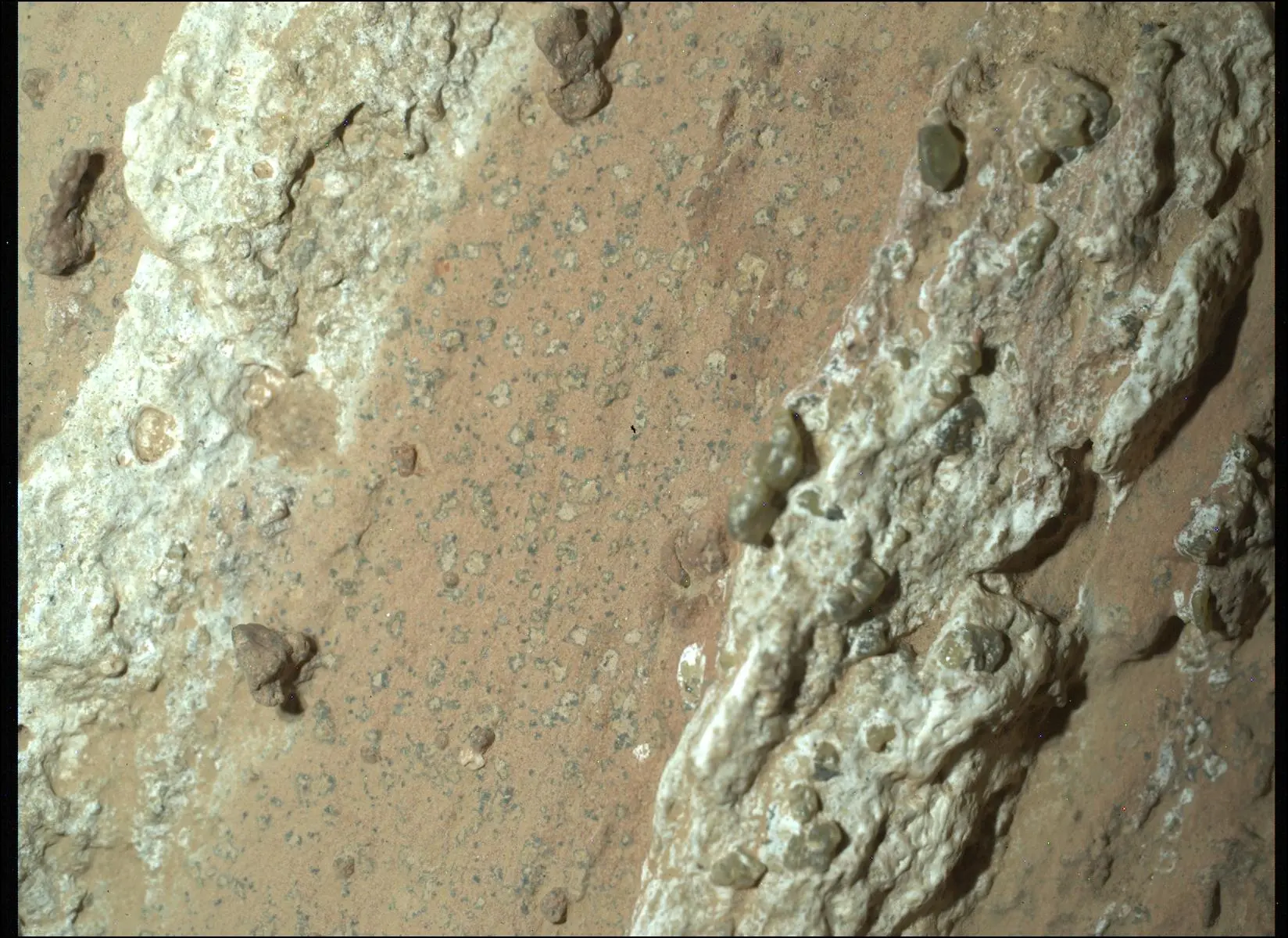
The most intriguing discovery was the colored spots found by Perseverance on the rock. They could have been left by microorganisms if they used the raw materials contained in the rock (carbon, sulfur, and phosphorus) as a source of energy.
High-resolution images revealed a distinct pattern of minerals arranged in reaction fronts (points of contact where chemical and physical reactions occur), which the scientific team dubbed “leopard spots”. The spots bear the hallmarks of two iron-rich minerals: vivianite (hydrated iron phosphate) and greigite (iron sulfide). Vivianite is often found on Earth in sediments, peat bogs, and around decaying organic matter. Similarly, some forms of microbial life on Earth can produce greigite.
The combination of these minerals, which appear to have formed as a result of electron transfer reactions between sediments and organic matter, is potential evidence of microorganisms using these reactions to produce the energy necessary for growth. However, the minerals could also have formed abiotically (i.e., without the presence of life) through reactions involving prolonged exposure to high temperatures, an acidic environment, and binding with organic compounds. However, the rocks at Bright Angel show no signs of exposure to high temperatures or acidic environments, and it is unknown whether the organic compounds present could have catalyzed the reaction at low temperatures.
It is not surprising that scientists instructed Perseverance to take a sample of this formation. It became the 27th sample collected by the rover during its operation. In the future, it may be delivered to Earth by the Mars Sample Return mission.
According to researchers, this discovery is particularly surprising because it concerns some of the youngest sedimentary rocks studied during the mission. Previously, it was assumed that traces of ancient life would be limited to older rock formations. The discovery suggests that Mars may have been habitable for a longer period than previously thought, and that older rocks may also contain traces of life that are simply more difficult to detect.
Earlier, we reported on how Perseverance noticed a “turtle” in the sands of Mars.
Provided by NASA

