

Even a relatively short space journey to Mars, which NASA plans to last 375 days. However, today’s engineers are already looking much further ahead—to Saturn’s mysterious moon, Titan. According to calculations by experts William J. O’Hara and Marcos Fernandez-Tous, the use of nuclear propulsion systems makes such an extremely complex mission physically possible.
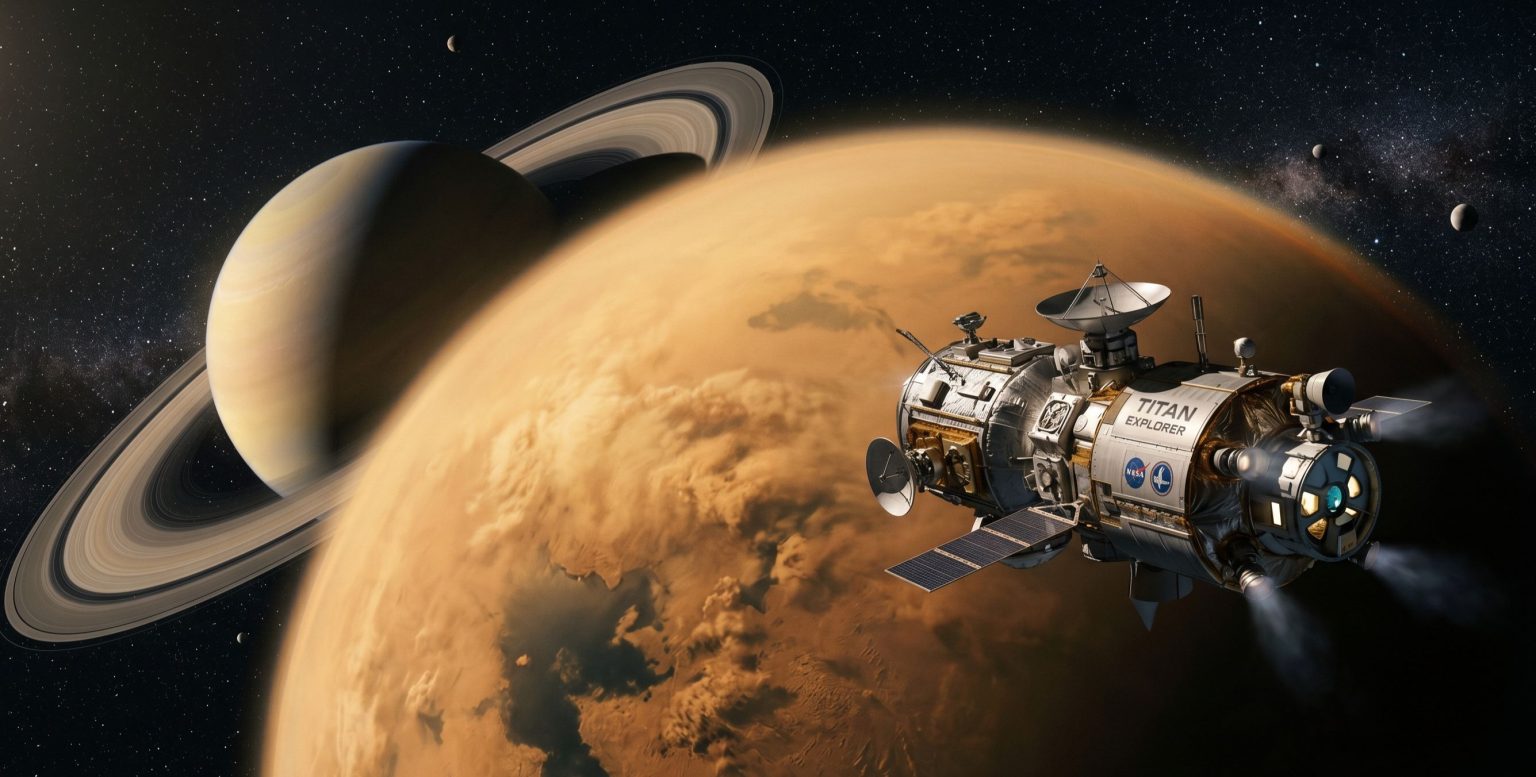
For example, a spacecraft design featuring a nuclear thermal power plant called Copernicus, which runs on liquid hydrogen and uranium-235, is capable of reaching Titan in just 220 days. The entire mission, including surface operations, will last approximately 1,000 days. This presents an unprecedented challenge for biology. Currently, the record for the longest continuous stay in space is held by Valeri Poliakov—437 days. But there is a significant caveat: he was aboard a space station that was reliably shielded from galactic radiation by Earth’s magnetic field. The crew of the Titan mission will be completely deprived of such a natural shield.
From Copernicus to VASIMR
The Copernicus project was originally developed at a NASA research center to enable rapid flights to Mars. Subsequently, the concept was adapted for Titan, which, at its closest approach, is 17 times farther from Earth than Mars. Adding massive fuel tanks could theoretically reduce the one-way flight time to as little as 90 days, but this would dramatically increase the launch mass and the astronomical cost of the spacecraft.
Engineers are also exploring alternative nuclear options. The VASIMR nuclear-electric plasma rocket could reduce the flight time to 149 days. And a promising direct-current thermonuclear engine would allow for a round-trip flight in 2–2.6 years. However, none of these innovative systems solves the fundamental problem: the lack of a lightweight and reliable shield to protect against radiation.
Why Titan?
Despite its extreme conditions—with temperatures as low as -179 °C, a lack of sunlight, and gravity seven times weaker than Earth’s—Titan offers unique advantages over Mars. Its nitrogen atmosphere is six times denser than ours. This allows the lander to slow down effectively without using rocket engines.
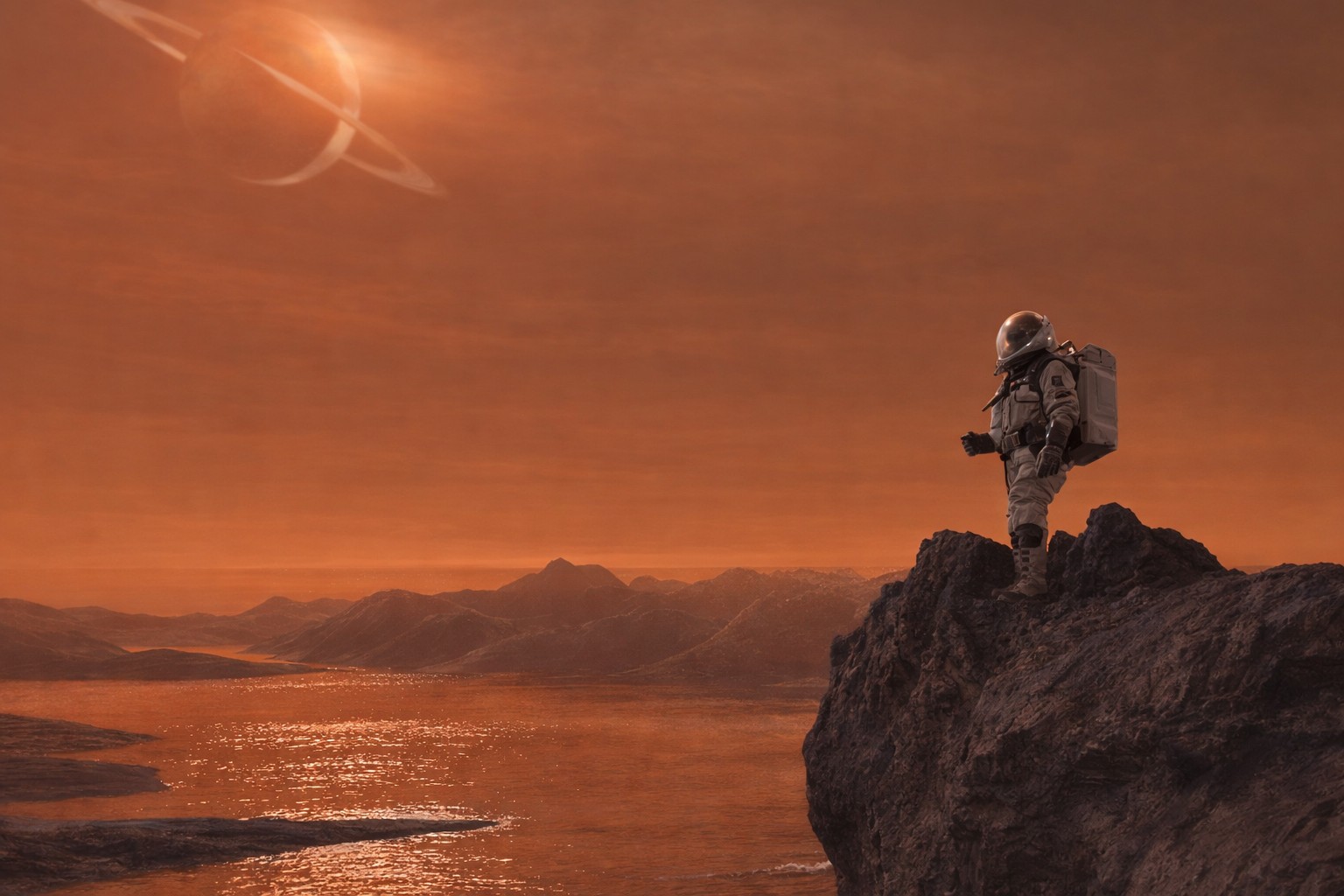
What’s more, once the crew is on solid ground, this dense layer of gas will act as a reliable shield against cosmic radiation. Another significant benefit is the presence of liquid methane and ethane in the soil, which the astronauts could extract and process into fuel for the return trip home.
Body against merciless space
The impact of a thousand-day journey on the human body remains the weakest link in this ambitious plan. Radiation damage to cells begins to accumulate as soon as the spacecraft leaves Earth’s magnetosphere. Today, humanity has not yet invented lightweight materials capable of stopping high-energy atomic nuclei, which easily pierce the walls of spacecraft.
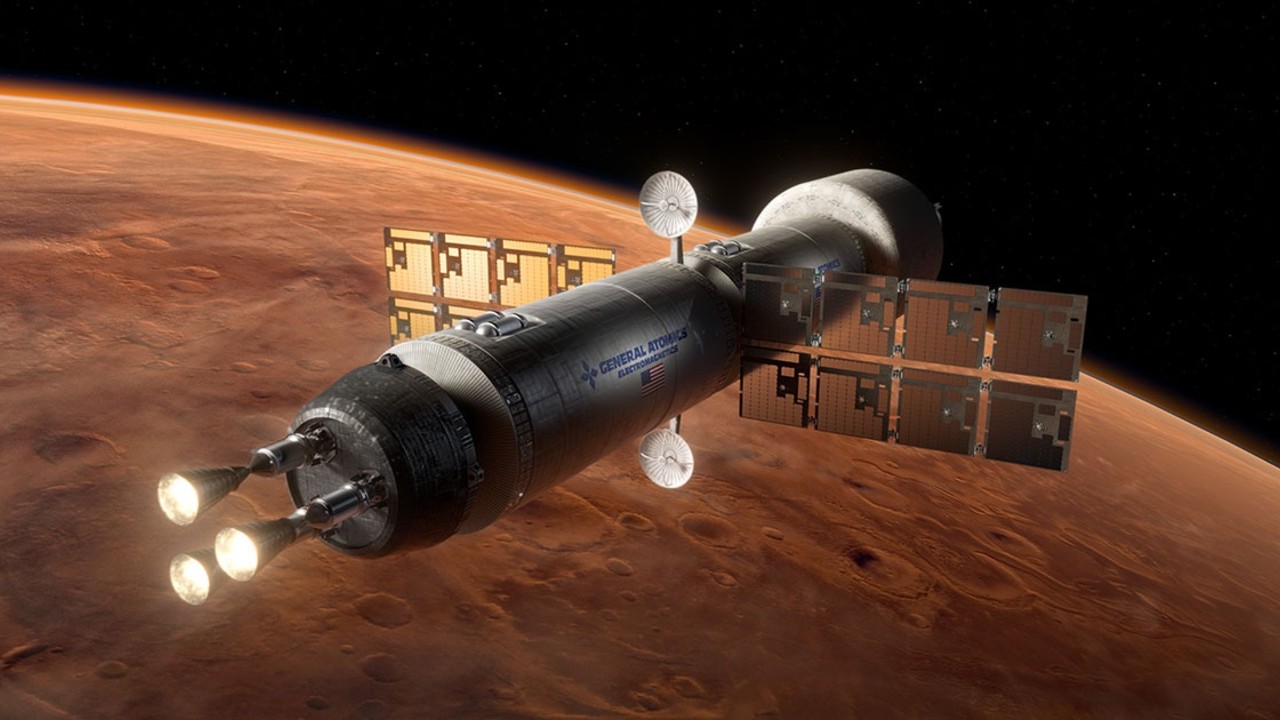
Microgravity also takes a heavy toll on the body: astronauts’ bones lose about 1% of their density each month, and their muscles atrophy rapidly. In addition, the redistribution of fluids in the body creates dangerous pressure on the optic nerve, which threatens partial or irreversible vision loss—this phenomenon has already been observed following six-month missions to the ISS. No one knows how the body and mind will react to 2.5 years of absolute isolation in a tiny space.
Reconnaissance before the big leap
Before humans ever venture into the outer Solar System, robotic systems will pave the way. The scout is expected to gather vital data long before the first astronaut takes a seat at the nuclear reactor. NASA’s quadcopter, named Dragonfly, is scheduled to arrive on Titan in 2034.
This innovative helicopter will collect soil samples to analyze their chemical composition, map the stability of the terrain, and measure actual radiation levels on the surface. Its findings will provide the definitive answer to the question: Can humans survive on this distant world? The engine power calculations seem to be the most reliable part of the plan at this point. The engines are indeed capable of propelling the spacecraft to Saturn, but no one has yet proven that the astronauts will be physically able to take their first step after such an exhausting landing.
We previously discussed how laser propulsion could help us reach Alpha Centauri in 20 years.
According to dailygalaxy.com

