

Venus’s slow and retrograde rotation around its own axis is one of the greatest mysteries of our Solar System. However, a new study presented at the General Assembly of the European Geosciences Union in Vienna offers a compelling explanation. Researchers believe that during the first 50 million years of its existence, the planet may have experienced a massive collision with a celestial body the size of the Moon.
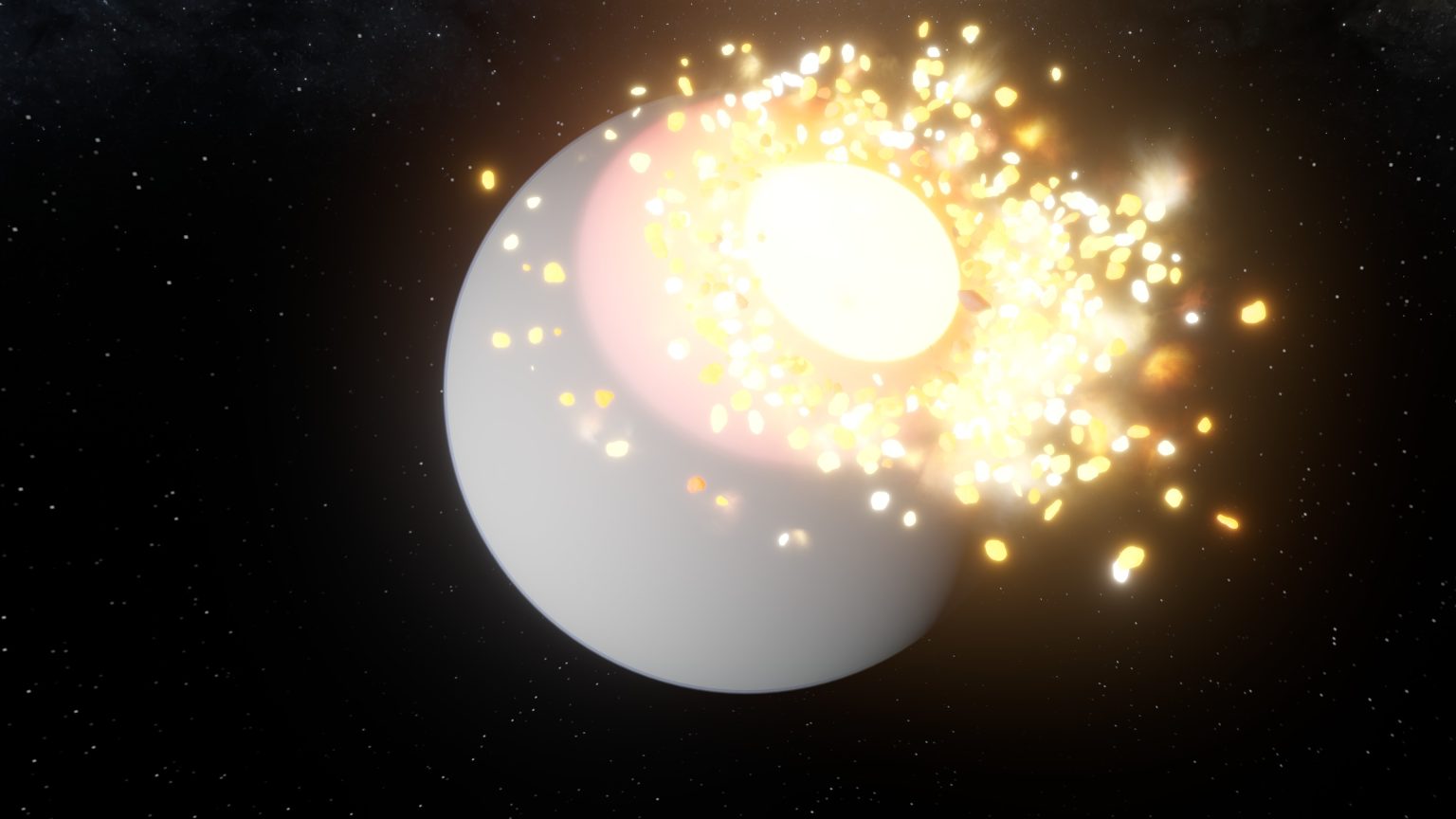
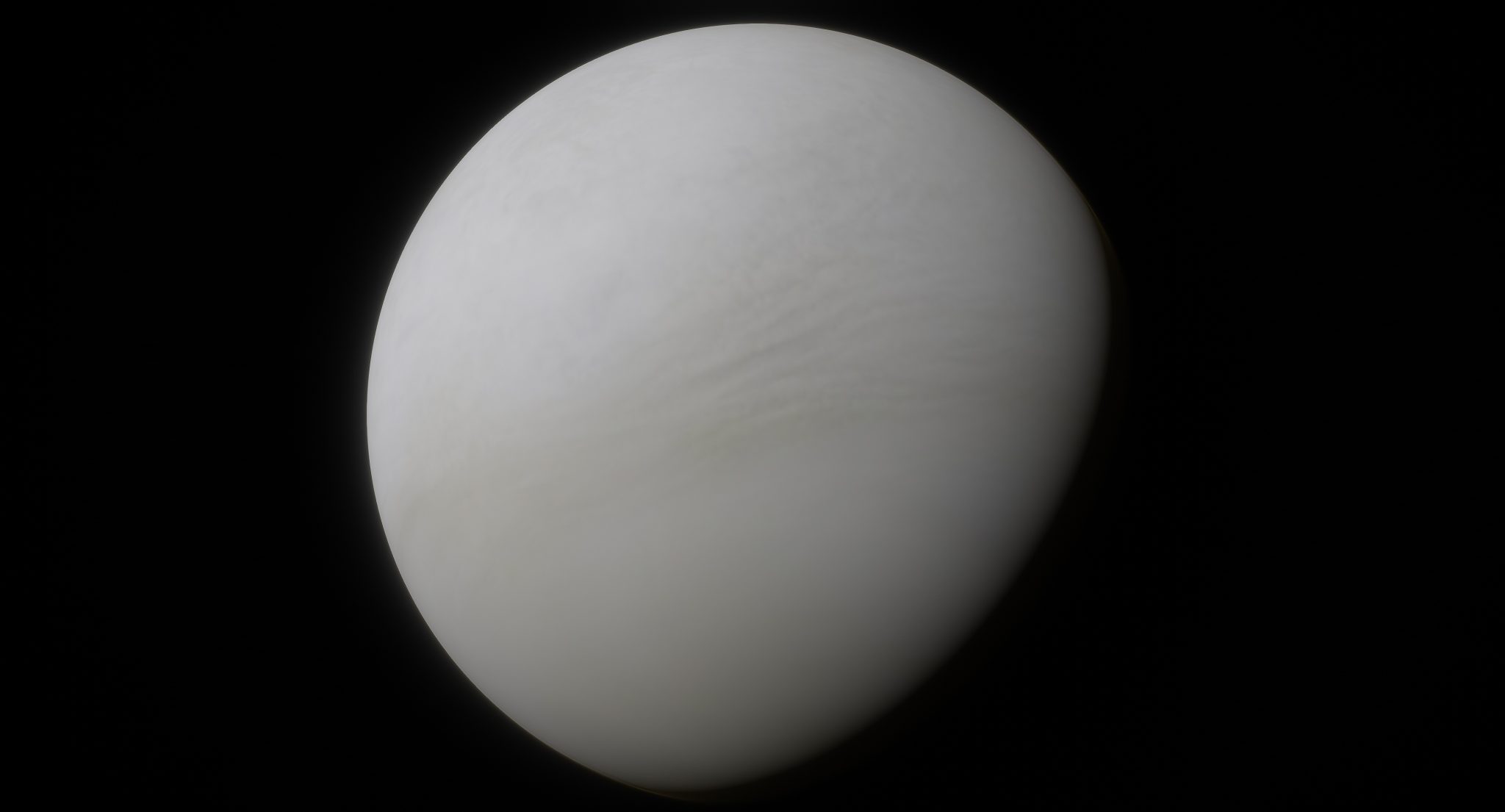
Cedric Gillmann, a planetary scientist at the Swiss Federal Institute of Technology in Zurich and the study’s lead author, explains that the researchers sought to determine whether such an impact could have radically altered the planet’s rotation. Today, Venus, which is nearly the same size as Earth, is a veritable hell: its surface temperature reaches 467°C, and the pressure near the surface is 92 times higher than on Earth.
Venus rotates on its axis in a retrograde direction, the opposite of most planets in the Solar System. One rotation takes about 243 Earth days, making Venus one of the slowest-rotating planets in the Solar System.
Simulation of a fatal blow
To test their theory, the scientists used computer simulations. “Basically, we’re throwing a large rock at an even larger one and watching how the planet deforms, how its rotation and internal temperature change,” Gillmann notes.

The results were striking. An object with a mass of about 10% that of Venus, striking the planet at a high angle, is capable of sharply slowing down the young planet’s initially rapid rotation. Depending on the characteristics of the impact, Venus could have either gradually slowed down to its current state or immediately begun rotating in a retrograde direction.
Oceans of molten magma
As expected, simulations have shown that such massive collisions create surface magma oceans on the planet. Their depth can range from a 100-kilometer-thick layer to the complete melting of the mantle. If the calculations are correct, the catastrophe melted nearly 99% of Venus’s mantle—the inner layer between the crust and the core.
However, by effectively radiating heat into space, such an ocean cools rapidly (by geological standards). According to Gillmann, just a few hundred million years after the catastrophe, the planet would have looked as if no impact had ever occurred. At the same time, discussions continue as to whether this collision caused the absence of plate tectonics. The only thing known is that it was the planet’s inability to recycle carbon on a large scale that led to its current runaway greenhouse effect.
Is there any water left underground?
Stephen Kane, an astrophysicist at the University of California, Riverside, emphasizes the importance of this issue. A planet’s rotation plays a crucial role in climate evolution, cloud formation, and the maintenance of conditions suitable for life, as it determines how the planet redistributes energy. Therefore, the history of Venus’s rotation is key to understanding whether it was once a more hospitable world.
Given Venus’s proximity to the Sun and the gradual increase in our star’s luminosity (by 10% every billion years), it was increasingly difficult for the planet to maintain a temperate climate. Even if it had oceans in the past, they would eventually evaporate, triggering an irreversible greenhouse effect. The European Space Agency’s upcoming mission, called Envision, will continue to study this complex planet.
For Cedric Gillmann, the biggest question remains whether there is water deep within the planet. If Venus’s interior is completely dry, it would mean that all water was lost during the planet’s evolution. If, however, there is still moisture deep within, the history of Earth’s scorching neighbor still holds many incredible secrets.
We previously reported on how a mysterious phenomenon on Venus was explained.
According to universetoday.com

