

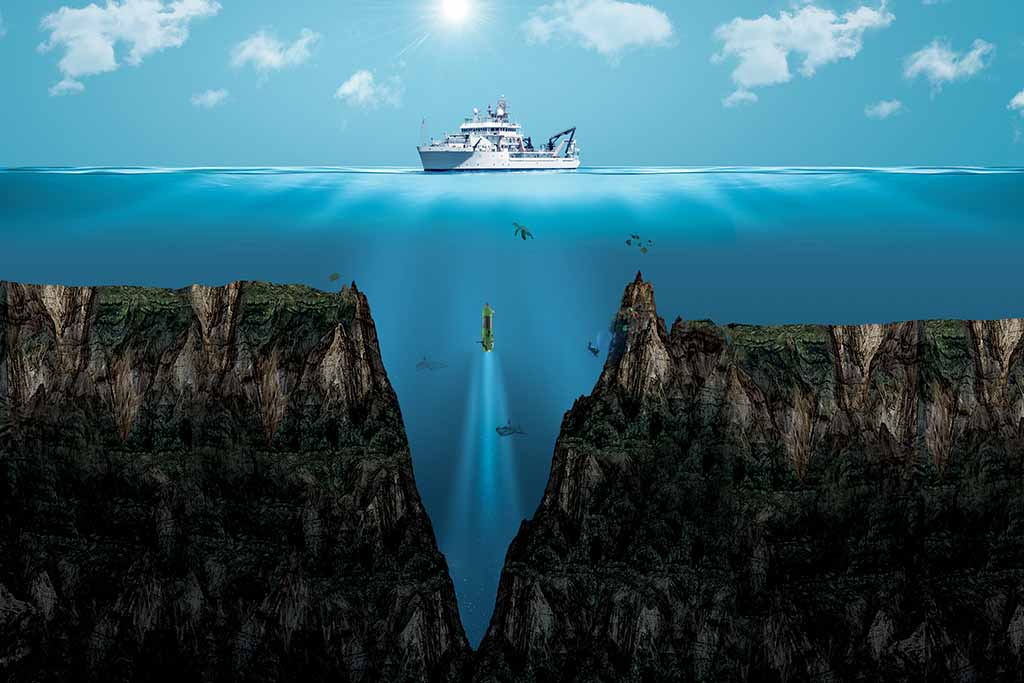
Deep-sea trenches are deep depressions at the bottom of the Earth’s oceans, which are unique features of our planet in the Solar System. They were formed as a result of the movement of tectonic plates and can reach depths of 10-11 km, creating one of the most amazing landscapes on our planet – the hadal zone.
Space at the bottom
There are places on our planet whose gloomy mystery can rival the darkness of space itself. Usually, these include Antarctic glaciers, where life is almost impossible, or the polar deserts on some islands of the Canadian Arctic Archipelago, which are often compared to Mars.
However, there are places on Earth that are almost as inaccessible to humans as outer space, even though they are as far away from it as possible. These are deep-sea trenches – narrow and long depressions at the bottom of the world’s oceans, whose bottoms are never reached by sunlight. Their landscape resembles that of a celestial body, and their few inhabitants resemble aliens.
However, to truly understand the depth of the trenches, you need to observe what happens when you gradually walk along the seabed, going deeper and deeper.
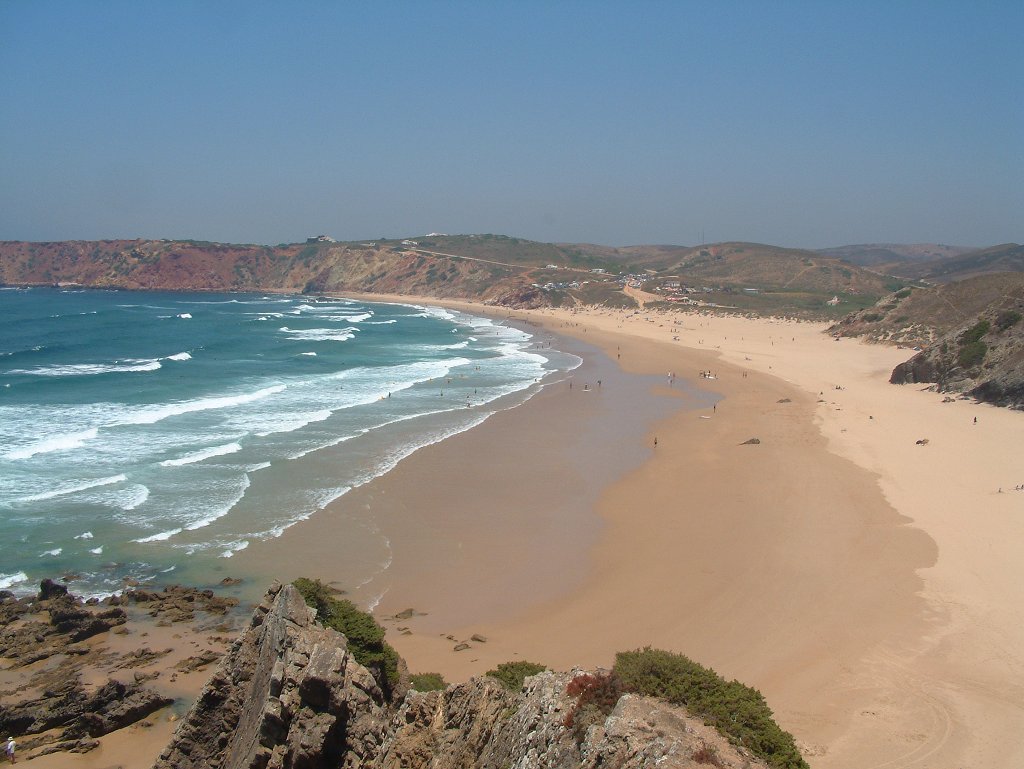
First, they determine the area between the highest point that gets underwater during high tide and the one that remains dry during low tide. This is called the littoral zone, and it is usually a narrow strip along the coast that sometimes gets a few kilometers wide. A great example of a littoral zone is a bunch of Ukrainian estuaries: looking at them, it is clear that the littoral zone is an area that makes any other part of the seabed seem deep.
Next comes the continental shelf – a section of the seabed where the depth slowly decreases to 200 m. The northern part of the Black Sea or the English Channel area, where the depth may not exceed hundreds of meters, tens of kilometers from the coast, are typical example. In essence, the shelf is part of the continental mass submerged by the ocean. Between the sedimentary rocks and basalt, as in much drier places, there is a layer of granite.
If you continue further, you will reach the continental slope, where the bottom descends at a much greater angle and quickly reaches a depth of 2-3 km. The continental slopes are particularly pronounced. For example, off the coast of North America.
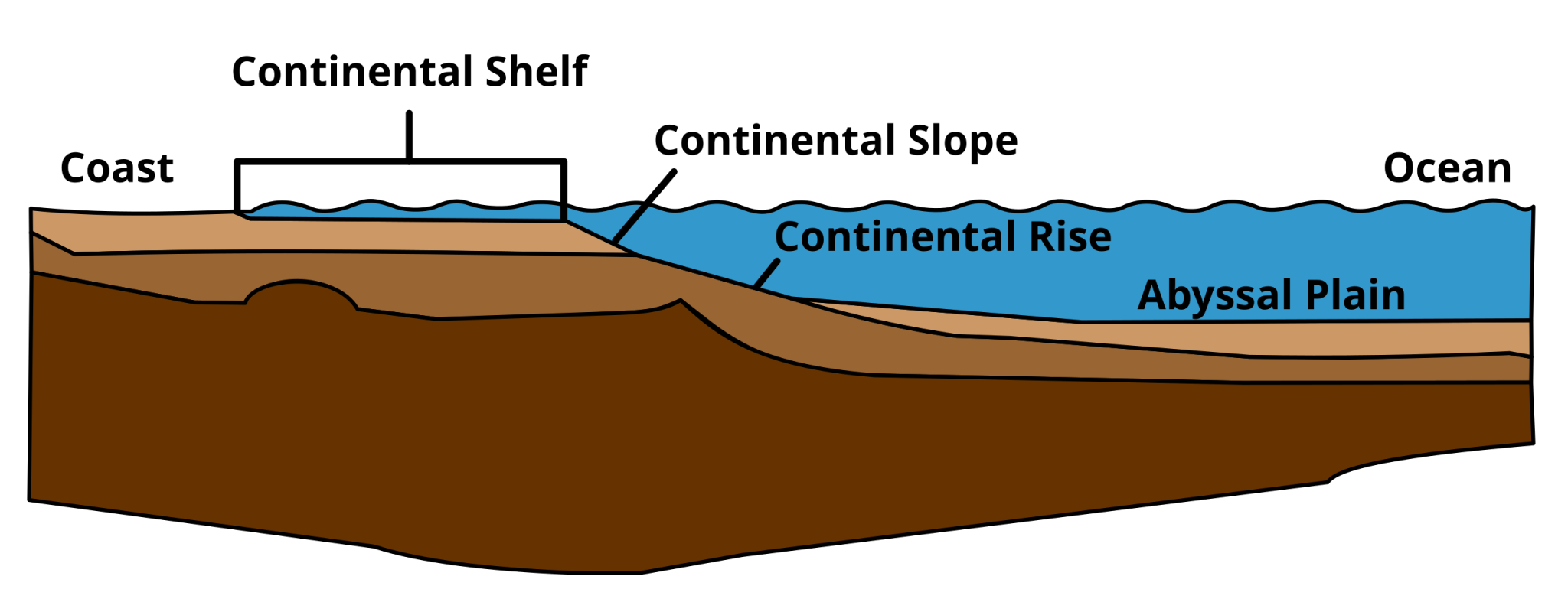
Further down, the angle of the seabed decreases again, and abyssal plains stretch to depths of 4-5 km. These are huge depressions, comparable in size to entire countries, bounded by continental slopes. Sunlight rarely reaches their bottom, and despite the fact that bathyscaphes have repeatedly descended there, we still know less about these areas than we do about the surface of the Moon.
Deep-sea trenches are located even deeper than abyssal plains. The term “hadal zone” is used to describe the fauna of this landscape. There is no need to talk about flora, as it is practically non-existent at depths greater than 5 km. These are truly abysses, where the bottom slopes steeply downward and no light penetrates.
Formation of oceanic trenches
The fact that all the deepest areas of the ocean are shaped like narrow, elongated strips stretching along the coasts of continents or island arcs can be explained by the peculiarities of their formation. As is well known, the Earth’s crust consists of large blocks – tectonic plates. They move along the viscous, relatively plastic outer layer of our planet’s mantle, and it is this movement that causes earthquakes and volcanic eruptions.
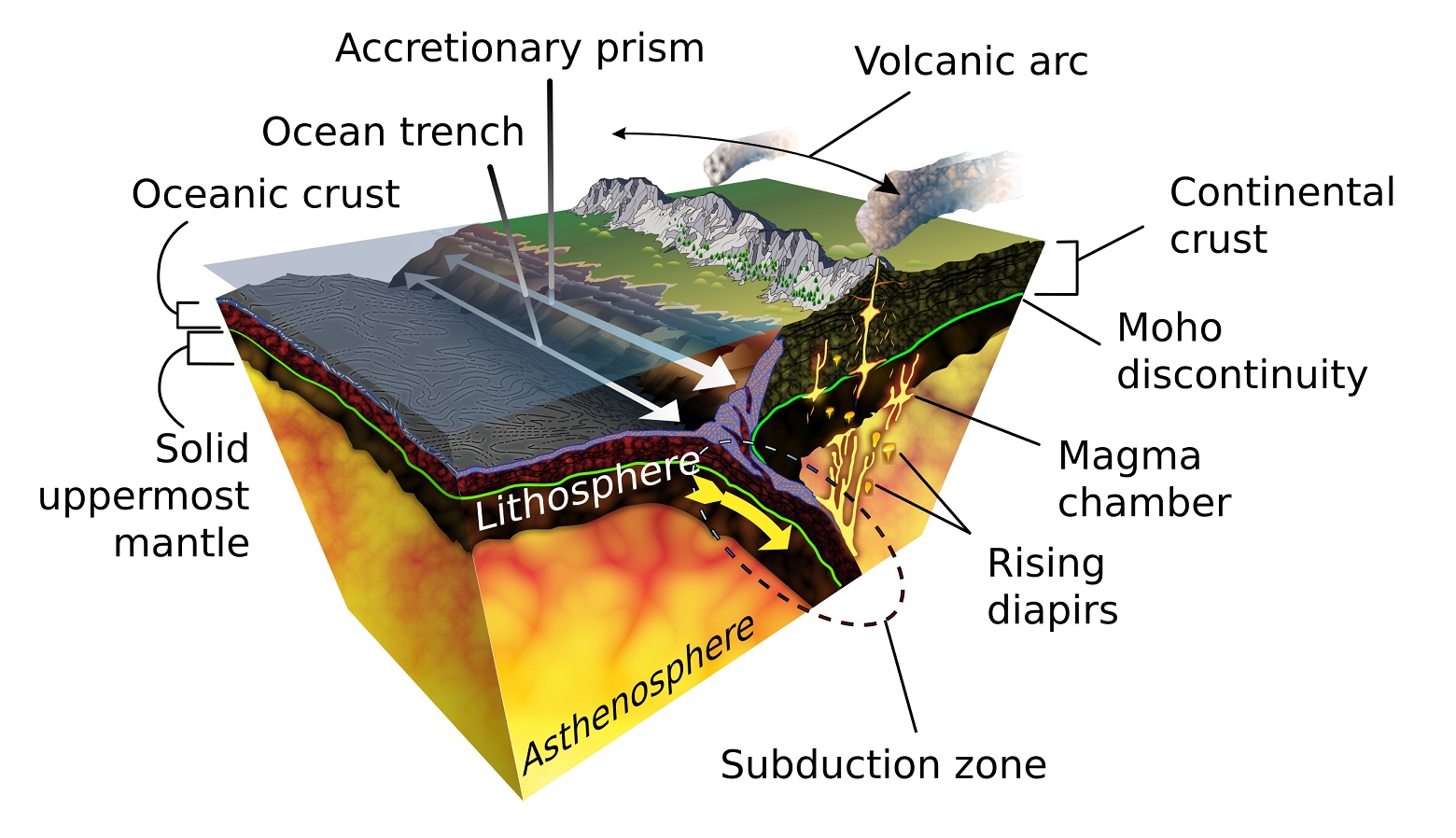
The crust of plates can be continental, i.e., contain the aforementioned layer of granite, or oceanic, i.e., consist only of basalt and sedimentary rocks. Some plates consist of both types, while others consist only of oceanic crust.
In most cases, the transition from the continental slope to the ocean depths involves the same tectonic plate. However, sometimes two different lithospheric blocks are encountered here: one with a continental crust and the other with an oceanic crust. In this case, the oceanic plate begins to subduct beneath the continental plate and partially melts. As a result, a deep depression is formed.
Its slopes are always gentler on the side of the subducting oceanic plate and steeper on the continental side. This is the structure we call a deep-sea oceanic trench. At the same time, the plate subducts very slowly, so from the outside it may seem like a completely calm place.
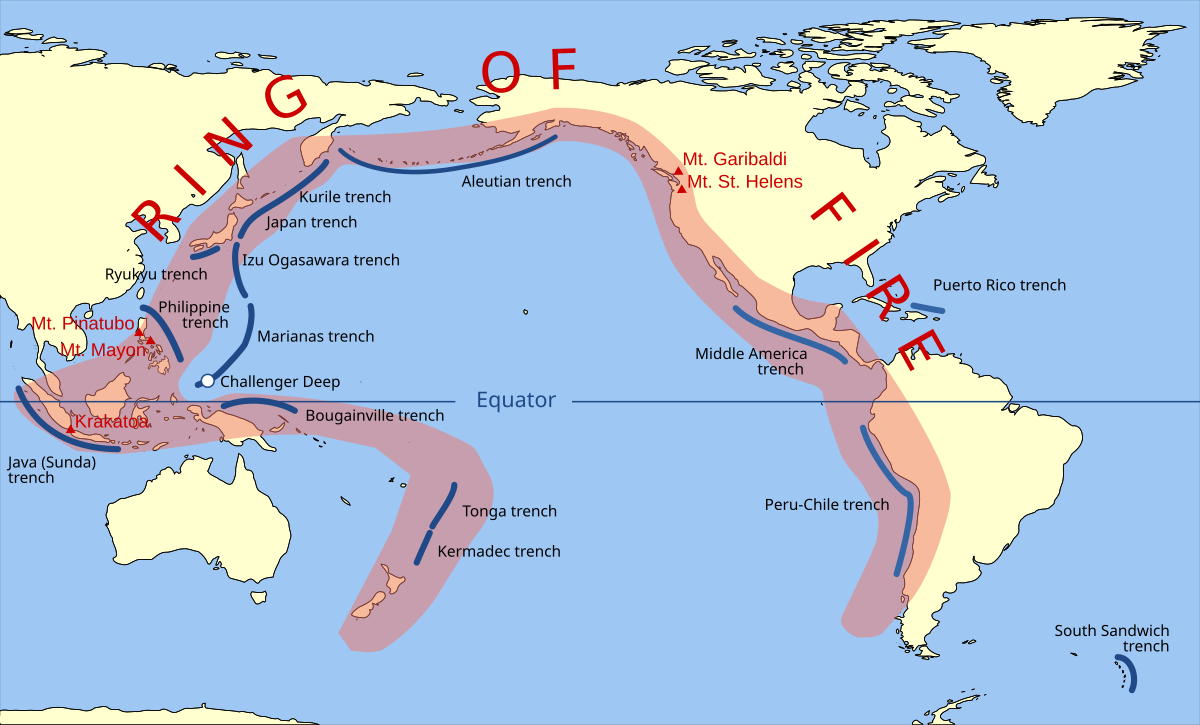
The way deep-sea trenches are formed determines their extremely uneven distribution across the surface of our planet. They are always located in tectonically active zones, mainly in the so-called Pacific Ring of Fire, which surrounds the largest ocean on our planet.
Mariana Trench
In fact, all ten of the deepest ocean trenches are located in the Pacific Ocean. There are more than thirty of them in total. For comparison, there are only three large trenches in the Indian and Atlantic Oceans, and none at all in the Arctic Ocean.
However, the most famous of the Pacific trenches is the Mariana Trench, which is also considered the deepest in the world. Its depth is estimated differently, but usually the value of 11,022 m is given. It is located in the western part of the Pacific Ocean, near the islands of the same name. Its bottom is so inaccessible that humans first reached it only in 1960, just a year before they first set foot on the surface of the Moon. Until recently, the number of people who had visited the bottom of this trench was smaller than the number who had visited our natural satellite.
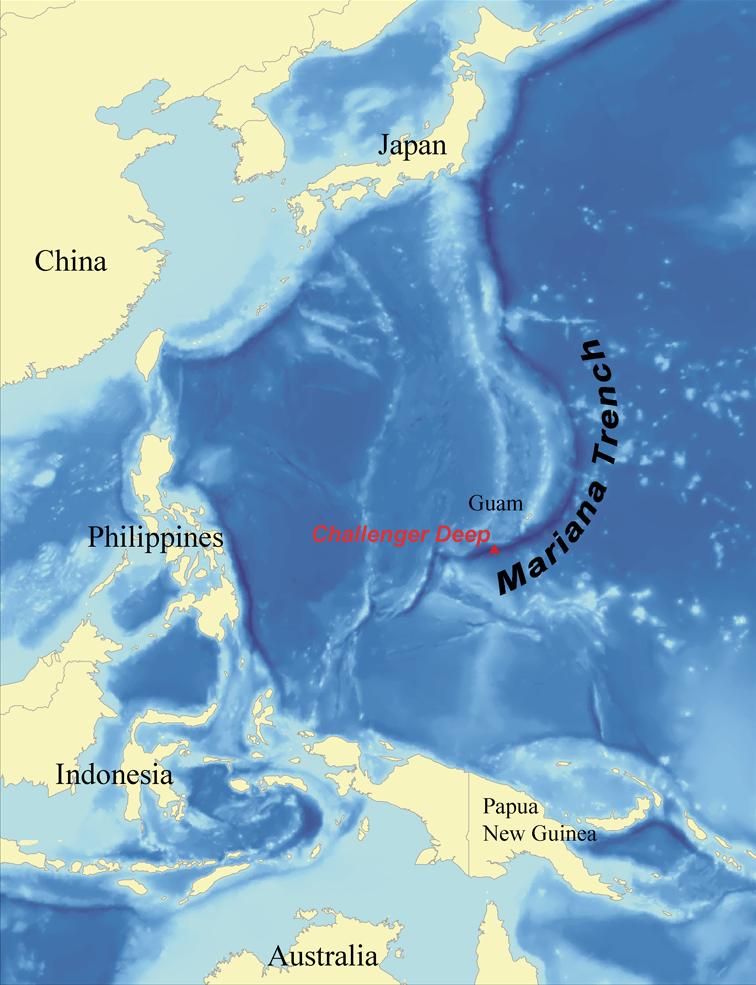
The water pressure at this depth is 108.6 MPa, which is 1,072 times greater than normal atmospheric pressure at sea level. However, microorganisms, crustaceans, and even fish have been found there. None of them is found anywhere else except this place, and they have never seen the light of the sun or stars. Their living conditions resemble those in space.
In addition, despite its inaccessibility, the Mariana Trench already bears the negative traces of human activity. Heavy toxic waste settles there and, together with river water, flows into the oceans.
Other trenches
Everyone knows about the Mariana Trench. However, the rest are no less amazing than it. Tonga, Philippine, Kermadec, Izu Ogasawara, Kuril-Kamchatka, North New Hebridean, Bougainville, and Japan – all of them are deep enough to completely submerge Mount Everest.
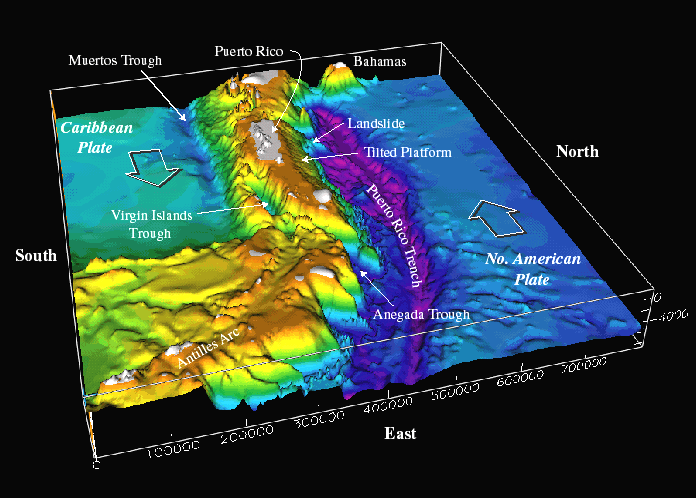
Although the Mariana Trench is the deepest, the title of the longest on Earth belongs to another Pacific structure – the Peru-Chile Trench. It stretches along the coast of South America for 5,900 km, where the Nazca Plate dives under the South American Plate.
The deepest and largest trench in the Indian Ocean is the Sunda Trench, which stretches for 4-5 thousand km along the coast of Indonesia. Its maximum depth is 7,729 m near the island of Bali.
The ocean trenches of the Atlantic Ocean are generally relatively short in length, as they are formed by small tectonic plates. The deepest of these is the Puerto Rico Trench, with a maximum depth of 8,742 m. This is only slightly less than the height of Mount Everest.
It would seem that ocean trenches have nothing to do with astronomy. However, when considering the planets of the Solar System, among the unique phenomena available only on Earth, along with the biosphere, it is worth mentioning them. After all, nowhere else do lithospheric plates move, and even more so, there are no places where they collide under a layer of liquid.

