

It is quite possible that the melting of glaciers, which everyone fears so much, could actually lead to an increase in phytoplankton in the oceans and thus halt the accumulation of carbon dioxide. This would be wonderful news for anyone concerned about severe climate change, but recent studies indicate that we should not get our hopes up.
Glaciers and iron
A group of researchers from Rutgers University in New Brunswick recently published a study demonstrating the complexity and ambiguity of climate change on our planet. It is related to the topic of glacier melting.
This process is usually viewed in a negative context. After all, the more glaciers melt, the less light they can reflect, and a feedback mechanism kicks in — more ice means slower warming, less ice means faster warming. You can read more about this in this article.
However, there is also an alternative theory that when meltwater from glaciers enters the ocean, it will release large amounts of bioavailable iron, causing massive blooms of microscopic algae, which will absorb excess carbon dioxide from the atmosphere.
The latter is an extremely potent greenhouse gas, so lower levels mean less excess heat in the atmosphere. The Earth’s climate is saved! However, it should be noted that mass algae blooms will eventually be followed by mass algae deaths, which will cause oxygen depletion in the oceans. Nevertheless, most researchers still view this possibility positively.
Glacier research
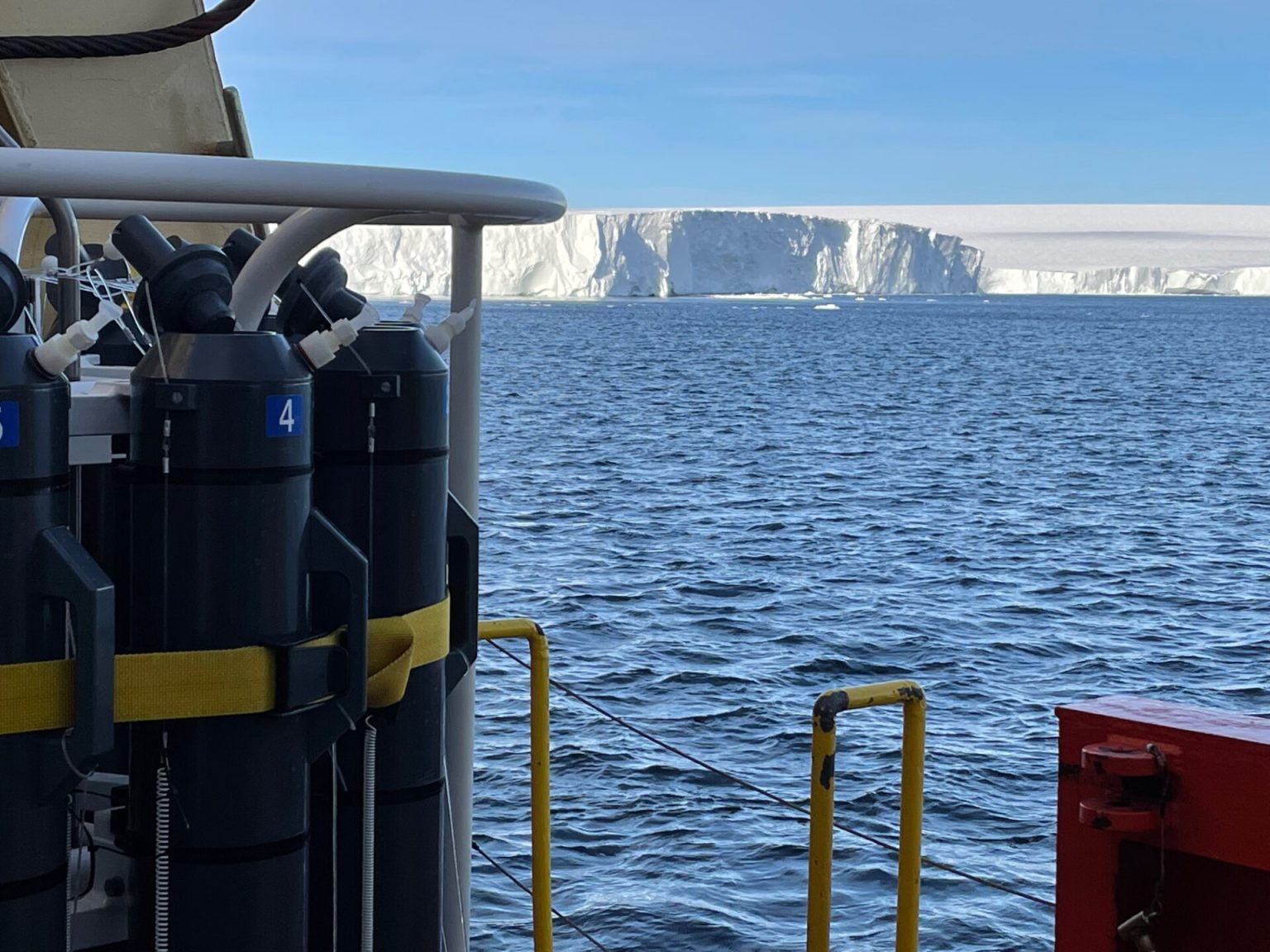
The only problem is that all of the above is based on mathematical calculations and modeling. No one has yet measured how much iron is actually released from glaciers, and this is precisely what researchers aboard the icebreaker Nathaniel B. Palmer set out to do in 2022.
The target of their research was the Dotson Ice Shelf, located in the Amundsen Sea in West Antarctica. Like all similar formations, it is a giant ice sheet sliding down onto the shelf, gliding over a layer of fresh water. The latter has greatly interested scientists.
They identified the location where water emerges from beneath the glacier, collected samples, and analyzed them in the laboratory. It turned out that the iron content was significantly lower than expected: only about 10% of the predicted amount is in a dissolved state. At the same time, isotopic analysis showed that 62% of the available iron is of deep origin, and another 28% is material lifted from the shelf.
All this is rather sad, because it means that the theory will not work. But perhaps it is for the best that algae will not grow in the oceans.
According to phys.org

