

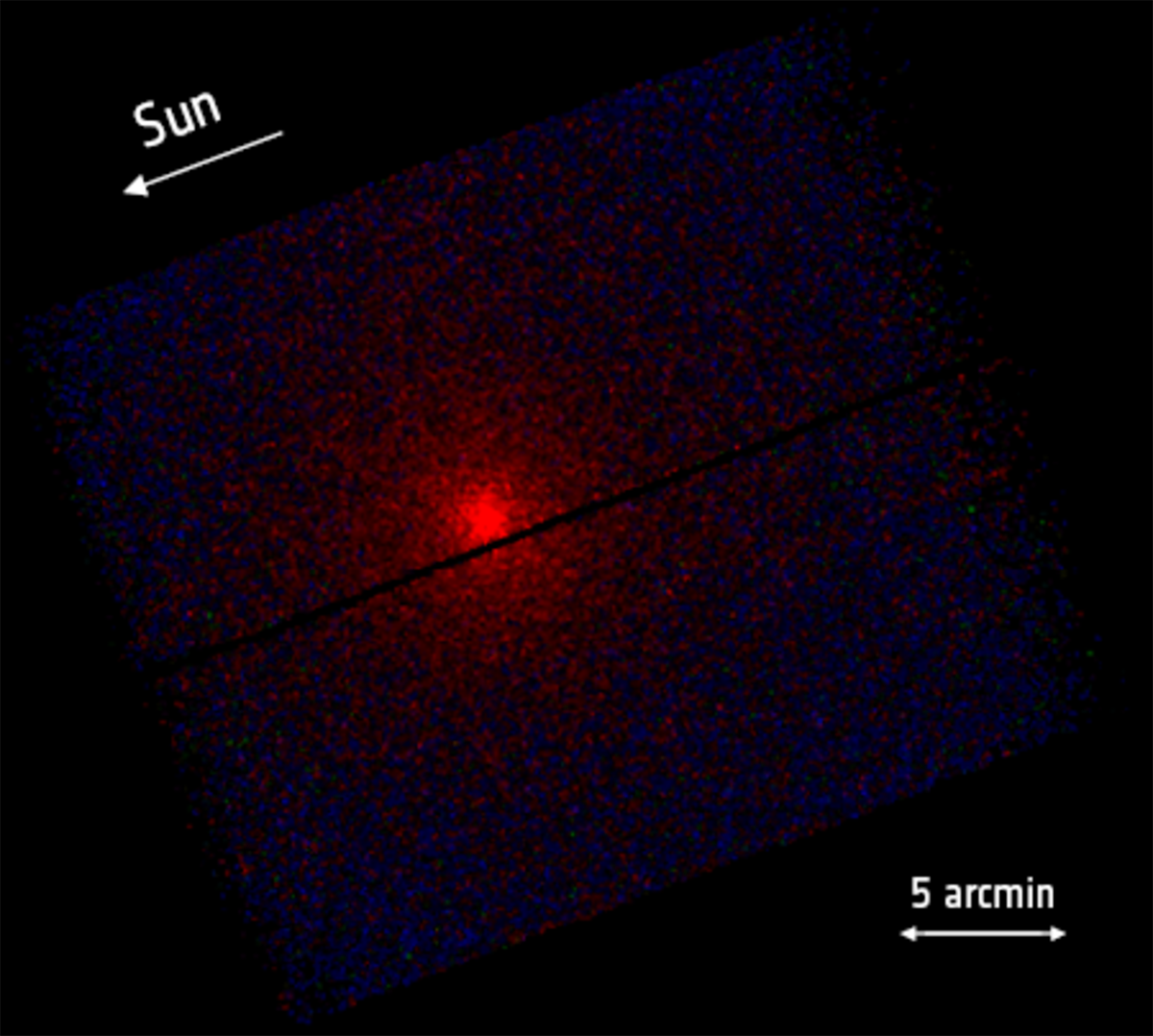
The European Space Agency (ESA) has published an image taken by the XMM-Newton space observatory. It shows the interstellar comet 3I/ATLAS.
Light visible to the human eye covers only a small segment of the electromagnetic spectrum. To obtain maximum data about celestial bodies, scientists usually observe them in different ranges.
The interstellar comet 3I/ATLAS is no exception. While ground-based observatories are capable of taking very valuable images, they cannot detect its X-ray radiation, for example. Analysis of the latter allows gases to be detected that other instruments are unable to find.
Therefore, ESA scientists used the XMM-Newton observatory to photograph comet 3I/ATLAS. It is located in space, which allows it to “see” X-rays that are blocked by the Earth’s atmosphere. The imaging of 3I/ATLAS took place on December 3 and lasted for about 20 hours. At that moment, the comet was about 282–285 million km away from the spacecraft.
In the published image, the comet glows in the low-energy X-ray range: blue indicates empty space with very few X-rays, while red indicates the comet’s X-ray glow. Astronomers expected to see this glow because gas molecules escaping from the comet produce X-rays when they collide with the solar wind.
This X-ray radiation may result from the interaction of solar wind with water vapor, carbon dioxide, or carbon monoxide, which have already been detected in previous observations. However, they may also correspond to hydrogen and oxygen. The latter are virtually invisible to optical and ultraviolet instruments installed on board the Hubble telescope. Several groups of scientists believe that Oumuamua, the first interstellar object discovered in 2017, could consist of exotic ice, such as nitrogen or hydrogen.
While Oumuamua is now too far away, comet 3I/ATLAS has provided a new opportunity to study an interstellar object. Observations in X-ray light will help scientists determine what exactly it is made of.
According to ESA

