

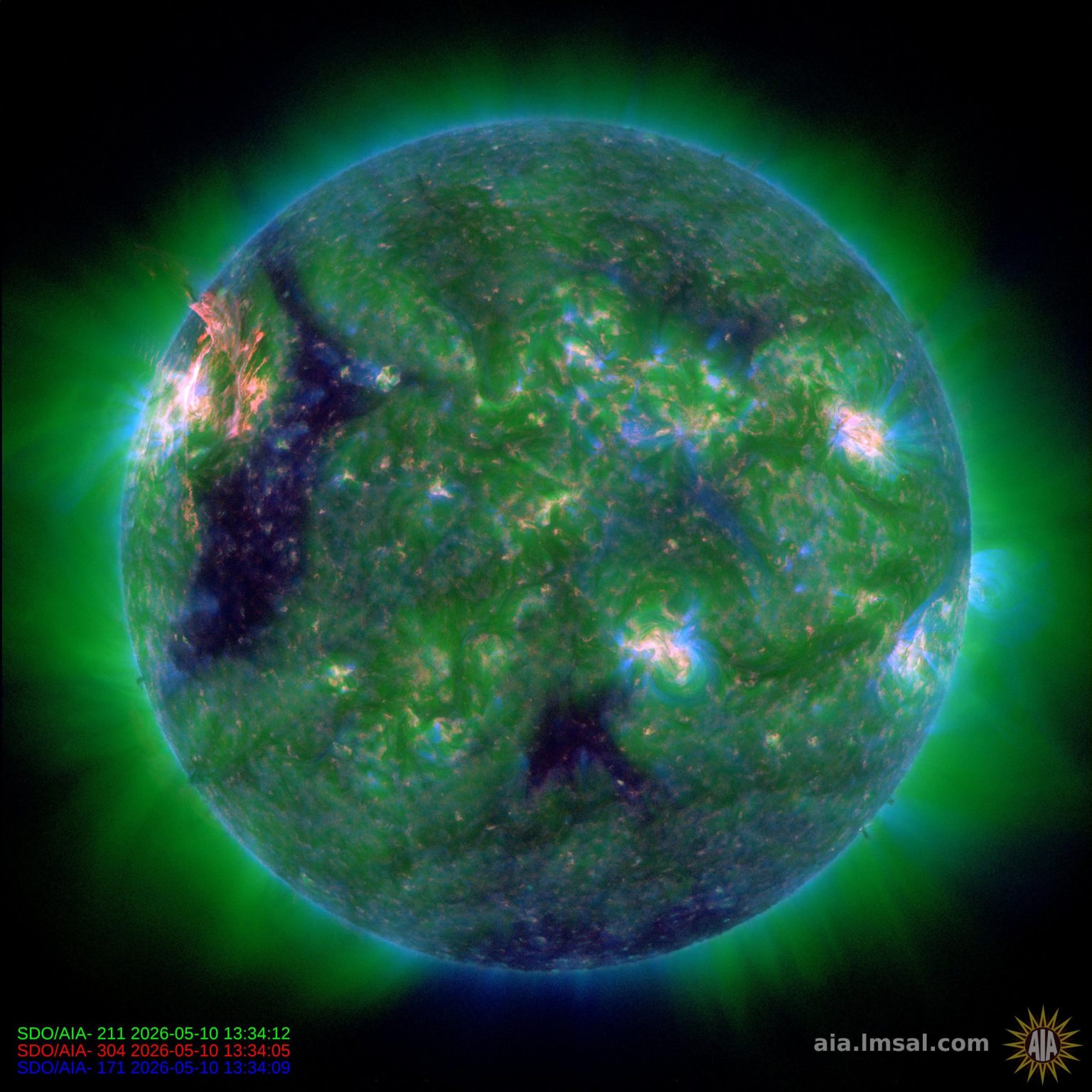
Our star has once again demonstrated its indomitable cosmic power. On Sunday, May 10, space observatories recorded a massive explosion: a solar flare literally blew a huge hole in the upper layers of the Sun’s atmosphere. According to the Space Weather Prediction Center of the U.S. National Oceanic and Atmospheric Administration (NOAA), this event was classified as a significant M5.7-class solar flare.
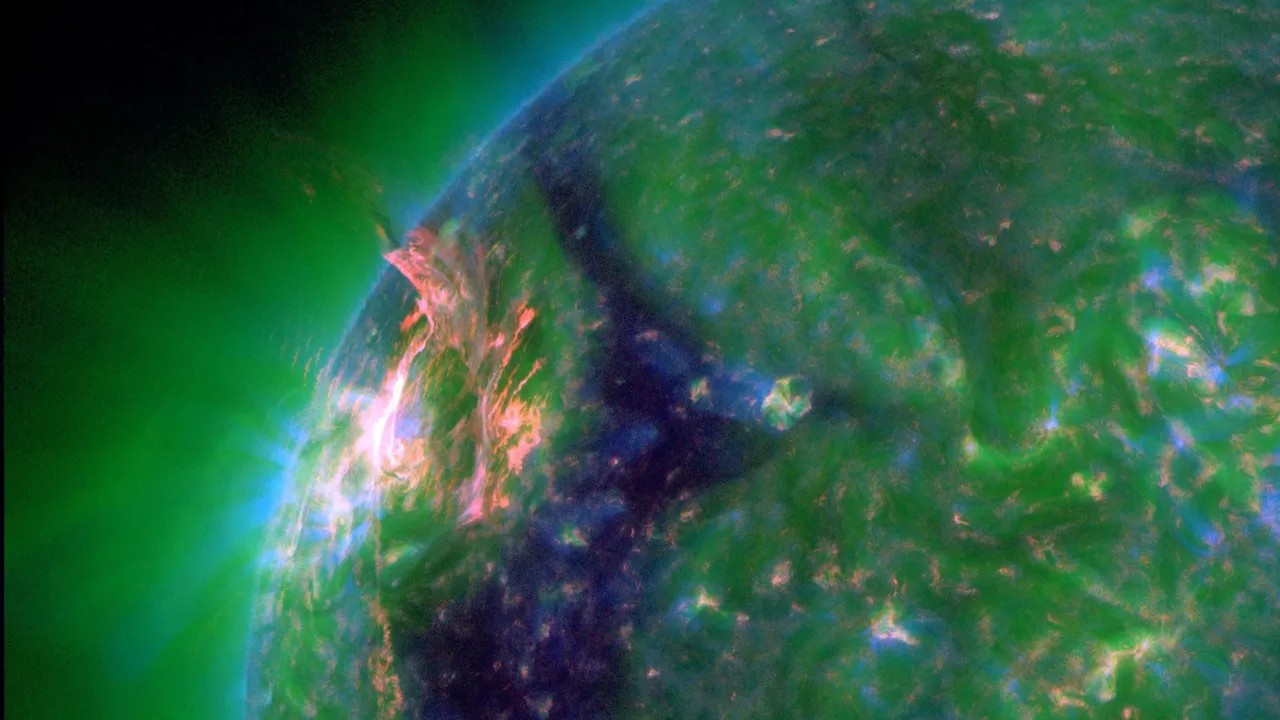
The main culprit behind the current space storm is a massive active region designated 4436. According to the Spaceweather website, it is a veritable generator of chaos: just last week, while on the far side of the Sun—invisible to us—this same sunspot generated at least five powerful coronal mass ejections. Since the Sun’s rotation continues to keep this sunspot facing Earth, astronomers do not rule out the possibility of new eruptions in the coming days, which could trigger more intense magnetic storms.
The Earth in the Crosshairs
Solar flares are sudden and incredibly intense bursts of electromagnetic radiation. M-class flares are the second most powerful category, following extreme X-class flares. Since this radiation (light, X-rays, and ultraviolet rays) travels at the speed of light, it reaches our planet in just eight minutes—effectively at the very moment astronomers detect it. Although Earth’s magnetic field and dense atmosphere reliably protect biological life from deadly cosmic radiation, high-energy photons bombard the ionosphere intensely.
This time, the excess energy instantly caused temporary but noticeable disruptions in high-frequency radio communications across the entire sunlit side of our planet, and could also have interfered with navigation satellites, as NASA had warned.
A plasma cloud is approaching
However, the electromagnetic burst is only the first act of this cosmic spectacle. The eruption was also accompanied by what is known as a coronal mass ejection (CME). Unlike the massless radiation of a solar flare, a coronal mass ejection (CME) is a massive cloud of superheated solar plasma and radiation (protons and electrons) that is ejected from the star and travels through interplanetary space at a much slower speed, taking several days to reach Earth.
“Computer simulations of the trajectory indicate that the main body of the plasma should pass well beyond Earth’s orbit,” according to an official statement from NOAA. “However, we cannot completely rule out a so-called secondary impact or the arrival of a shock wave late on the evening of May 12 or early on May 13.”
Geomagnetic storm: What Earth’s inhabitants can expect
If this plasma tail manages to “hook” our planet’s magnetic shield, the consequences will be immediate. Experts at the UK Met Office are forecasting a minor G1-level geomagnetic storm. Geomagnetic storms are classified on a five-point scale, with G5 being the most dangerous and extreme level, capable of causing power grid failures.
Although a G1-class storm is considered the weakest in the classification, it still has consequences. The Space Weather Prediction Center notes that such a storm is quite capable of causing minor fluctuations in power grids, slightly affecting satellite orbits, and disorienting certain migratory animals that rely on the magnetic field for navigation. Above all, the storm promises to treat observers to the northern lights, which may shift south of their usual latitudes and become visible, for example, in the northern parts of the U.S. states of Michigan and Maine.
The Active Spot 4436 Phenomenon
Such events have attracted particular attention from scientists, as they occur at a time when the star should be gradually calming down. In recent years, the Sun has been at the peak of its 11-year activity cycle—the so-called solar maximum. According to astrophysicists’ calculations, this peak likely ended in early 2025. In theory, global solar activity should decline steadily from that point on.
However, 5.7-magnitude solar flares are still occurring as large sunspots appear on the sun’s surface.
According to livescience.com

