

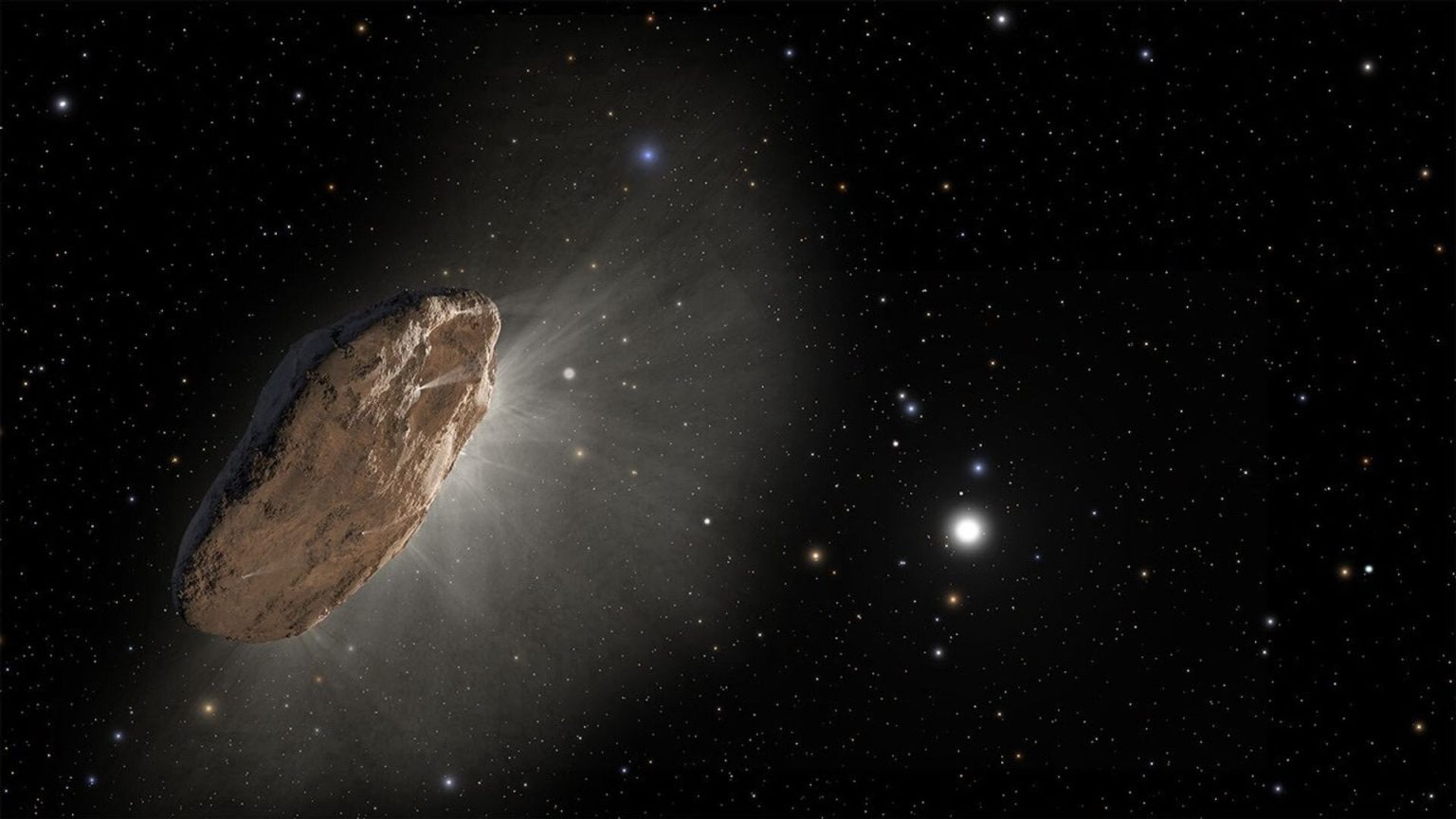
Are there extraterrestrial probes in our Solar System? In a new study, scientists explore this possibility and the prospects for detecting these probes using modern space technology.
Visitors from other worlds
Even at this early stage of the space age, humanity has already begun launching probes that will eventually reach other Solar Systems, although that was not their original purpose. Five robotic explorers—Pioneer 10 and Pioneer 11, Voyager 1 and Voyager 2, and New Horizons—are on trajectories that will take them beyond the Solar System and may one day enter another. By that time, they will no longer be operational, but they serve as proof of the concept that space civilizations really do create interstellar probes.
This raises an obvious question: Has anyone else sent robotic probes to our planet? In a recent article, astronomer T. Joseph W. Lazio points out the bitter truth—we still have no idea, and our technology will have to become much more advanced if we plan to find out.
Classification of probes
To analyze where we currently stand in terms of our ability to detect technosignatures, Dr. Lazio uses a four-quadrant matrix originally developed in a W.M. Keck Institute for Space Studies report. In this system, artifacts are classified based on their location and whether they are still operational.
Passive probes are inactive or inert objects that simply fly through the Solar System, likely along a hyperbolic trajectory. Active probes are operational spacecraft that use internal or solar energy to take measurements, transmit data, and maneuver. Passive surface artifacts are debris from collisions or remnants of equipment that lie silently on the surface of a moon or planet. Active surface artifacts are equipment that is still functioning on the surface of a planet or asteroid, such as a mining station or an automated monitoring station.
In his article, Lazio tests a single falsifiable hypothesis: that one or more physical extraterrestrial technosignatures are present in the Solar System today. Can humanity, given its current level of technology, disprove this hypothesis? Absolutely not.
Difficulty in detecting artificial objects
To be honest, we have a pretty good chance of finding a non-functional interstellar probe, if it’s still drifting through space. The problem is distinguishing the probe from a completely natural asteroid or comet. Every time a new interstellar visitor, such as 3I/ATLAS, arrives, many people—even reputable scientists—immediately conclude that it’s an alien spacecraft sent here to observe us. But just how difficult this can be is best illustrated by the case of object 2020 SO.
This object, discovered back in 2020, was moving in a strange orbit, although it was initially classified as an asteroid. Because it was so anomalous, scientists decided to study it more closely and discovered that the object’s spectrum in the near-infrared range exactly matched the characteristics of stainless steel and polyvinyl fluoride. In other words, 2020 SO turned out not to be a space rock, but a “Centaur” rocket booster from NASA’s 1966 “Surveyor 2” mission.
So, the challenge in searching for free-floating “passive” artifacts lies not so much in detecting them directly as in proving that they are not simply one of the millions of other passive rocks floating in the Solar System. But what about artifacts on planets? After all, we’ve managed to find parachutes and even rover tracks left behind by our landers. We should be able to find an extraterrestrial artifact using similar methods, shouldn’t we?
The ability to detect probes on the surfaces of other planets
Perhaps the problem is that we haven’t yet examined every corner of the Solar System as thoroughly as we did when searching for those specific technological artifacts. In fact, most of the Solar System is explored at an average resolution that won’t allow us to detect anything other than artifacts that are many times larger than anything humanity has created to date. On Saturn’s moons, for example, our resolution is only about 1 kilometer per pixel. Even on the Moon, where we have a resolution of 0.5 meters per pixel, only a small portion of the lunar surface has been studied in such detail.
Even if we had that level of resolution, detecting it would mean that the artifact itself remained intact. Obviously, if something crashed into Jupiter , it is likely lost forever. But even on the relatively favorable surface of Mars, micrometeorite impacts, solar radiation, and dust storms can erode a passive surface artifact over the course of several million years—which is just a blink of an eye in the history of the Solar System.
Searching for probes by technical signatures and promising projects
Active probes, on the other hand, should—at least in theory—be easier to detect. One of the key approaches is that they must obey the laws of thermodynamics—or, at least, that is what we assume. This means they must dissipate the waste heat generated by their activity, and therefore they will appear “hot” compared to what we would expect from a passive system. That is, such probes must produce excess infrared radiation. For example, among the data obtained by the infrared telescope WISE there are objects with unusual thermal characteristics, although at present all of them have natural explanations or require further research. Modeling the temperatures of space rocks involves numerous challenges, so it is impossible to reach a definitive conclusion, and we lack the resources to observe each of these anomalous objects closely enough to truly determine what they are.
However, WISE is not the only survey that will map these small objects. The Vera C. Rubin Legacy Survey of Space and Time, SPHEREx, and the Near-Earth Object Surveyor mission are proceeding as planned and should provide unprecedentedly large arrays of observational data. Analysis of these treasure troves of data could lead to the discovery of objects with significant anomalies that warrant further investigation.
However, until we send an actual probe to one of them, we probably won’t be able to say with certainty whether it is a natural object or not. But perhaps the time has finally come for the Search for Extraterrestrial Artifacts (SETA) project to prove itself—or, depending on the circumstances, to conduct observations.
According to phys.org

