
For the first time in the history of astronomy, scientists have discovered the fundamental building blocks of life locked in cosmic ice beyond our galaxy, the Milky Way. This revolutionary discovery, made using the James Webb Space Telescope (JWST), suggests that the key ingredients for life may be quite common throughout the Universe. The discovery was made around a newborn star in a neighboring galaxy, the Large Magellanic Cloud.
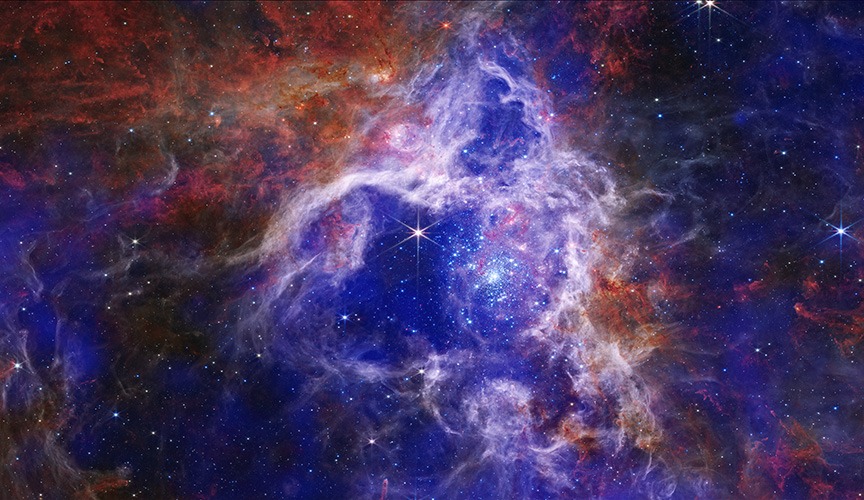
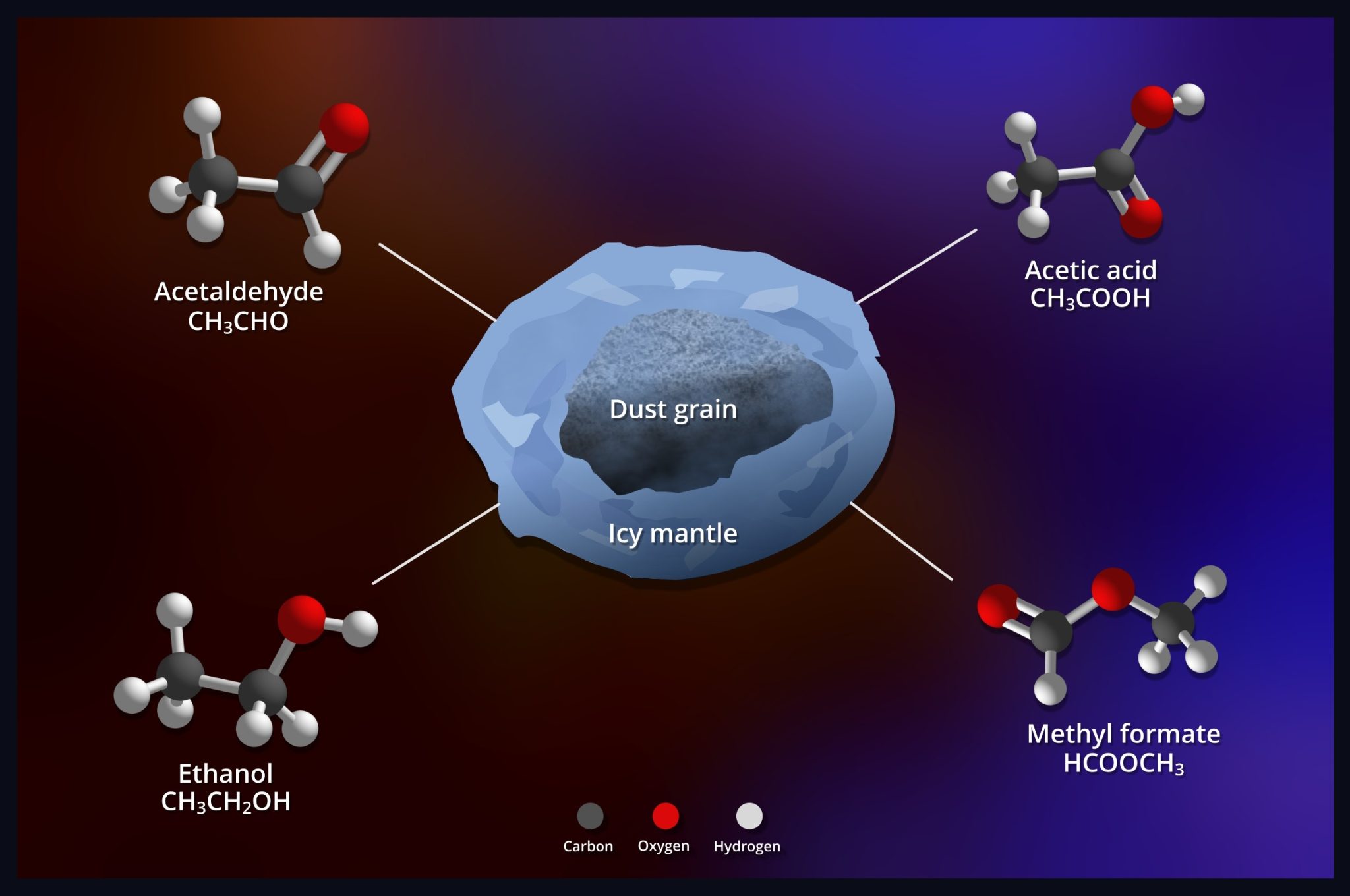
In the icy grains orbiting the young star ST11, a research team led by astrophysicist Marta Sewilo (NASA) has identified a whole “cocktail” of complex organic molecules. These include ethanol, acetaldehyde, and methyl formate. These compounds have never before been observed in the form of ice outside our galaxy. A separate breakthrough was the discovery of acetic acid, which had not previously been found in space in a frozen state.
These molecules are considered to be the chemical precursors of more complex structures that form life: amino acids, sugars, and nucleosides. Their discovery sheds light on where and how prebiotic compounds formed even before the birth of our planet.
How did the discovery happen?
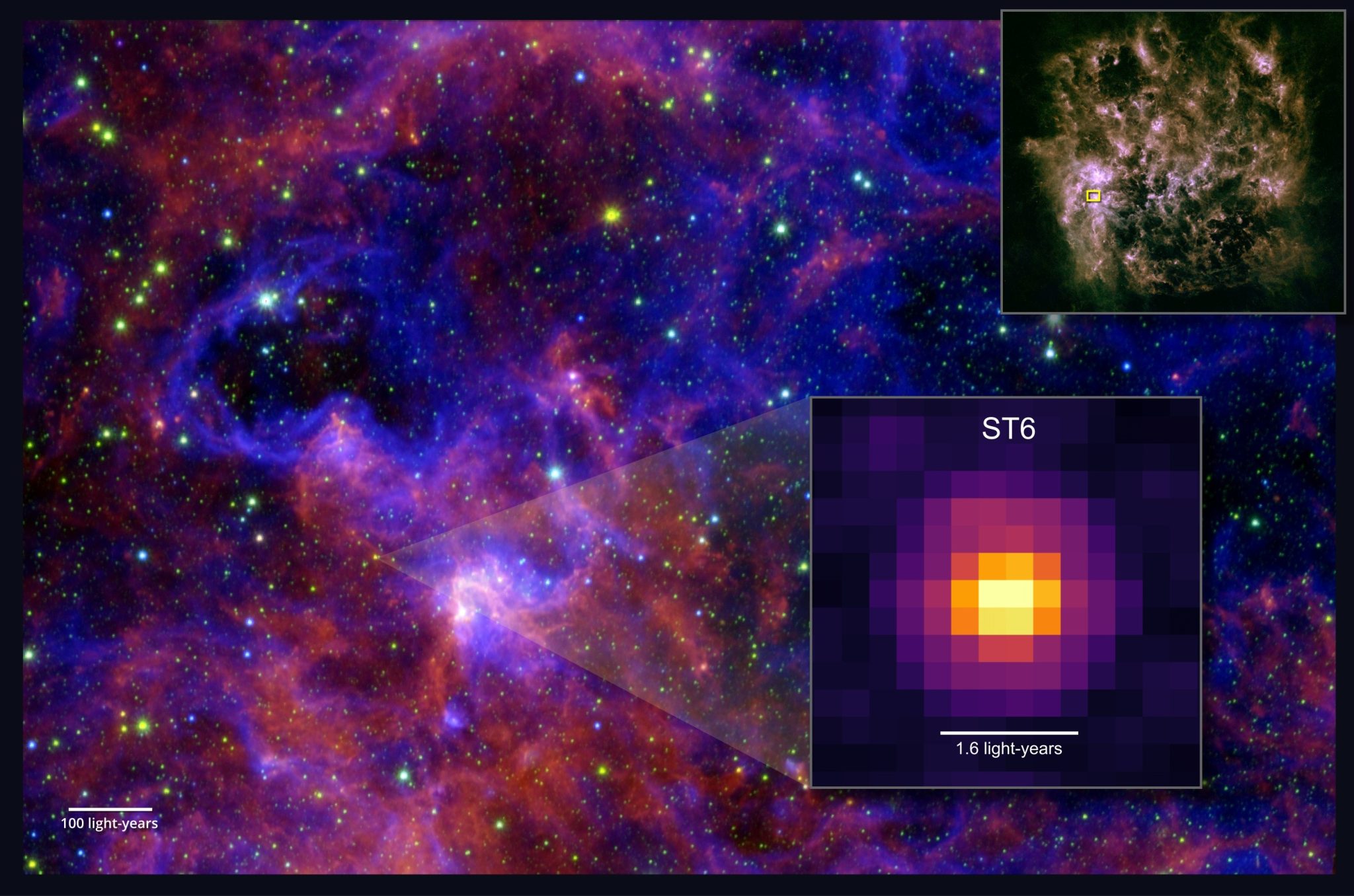
The team pointed James Webb’s powerful instruments at the star ST11, located 160,000 light-years away in the N158 nebula. The telescope analyzed the infrared light absorbed by ice particles around the star. Each molecule has a unique “spectral fingerprint” — it absorbs light at specific wavelengths. By comparing the spectra obtained with a database, scientists were able to confidently identify the “signatures” of organic compounds.
The Large Magellanic Cloud is an environment that is radically different from the Milky Way. It contains significantly fewer heavy elements, such as oxygen or carbon, and dust, but it is exposed to intense ultraviolet radiation. Such conditions were considered less favorable for the formation of complex chemistry.
However, the discovery proves that even in such “extreme” conditions, key prebiotic molecules are successfully formed. It is believed that this occurs on the surface of ice dust particles, where atoms and molecules react under the influence of radiation, creating more complex organic compounds.
The study opens a new chapter in astrochemistry. “We have taken a big step forward in understanding how complex chemistry arises in the Universe,” says Marta Sewilo. The next step will be to search for similar molecules in other young stars in the Large Magellanic Cloud to determine whether the “chemical factory” found is a universal phenomenon or just a local one.
Earlier, we reported on how aliens cannot find us due to technological backwardness.
According to umd.edu

