

Our star has demonstrated an impressive display of cosmic sympathy. A giant coronal hole, shaped like a heart, has formed in the Sun’s atmosphere. This object, hundreds of times larger than Earth, was recently located directly opposite our planet, directing a powerful stream of solar wind toward it.
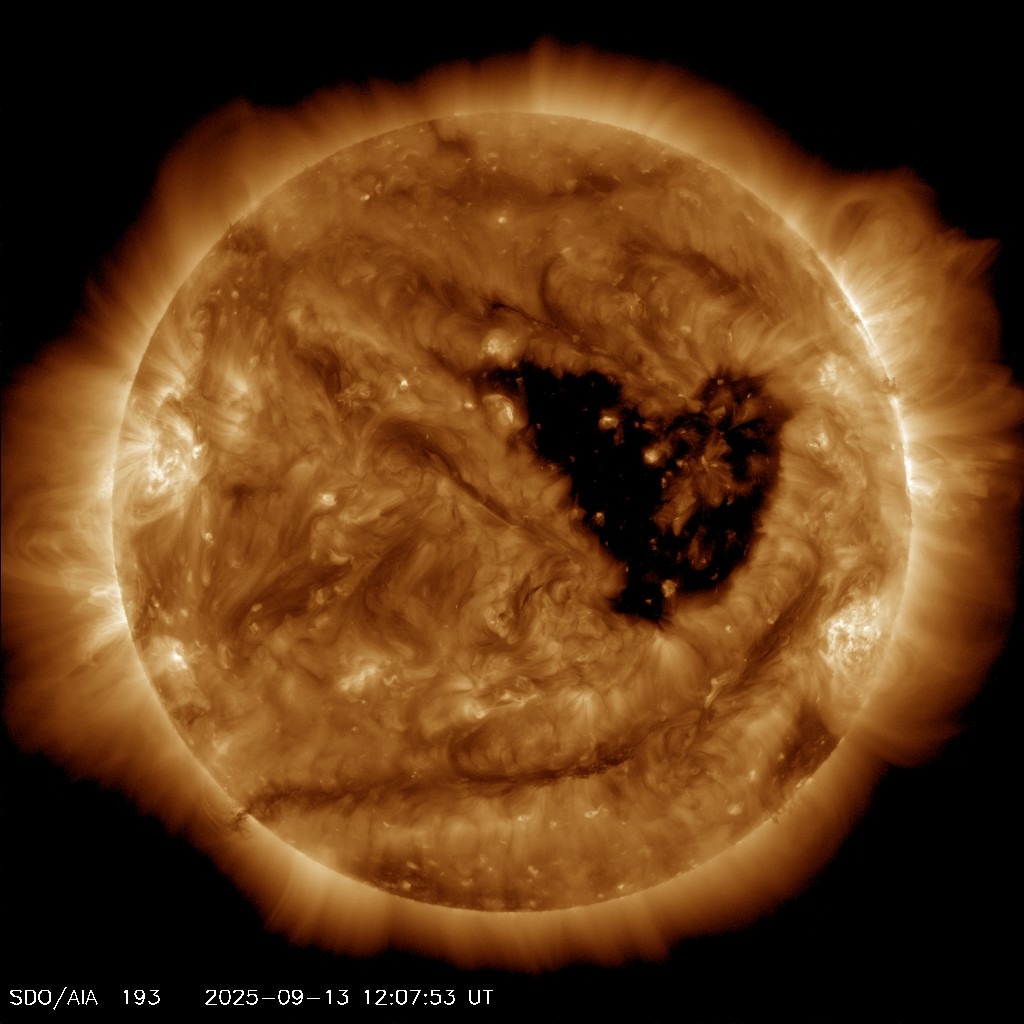
It is important to understand that coronal holes are not actual “breaks” in the Sun. These are areas where the star’s magnetic field is significantly weaker. This allows the solar wind – a constant stream of charged particles – to escape much more easily and at a higher speed, creating a kind of “gust” in space.
It is impossible to see this phenomenon visually. However, in the ultraviolet and X-ray spectrum, they appear as dark spots because the plasma in these areas is cooler and less dense than in the surrounding areas of the solar corona.
The path to the aurora borealis
When a powerful stream of particles from such a hole reaches Earth, it interacts with its magnetosphere. The particles accelerate along magnetic lines and penetrate the upper layers of the atmosphere near the poles. It is their collision with gas molecules that causes one of the most enchanting phenomena – the aurora borealis.
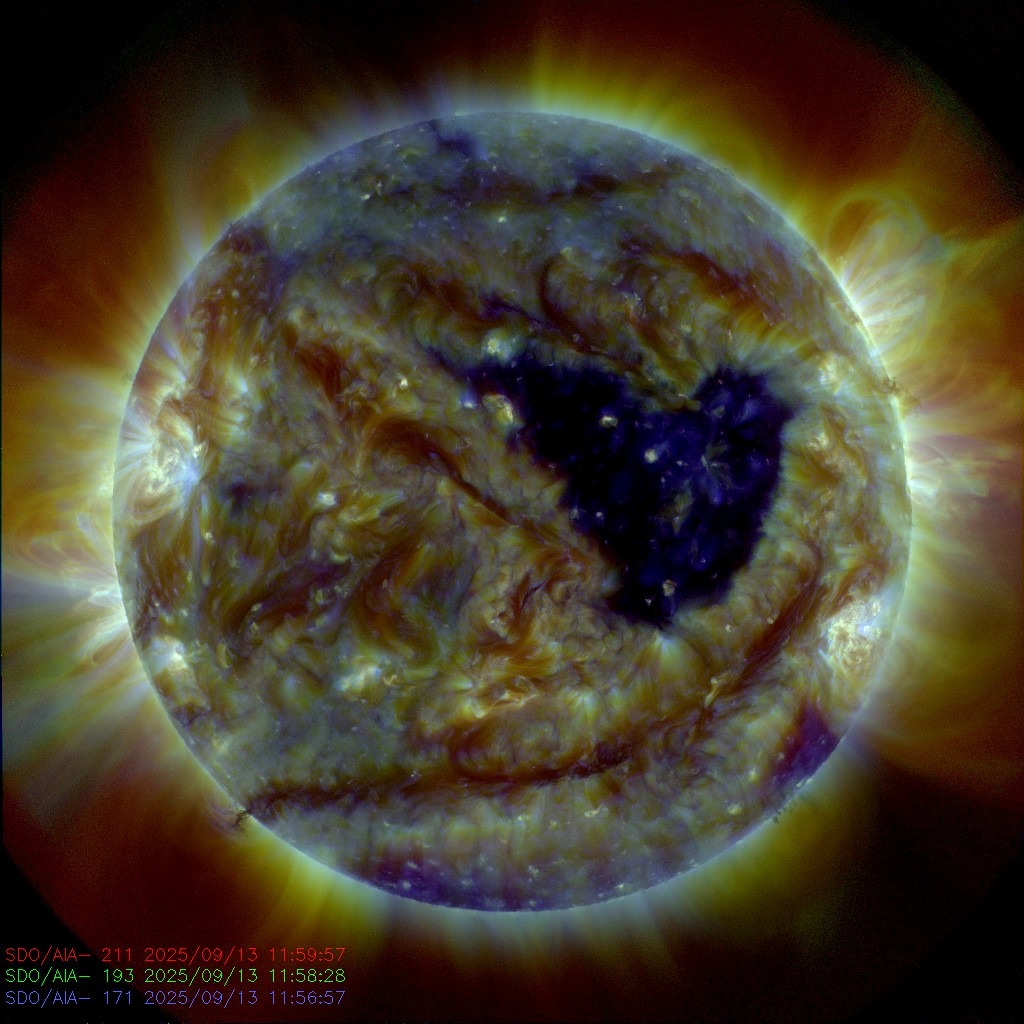
Although the brightest flares are caused by powerful coronal mass ejections, winds from coronal holes are also significant. It was this “heart-shaped” hole that caused a strong geomagnetic storm in September, which gave observers in high latitudes an unforgettable spectacle.
The future of solar activity
The Sun is now gradually emerging from the peak of its 11-year cycle of activity, known as the solar maximum. This means that the overall number of events, such as flares and ejections, will decrease. However, coronal holes remain a key aspect of our star’s behavior.
According to data from NASA’s Jet Propulsion Laboratory, there has been a gradual increase in solar wind strength since 2008. This allows scientists to assume that the approach to the 26th solar cycle may be accompanied by more such phenomena than previously expected. This promises us even more spectacular space “postcards” in the future.
We previously reported on how solar flares help solve a half-century-old scientific mystery.
Provided by: Science Alert

