

Many hot mini-Neptunes, which were previously thought to be covered by oceans of magma, have solid surfaces. This is the conclusion reached by a team of American researchers.
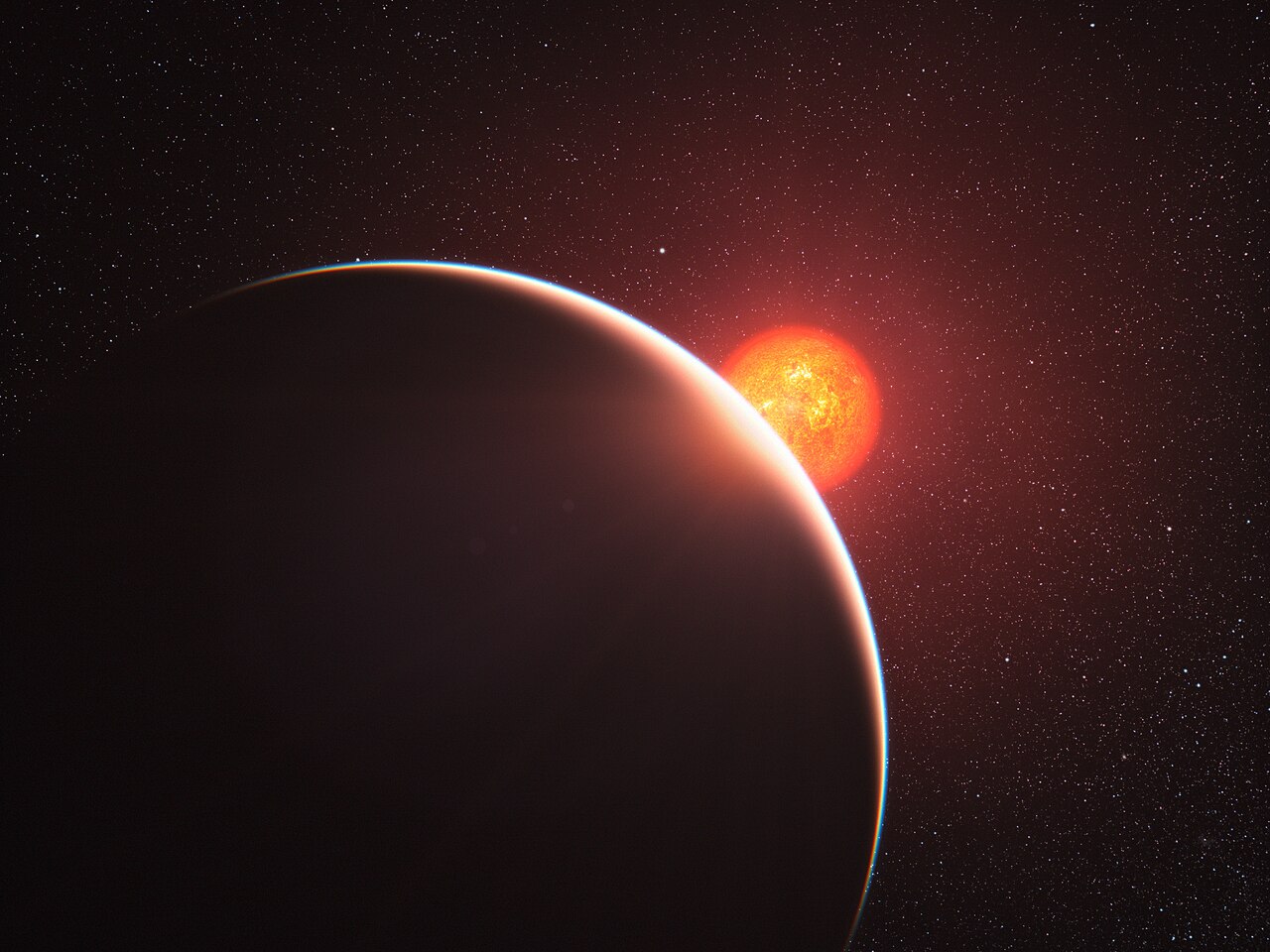
Mini-Neptunes are exoplanets with dense atmospheres that occupy an intermediate position between rocky bodies such as Earth and gas giants such as Neptune. There are no such objects in the Solar System, but they are extremely common in other star systems.
Previously, it was believed that many hot mini-Neptunes, whose orbits pass at a short distance from the star, were entirely covered by oceans of magma. However, the results of a new study suggest that in reality they may have a solid surface.
Scientists came to this conclusion while studying an exoplanet called GJ 1214 b. It orbits a red dwarf located 40 light-years from Earth. Data collected by the James Webb Space Telescope suggests that its atmosphere may contain larger molecules than just hydrogen and helium. This means that it will be heavier than previously thought — much heavier than Earth’s thin atmosphere.
The heavy atmosphere will create conditions of extremely high temperature and high pressure on the surface. In fact, the pressure there will be so high that molten magma will turn back into solid rock — similar to how carbon condenses into diamonds deep beneath the Earth’s surface.
After that, the research team wondered what this meant for other exoplanets. By simulating a series of exoplanets with different conditions, they discovered that a significant portion of hot mini-Neptunes, previously thought to be lava worlds, may actually have solid surfaces.
This discovery is important for understanding the nature of mini-Neptunes. Astronomers want to understand how such bodies form and what they look like in order to gain a more complete picture of how planets form in general. Among other things, this could help in the search for life in the Universe.
Earlier, we reported on a mini-Neptune that surprised scientists with its “poor” atmosphere.
According to Phys.org

