

A new study supported by NASA has assessed the resource potential of Titan, Saturn’s largest moon, and concluded that this world surpasses the Moon and Mars in terms of its potential for human exploration. The authors of the study believe that Titan could serve as a base for spacecraft to make stopovers on their way to distant corners of the Solar System.
What’s on Titan?
A research team led by astronomer and planetary scientist Conor Nixon of NASA’s Goddard Space Flight Center has compiled a detailed inventory of Titan’s resources. A preprint of their scientific paper is already available online and is awaiting peer review for publication in the journal Acta Astronautica.
Titan is the only moon in the Solar System with a dense nitrogen atmosphere. The methane cycle on its surface resembles Earth’s hydrological cycle, where solid and liquid substances evaporate, form clouds, and return to the surface as precipitation. This makes Titan a unique object for studying prebiotic chemistry—that is, the early chemical processes that precede the emergence of life.
Hydrocarbons and water
Titan’s atmosphere contains up to five percent methane. Methane, ethane, propane, and other organic compounds have been found on the surface and in Titan’s atmosphere. They can be used to produce plastic, synthetic rubber, fertilizer components, solvents, and pharmaceutical raw materials.
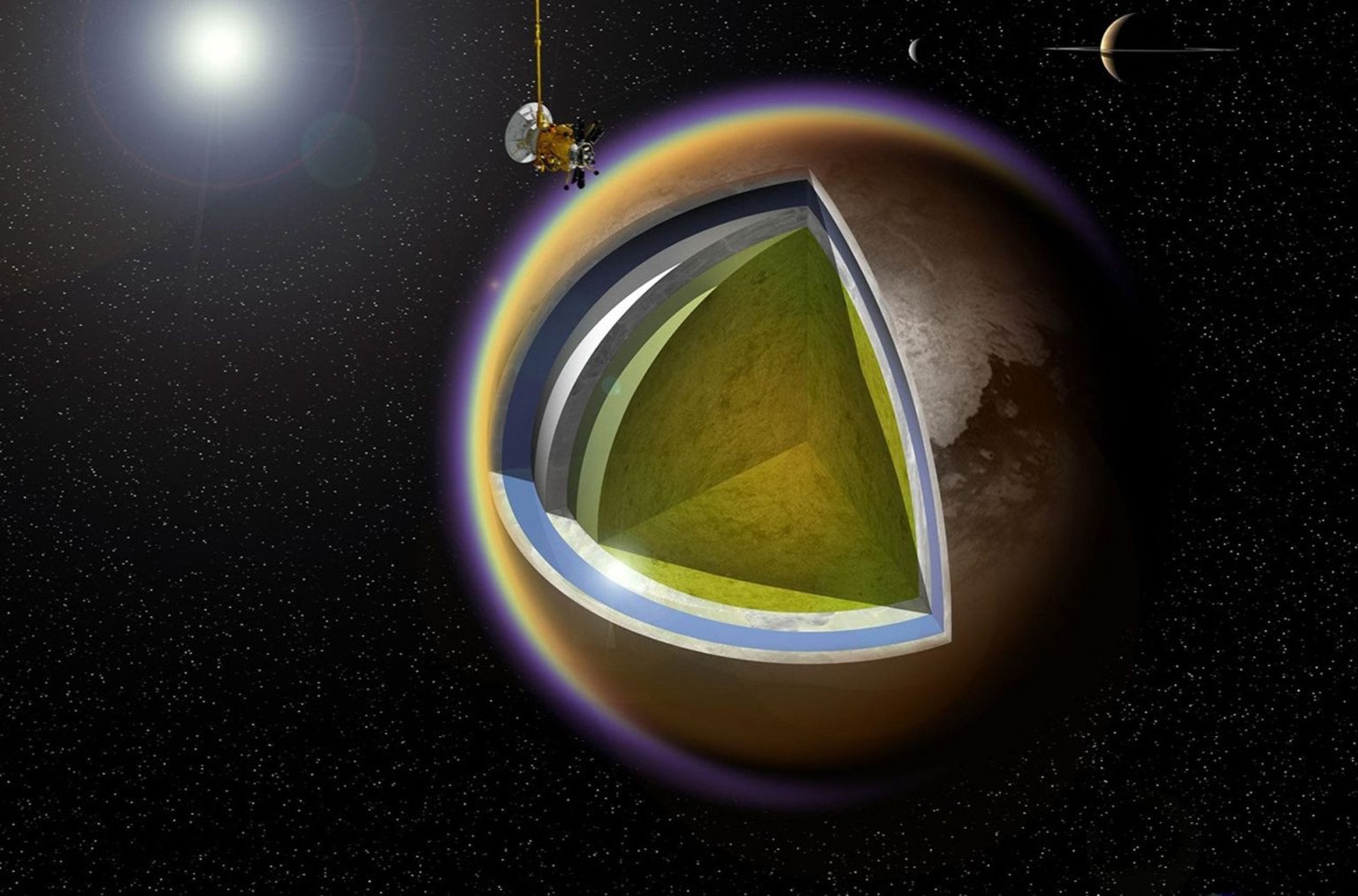
A significant part of Titan’s internal structure is water ice. There is probably a liquid ocean beneath the surface, where ammonia and high salinity prevent the water from freezing. This water can be used to produce drinking water, oxygen, and hydrogen for rocket fuel. On the surface of the satellite are lakes and seas of liquid methane and ethane.
A base on the outer edge of the Solar System
Conor Nixon and his colleagues examined a broader range of scenarios compared to previous studies, which focused exclusively on fuel production for sample-return missions to Earth. The new approach involves using Titan as a waystation for spacecraft heading further out into the outer Solar System, specifically to Uranus, Neptune, or other moons of Saturn.
On Titan, spacecraft could be resupplied with both fuel and raw materials for 3D printing, textiles, and probably food ingredients. Saturn’s moons Enceladus and Mimas also possess significant resources and could become targets for exploration from a base on Titan.
Prospects for development
After comparing Titan with the Moon, Mars, and several near-Earth asteroids, the study’s authors concluded that none of the objects examined can match this moon in terms of its total resources. Flights to Titan require a nuclear engine due to the great distance, so the exploration of this world remains a matter for the distant future.
Saturn’s atmosphere also contains significant reserves of the rare isotope helium-3, which is considered a potential fuel for fusion reactors. If humanity ever builds infrastructure in the Saturn system, this region could become the primary resource hub for the entire Solar System.
According to universetoday.com

