

On April 2, 2026, as NASA astronaut Reid Wiseman pointed his camera lens at our planet, the Orion spacecraft carrying the Artemis II mission crew was en route to the Moon. At first glance, the image he captured seems like a perfectly ordinary view of the familiar “Blue Marble.” However, if you look closely at the details, it turns out to be one of the most unique and moving images in the entire history of the mission.
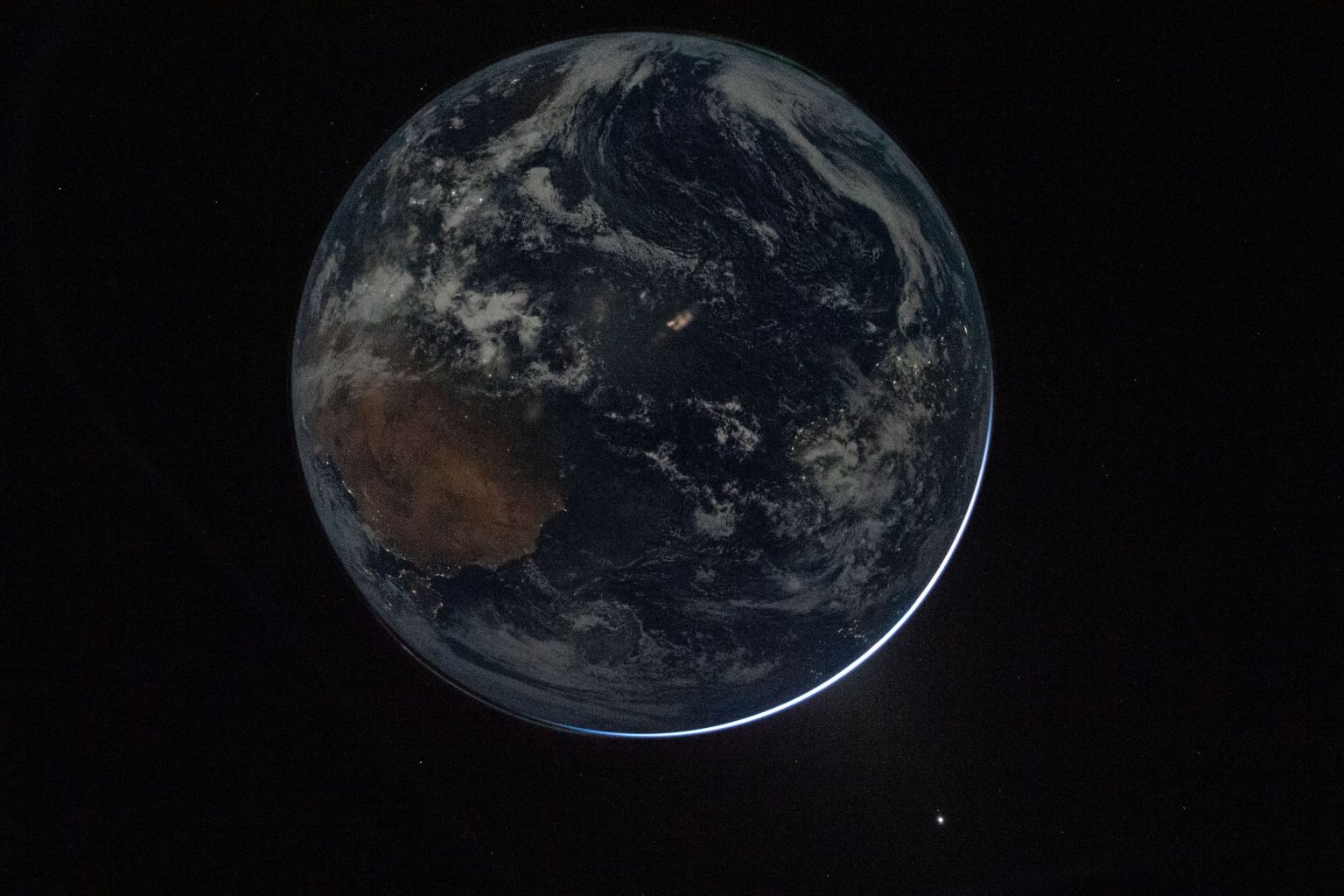
At the moment the photo was taken, the astronaut and his crew were above the night side of Earth. Despite this, the planet in the photograph appears to be illuminated by the Sun. The secret lies in the fact that Earth was in the bright glow of the Pink Full Moon, which occurred on April 1—exactly one day before the Artemis II mission launched from the Kennedy Space Center in Florida.
Wiseman managed to capture this extremely faint sunlight, reflected from the Moon’s surface back to Earth, by using a Nikon D5 camera set to its maximum sensitivity. A comparison of this image with archival photos from the Gateway to Astronaut Photography of Earth website reveals a striking difference between what the camera captured and what the naked human eye could perceive.
Cities at night and the double aurora
Since the Moon served as the main source of light, the nighttime features of our planet were revealed in extraordinary detail. From the vantage point of a spacecraft flying over the central part of the Atlantic Ocean, the lights of cities in Spain, Portugal, Brazil, and various African countries are clearly visible.
However, the artificial lights of major cities aren’t the only thing shining in this photo. Since the global panorama spans both the North and South Poles, Wiseman was able to capture an extremely rare phenomenon: the simultaneous glow of the aurora at opposite ends of the Earth. Two green bands are clearly visible in the upper right and lower left segments of the planet. These are the northern and southern lights, which occur when charged particles from the solar wind collide with molecules in Earth’s atmosphere along magnetic field lines.
Cosmic dust and the glow of Venus
At the lower right edge of the planet, you can also make out a ray of sunlight piercing through the Earth’s atmosphere. In another identical image, but taken with a shorter exposure time, this illuminated part of the atmosphere appears as nothing more than a thin blue crescent.
Just beyond this atmospheric crescent, a faint, bright patch is visible. This is zodiacal light—a faint glow caused by the scattering of sunlight by clusters of interplanetary dust. On Earth, this phenomenon is sometimes observed in very dark places near the horizon during twilight (usually around the equinox) and is called false dawn or false twilight. And a little further beyond this bright spot, in the lower right corner of the photo, the planet Venus shines majestically.
Family portrait
Thanks to the striking combination of elements—Earth in the foreground, the aurora, sunlight refracted by the atmosphere, interstellar dust, and Venus—this image resembles a true family portrait of the inner Solar System.
In a single frame, Reid Wiseman managed to transform the “Blue Marble” we are all familiar with into something far more magnificent: a living, sun-drenched planet bathed in moonlight, seen in its true cosmic setting.
We previously reported on how images from the Artemis II mission revealed a major orbital crisis.
According to Live Science

