

“From the pages of Jules Verne to a modern-day mission to the moon, a new chapter of our exploration of our celestial neighbor is complete,” said Rob Navias of NASA, commenting on the historic moment when the Orion spacecraft of the Artemis II mission successfully splashed down in the Pacific Ocean in April of this year.
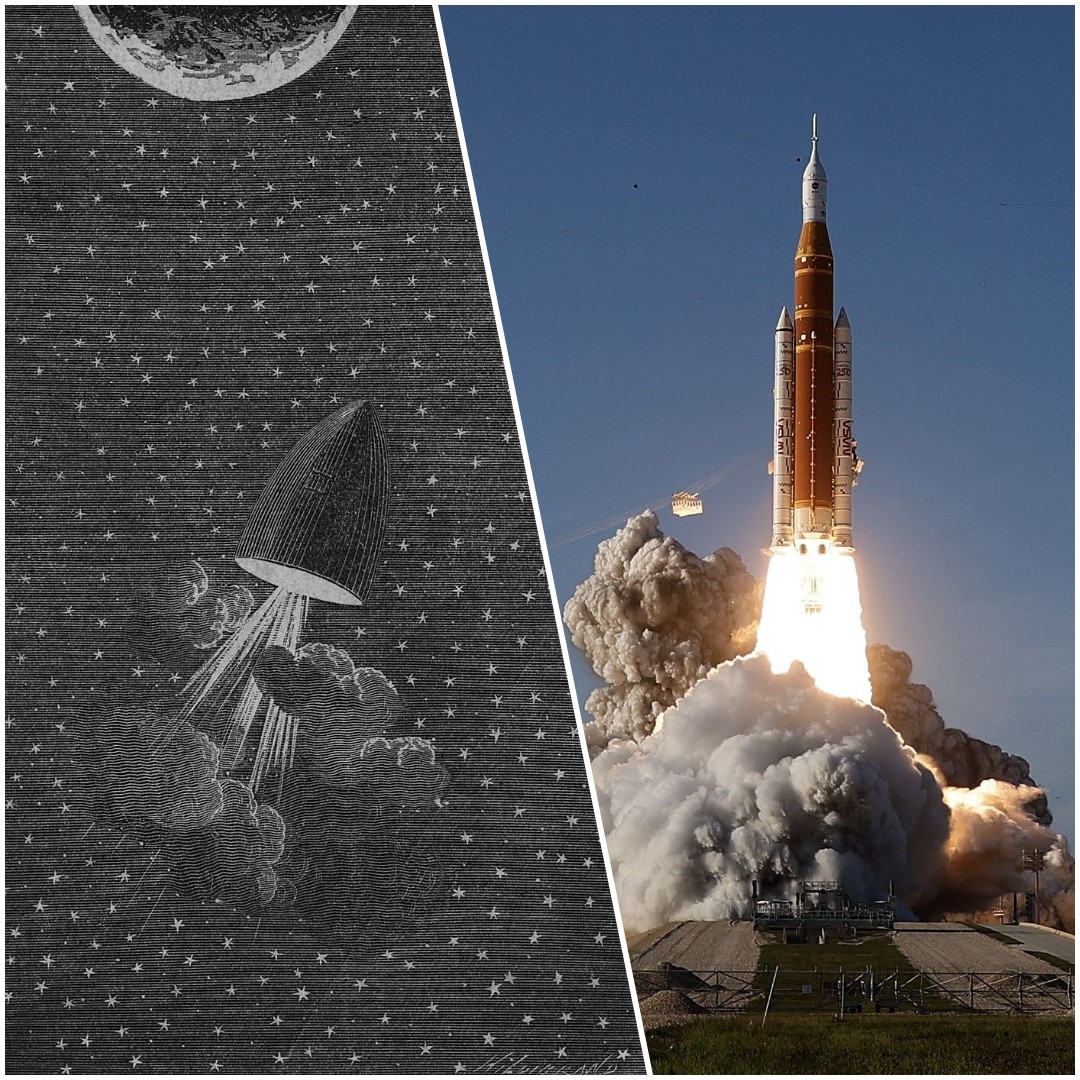
Indeed, the similarities between modern lunar missions and the journey described by the French science fiction writer back in the mid-19th century are simply striking.
Father of the scientific approach in science fiction
At a time when most 19th-century science fiction writers sent their heroes to other planets in hot-air balloons, Jules Verne relied on rigorous calculations. He worked with concepts such as escape velocity, orbital maneuvers, and course corrections. Of course, the writer made mistakes that seem amusing today. However, many of his ideas turned out to be surprisingly prophetic for real space exploration, the dawn of which was still more than a century away.
In his fourth novel, From the Earth to the Moon (1865), Verne tells the story of how members of the Baltimore Rifle Club, following the end of the American Civil War, decide to find a new use for their ballistic talents. The club’s president, Impey Barbicane, proposes an ambitious idea: to fire a projectile straight to the Moon from a giant 274-meter cannon called the Columbiad.
Prophecies and the first physical paradoxes
Verne was obsessed with facts and figures. He provided a surprisingly precise rationale for the choice of launch site for the Columbiad. According to his logic, the launch had to take place as close to the equator as possible in order to take advantage of the additional acceleration provided by the Earth’s rotation. Many decades later, NASA engineers reached the same conclusion. The author set his fictional spaceport in Florida—not far from the real Cape Canaveral, from where rockets launch today.
Frenchman Michael Ardan volunteered to pilot the hollow projectile, and was later joined by Barbican and Captain Nicholl. And this is where the novel’s first serious flaw lies. A modern rocket accelerates gradually, allowing the crew to withstand the G-forces. In contrast, a cannon shot would have accelerated the capsule almost instantly, which would inevitably have crushed the crew inside the projectile.
Naive Physics
However, according to the story, the launch is successful. The sequel, Around the Moon (1869), recounts that the projectile missed its target and entered a free-return trajectory, circling the far side of our natural satellite.
Some details of the travelers’ daily life are charmingly naive. Vern equipped the capsule with chemical apparatus for producing oxygen, yet the characters had no qualms about briefly opening the windows in open space. The interior itself resembled a luxurious, spacious Victorian study, where the crew enjoyed exquisite meals with wine. This stands in stark contrast to the freeze-dried rations that Reid Wiseman and his crew ate aboard Orion during the Artemis II mission.
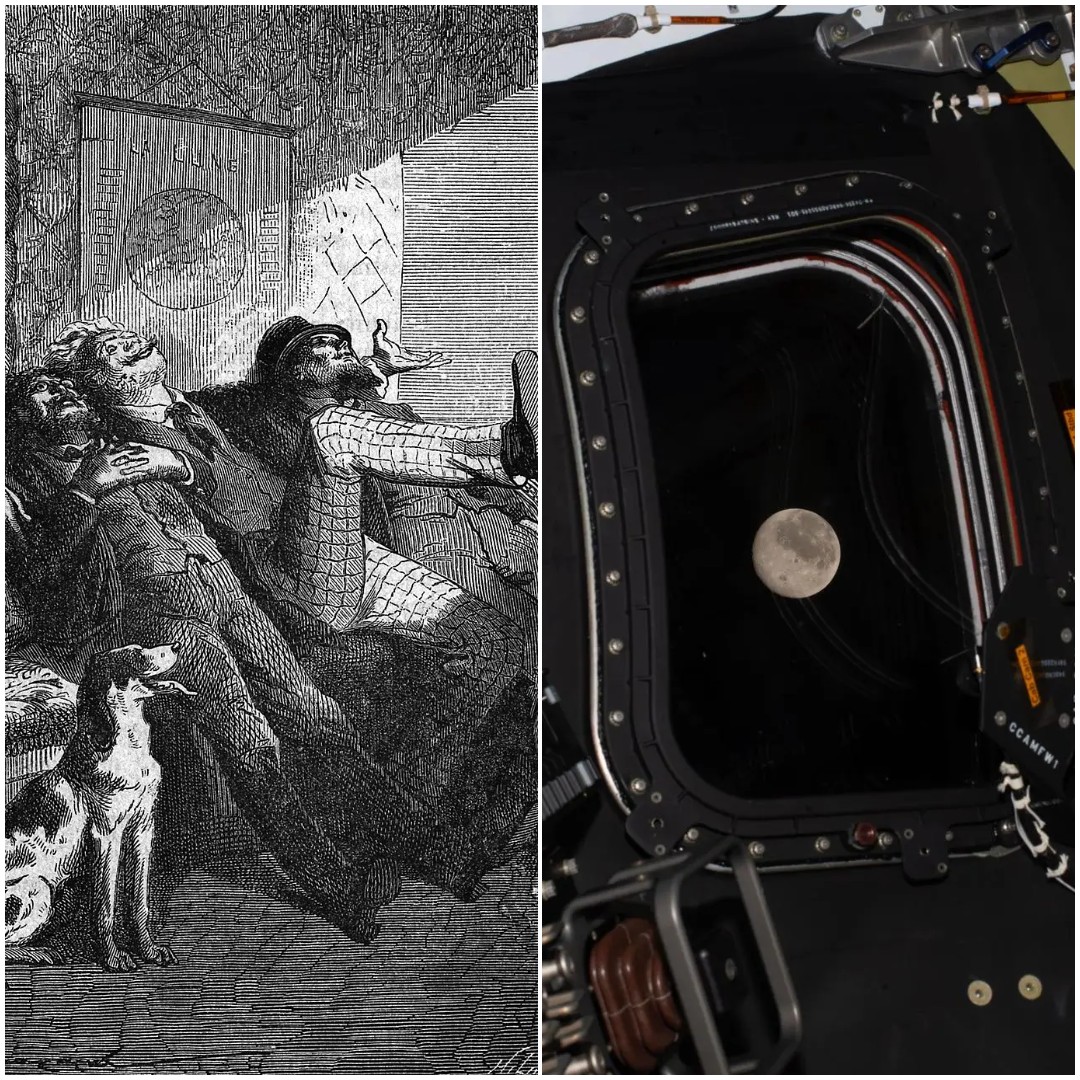
Jules Verne correctly assumed that gravity acts far beyond the Earth, but mistakenly believed that there was a point between the Earth and the Moon where it completely disappears. In his view, weightlessness occurred only at a single “neutral point”—where the gravitational forces of the Earth and the Moon were perfectly balanced. Nevertheless, the very fact that he attempted to describe the state of weightlessness in an era when people had no such experience is truly remarkable.
Flashlights in the darkness of the moon
During the flight, Verne’s characters gaze intently at the Moon, drawing on real astronomical data that the author gathered in Parisian libraries. When the capsule passes over the Moon’s dark side, the crew notices mysterious flashes of light in the distance. In accordance with the science of his time, Verne explained them as volcanic eruptions.
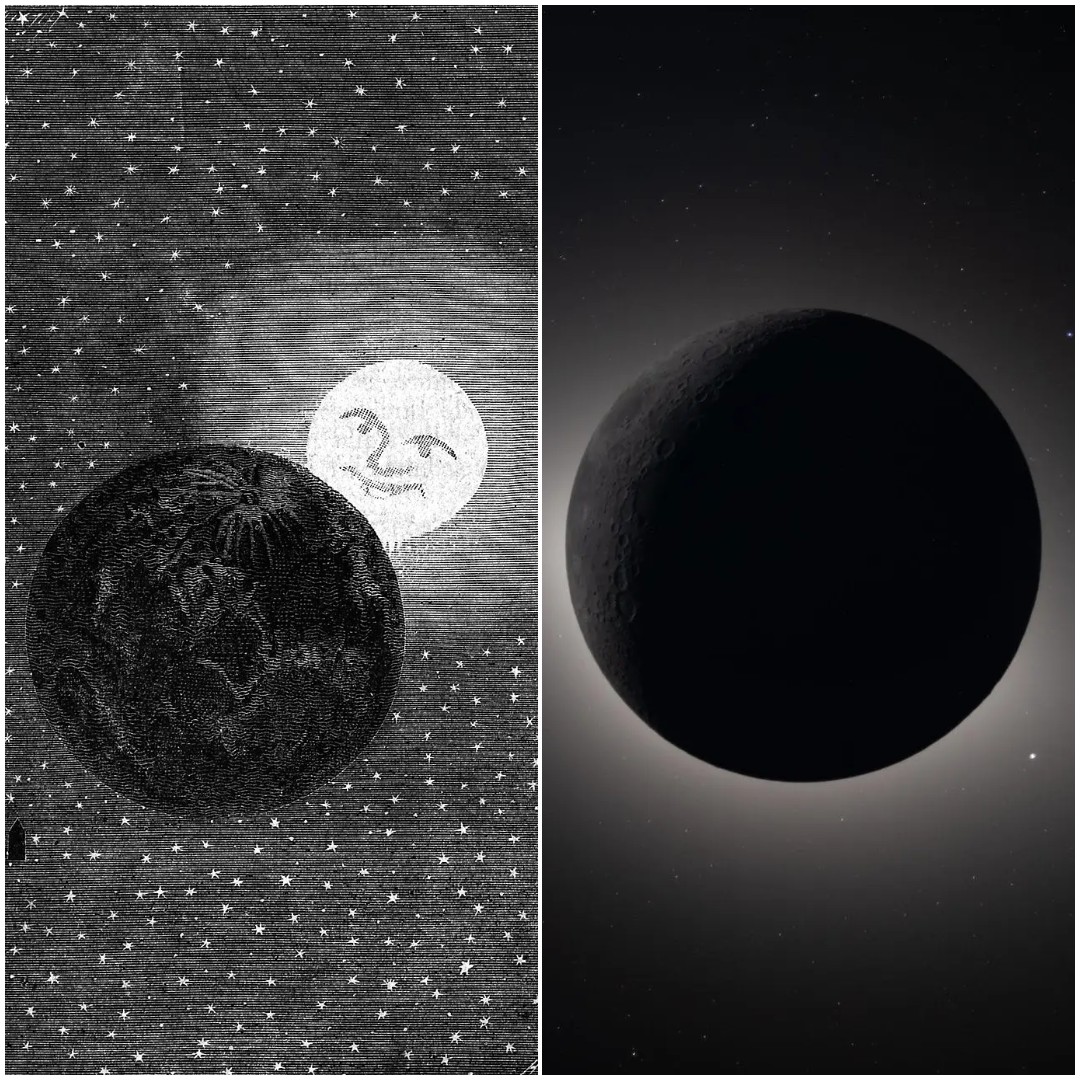
Interestingly, the Artemis II astronauts also saw a similar flickering, but it was caused by meteorites striking the far side of the Moon. When the crew reported this to Earth, the team literally jumped for joy. By an amazing coincidence, a few pages later, the book capsule also collides with a meteorite, which explodes, scattering into thousands of fragments.
Triumphant landing
To avoid being stranded in orbit forever, the fictional crew uses rockets to correct their course. Eventually, the spacecraft successfully re-enters Earth’s atmosphere. Barbicane, Nicholl, and Ardan splash down in the Pacific Ocean. Although their capsule had no parachutes, the heroes miraculously survive the horrific impact with the water, and, like the crews of the real Apollo and Artemis programs, they are rescued by U.S. Navy ships. In the finale, the trio embarks on a triumphant tour of America.
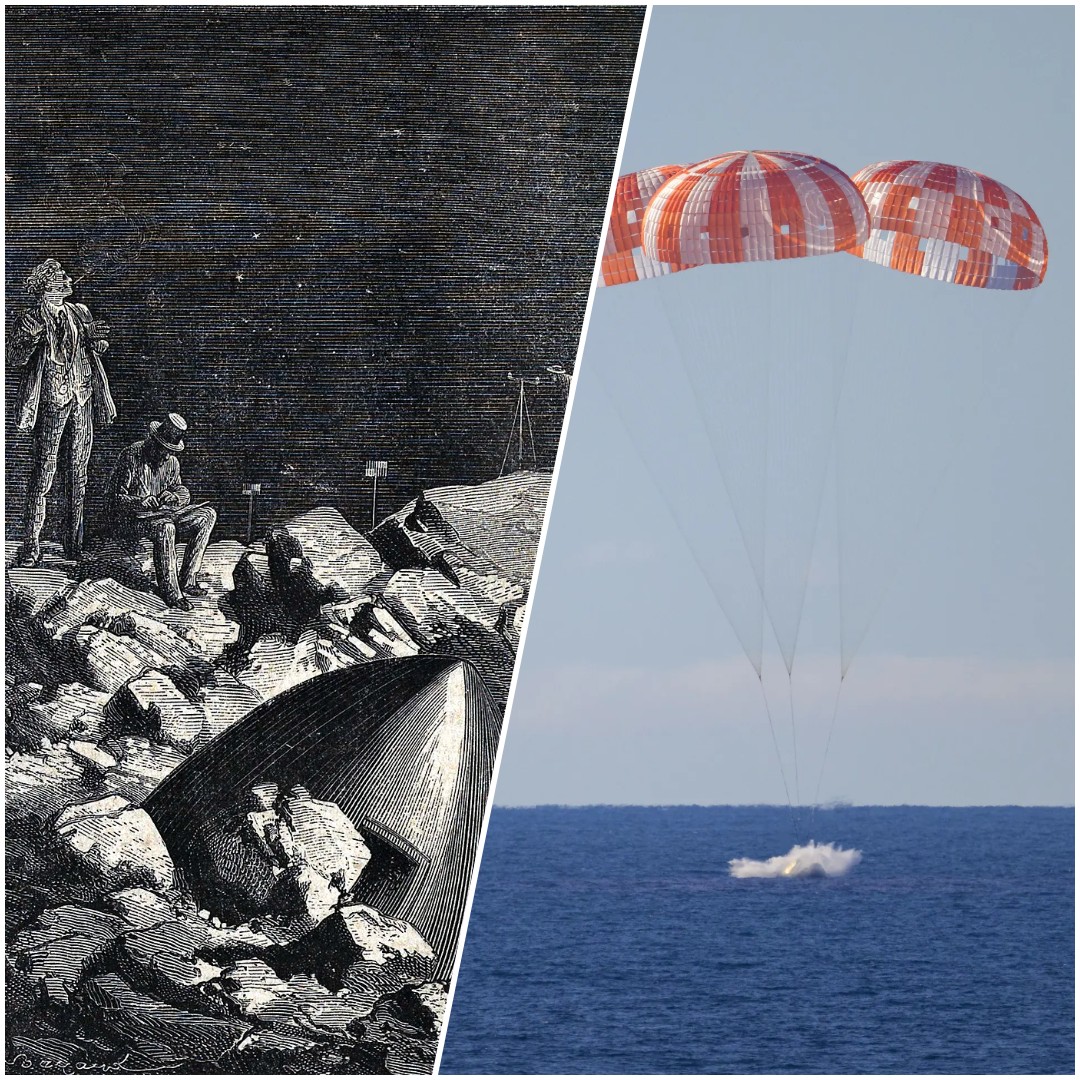
“A hundred years ago, Jules Verne wrote a book about a voyage to the moon. His spaceship, Columbia [sic], took off from Florida and landed in the Pacific Ocean after completing a trip to the moon,” said Neil Armstrong during the Apollo 11 mission’s return home in 1969.
And today, 160 years after its publication, Jules Verne’s fantastical space voyages continue to resonate in humanity’s real-life missions to the stars.
Earlier, we looked at the most common mistakes found in works of science fiction.
According to Space

