

Astronomers continue to be fascinated by the mysterious object 3I/ATLAS, which arrived in our solar system from interstellar space. Scientists from around the world are studying it intently with powerful telescopes, trying to unravel its origin and unusual composition. Although the vast majority of researchers are inclined to believe that it is still a comet, the discovery has sparked scientific imagination and provoked a series of bold hypotheses.
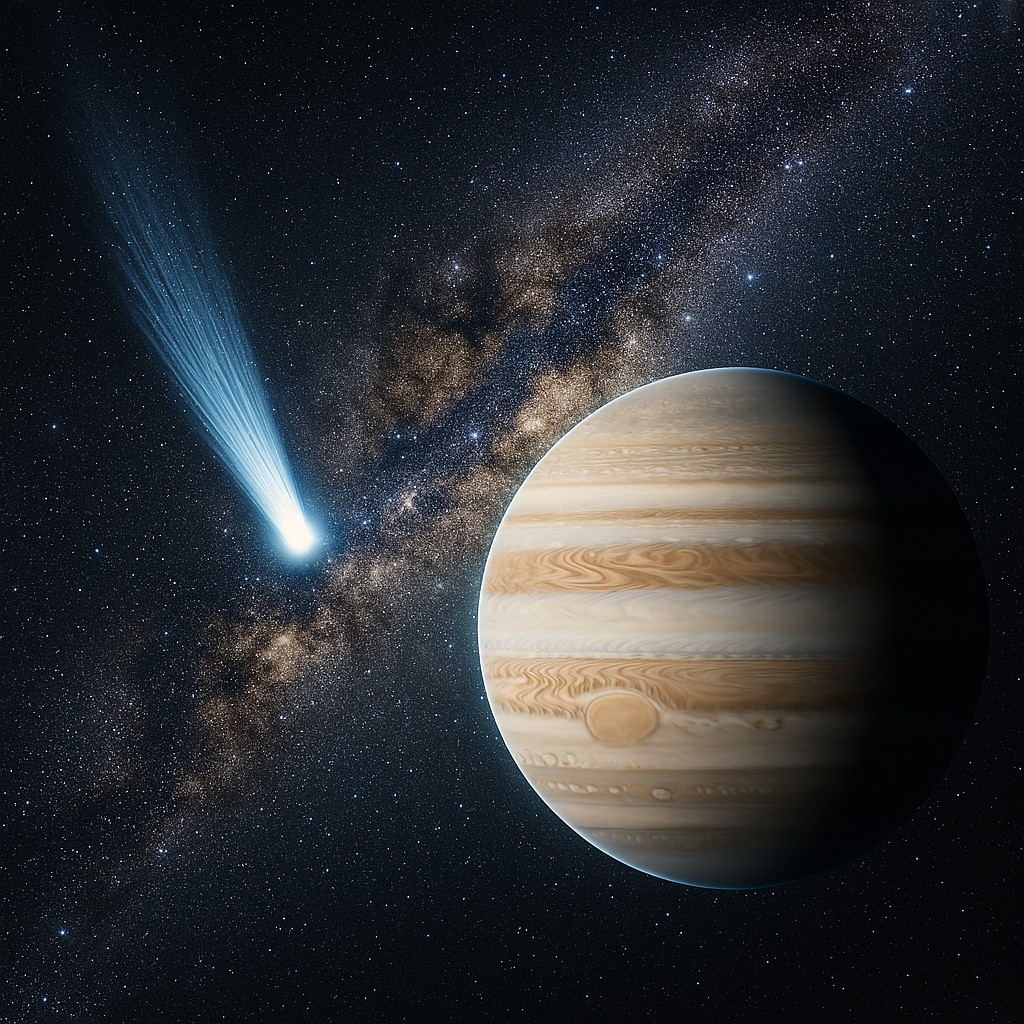
One of the most interesting ideas capable of radically changing our understanding of planet formation was presented by astrophysicist Susanne Pfalzner. At a joint meeting of the European Science Congress in Germany, she put forward a theory that interstellar travelers such as 3I/ATLAS could act as “seeds” for the rapid birth of giant planets.
Shortcomings of classical theory
The current model of planet formation, known as accretion, describes a slow process: small particles of dust and gas in the disk around a young star collide and gradually grow, forming larger and larger bodies. However, this theory has a serious flaw: it cannot fully explain how massive gas giants similar to Jupiter are successfully formed.
Computer models show that at high speeds, small bodies are more likely to break apart in collisions than to stick together. This poses a significant problem, especially for stars similar to our Sun, which retain their dust disks for only two million years. In such an extremely short time on a cosmic scale, it is practically impossible to create a giant planet solely through accretion.
Space seeds
Pfalzner’s hypothesis offers an elegant solution to this mystery. The researcher suggests that the gravity of a young star can effectively capture millions of interstellar objects similar in size to the first such visitor, Oumuamua, which is about 100 meters in size. These interstellar rocks could be ideal building materials.
“Interstellar space could supply ready-made seeds for the formation of the next generation of planets,” says the scientist. These objects, already dense and formed, give the formation process a significant boost, providing a massive core around which gas can quickly accumulate, accelerating the birth of a giant.
Why do giants like bigger stars?
This theory also perfectly explains why gas giants are extremely rare in systems with cold, small stars known as M dwarfs. The reason is simple: they have weaker gravity.
“Stars with greater mass are more effective at capturing interstellar objects,” explains Susanne Pfalzner. “Therefore, the formation of planets from interstellar objects should be more efficient around these stars.”
Pfalzner and her team are now actively working on computer simulations to determine how many planets captured interstellar objects can form and how they are distributed in circumstellar disks. This work could open a new chapter in our understanding of how worlds are born.
We previously reported on how comet 3I/ATLAS changed color during a lunar eclipse.
Provided by: europlanet.org

