

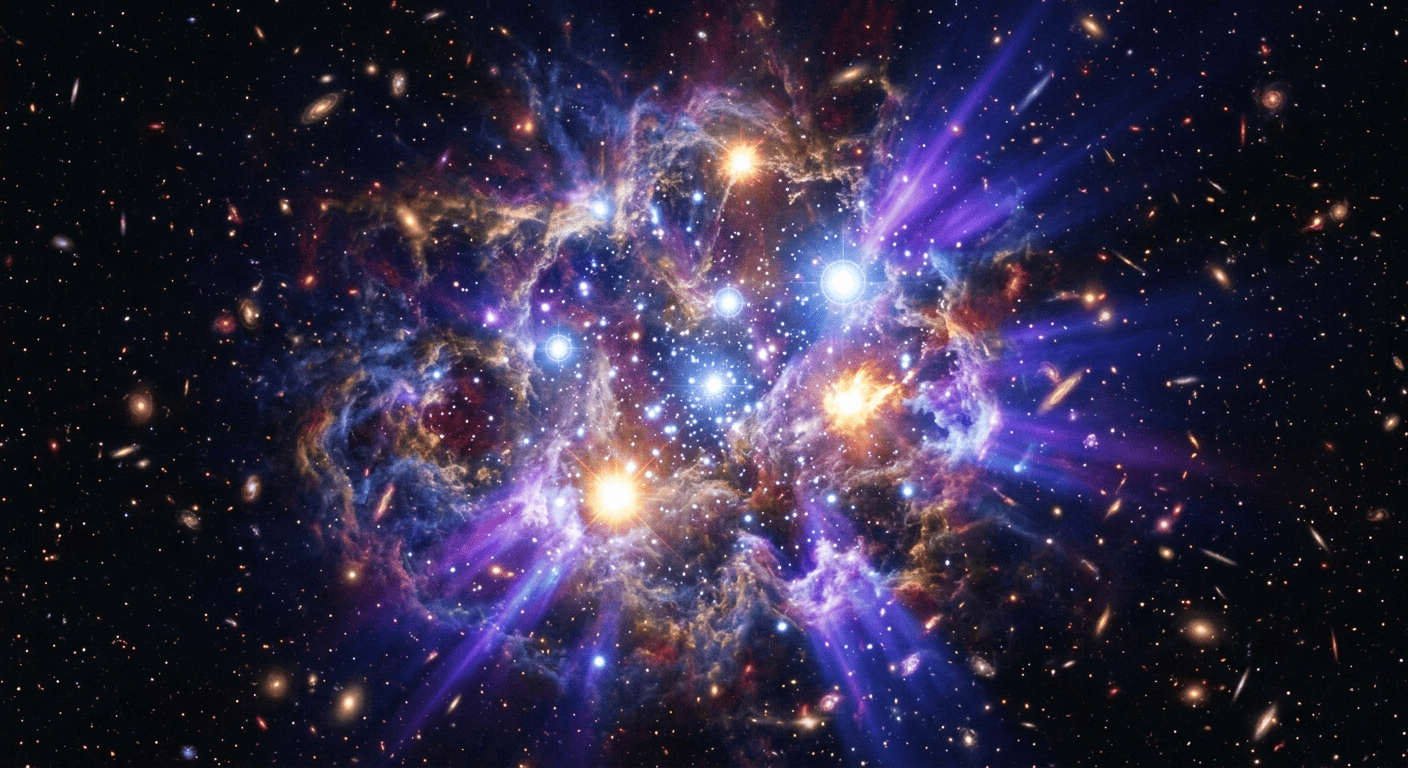
The James Webb Space Telescope has revealed that galaxies in the early Universe appear much brighter than any models had predicted. A new study offers an explanation, suggesting that the reason may lie in the unique properties of dust formed after the explosions of massive stars.
Brighter than expected
When the James Webb Space Telescope was pointed at the earliest regions of the Universe, astronomers expected to see faint galaxies shrouded in dust clouds. Instead, they discovered objects that existed less than 550 million years after the Big Bang and emitted ultraviolet light much more intensely than any predictions.
The fact is that dust clouds within galaxies absorb ultraviolet light—a phenomenon astronomers refer to as attenuation. If this filter isn’t working, the galaxy appears much brighter to an outside observer. Several possible explanations have emerged—ranging from intense star formation to hidden black holes. However, the hypothesis regarding the unusual properties of the dust has garnered the most attention.
Doesn’t block the light
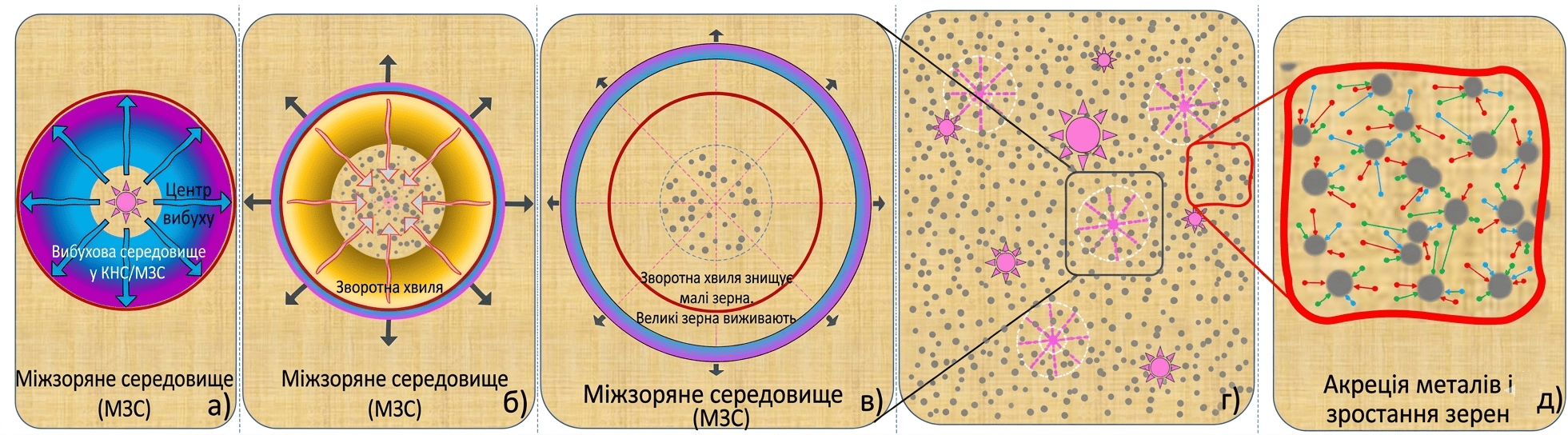
In mature galaxies, dust accumulates gradually: over billions of years, tiny particles absorb metals from the surrounding gas. In the young galaxies of the early Universe, there simply wasn’t enough time for this process to occur.
When the shock wave bounces back through the ejected material, it destroys the smallest particles. Only the larger particles survive, and they are transparent to ultraviolet radiation.
Answer in the structure of dust
Researchers led by Denis Burgarella of the Marseille Astrophysics Laboratory have developed a model that takes into account the optical properties of cosmic dust from supernovae, its dependence on the galaxy’s metal content, and the spatial distribution of clouds and stars. The key feature is its porous structure: the particles do not form a solid screen but are distributed unevenly, leaving “windows” through which ultraviolet light escapes unimpeded.
The model reproduced the James Webb data without any exotic assumptions. It also explained the existence of GELDA galaxies (Galaxies with Extremely Low Dust Attenuation). These objects are rich in gas but nearly transparent to ultraviolet light. The earlier theory—that the explosions simply “blew” dust out of the galaxies—did not stand up to scrutiny, because if that were the case, the gas would have disappeared as well, and gas makes up over 90% of the material there.
Traces of the first generation of stars
The researchers also focused on the galaxies with the lowest metal content in their sample. The dust in these galaxies may be a direct legacy of Population III stars—the first generation of stars in the Universe, formed from pure hydrogen and helium before the emergence of heavy elements. No such star has yet been observed directly.
According to the authors, the chemical signature of their supernovae—which take the form of large, weakly absorbing dust grains—can be detected in the attenuation properties, metal content, and infrared radiation of these galaxies. The authors emphasize that the results require further clarification—the properties of supernova dust in the early Universe are still not well understood. Further observations using the James Webb Space Telescope and the ALMA radio telescope should help clarify the details.
According to phys.org

