

The interstellar object 3I/ATLAS continues to baffle scientists with its mysteries. A new study conducted using the powerful ALMA (Atacama Large Millimeter/submillimeter Array) radio telescope has enabled scientists to measure the heavy water (HDO) content in the comet for the first time in history. The results were staggering: the chemical composition of this comet suggests that it formed under conditions far harsher and colder than those in which our Sun and its planets were born.
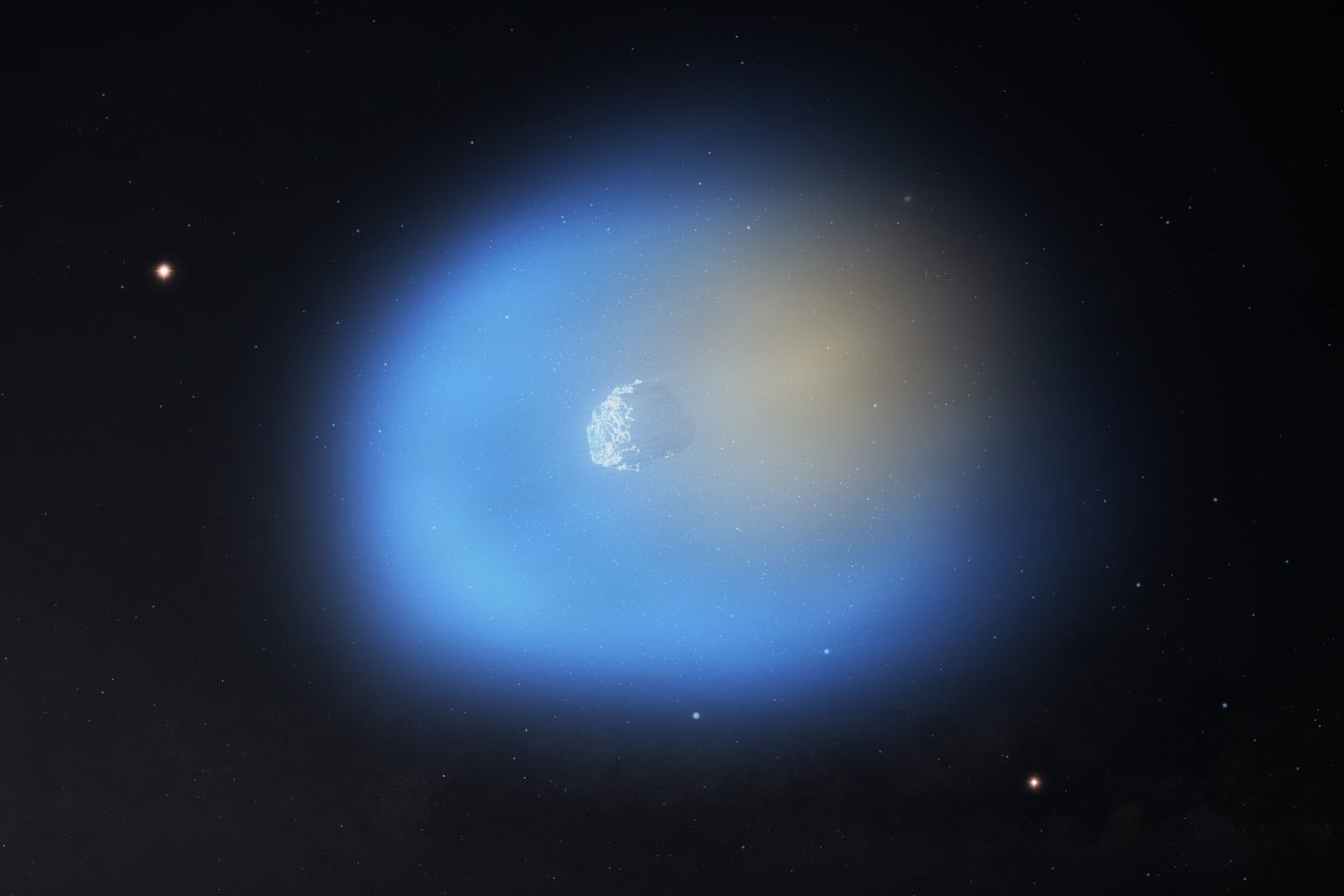
Comets are often called the “dirty snowballs” of space, since they consist mainly of ice and dust. However, this ice is not just frozen water, but a true time capsule that preserves information about the chemical environment at the moment the star was born. In addition to ordinary water (H₂O), comets contain what is known as heavy water or deuterium-rich water, in which one hydrogen atom has been replaced by its heavy isotope, deuterium.
A team of astronomers led by Luis E. Salazar Manzano of the University of Michigan has determined that the proportion of deuterium-rich water in 3I/ATLAS is at least 30 times higher than in comets in our Solar System. Moreover, this ratio is 40 times higher than in Earth’s oceans. Such an anomalous deuterium-to-hydrogen ratio is direct evidence that the comet’s home system evolved according to a completely different scenario than ours.
Life at -243°C
Why is this indicator so important? The fact is that the processes that enrich water with deuterium are extremely sensitive to the environment. To achieve the concentration observed in 3I/ATLAS, the formation medium would have had to be incredibly cold.
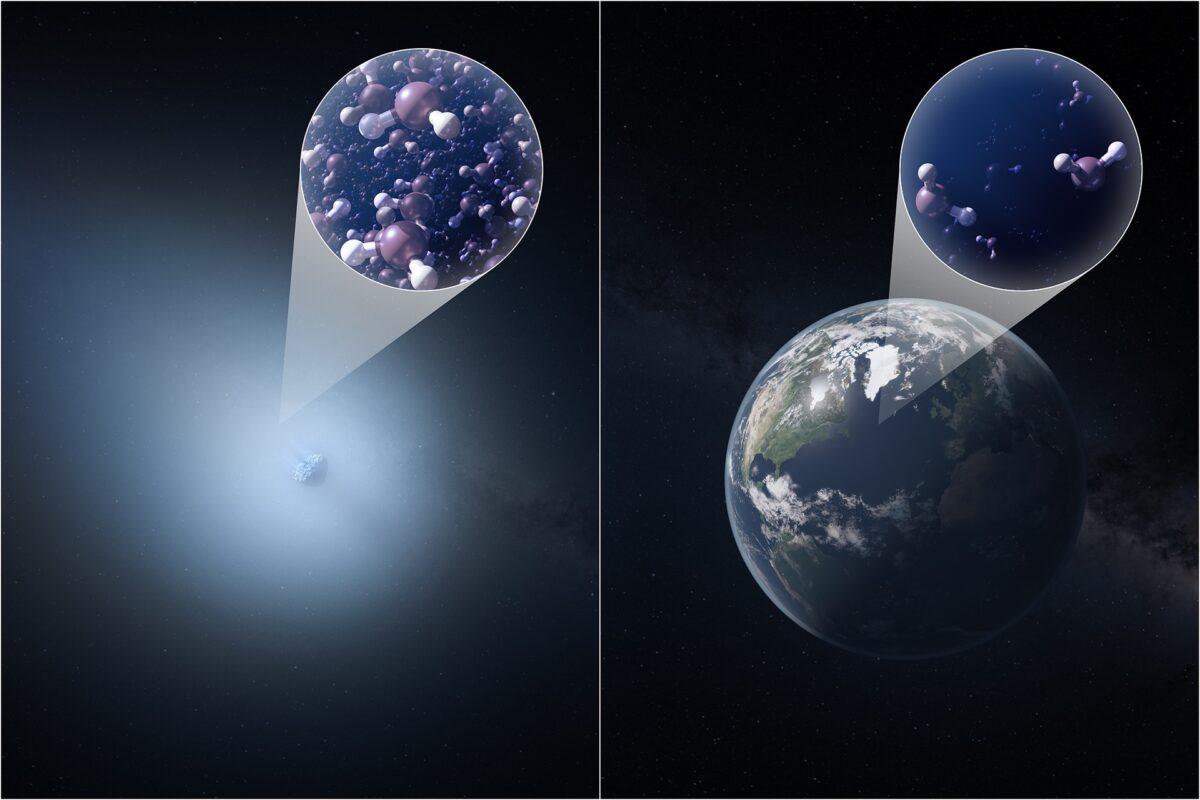
According to scientists, the comet is believed to have formed in a cloud of gas and dust with a temperature not exceeding 30 K (-243 °C). This is significantly colder than the conditions under which objects formed in the protoplanetary disk around our young Sun. These chemical “scars” were imprinted in the comet’s ice billions of years ago and have remained unchanged throughout its endless journey through interstellar space.
ALMA’s Technological Triumph
Taking such precise measurements was no easy task. Most modern optical telescopes have a strict limitation: they cannot be pointed toward the Sun, as the bright light would damage their highly sensitive sensors. However, radio telescopes such as ALMA operate in a different frequency range.
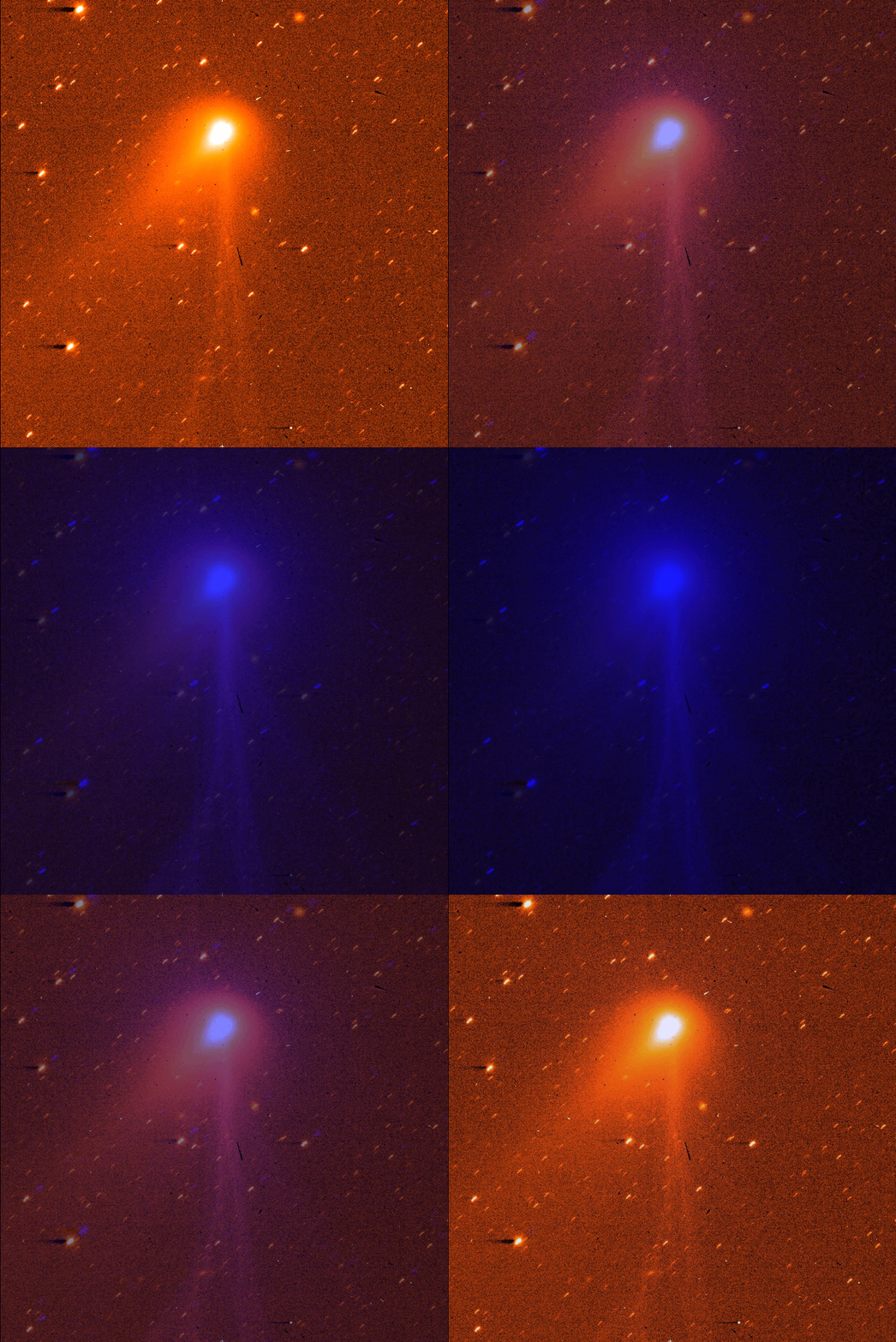
The observations were conducted using the Atacama Compact Array (ACA), part of the ALMA complex, just six days after comet 3I/ATLAS passed through perihelion—its closest point to the Sun. At that moment, the ice began to evaporate rapidly, releasing water molecules. Interestingly, the scientists didn’t even have to detect ordinary water directly—they used complex modeling based on methanol radiation to calculate the total amount of ice, whereas HDO molecules were detected directly.
Space fossils
The discovery, published in the journal Nature Astronomy, is significant not only in terms of planetary science but also in terms of cosmology. The ratio of deuterium to hydrogen in the universe was established during the Big Bang. By studying objects such as 3I/ATLAS, humanity has a unique opportunity to glimpse other parts of the Galaxy without leaving the Solar System.
“Every interstellar comet is a fossil that carries the history of its home,” notes Associate Professor Teresa Paneque-Carreño. New data shows that our solar system is not a universal model. The universe is far more diverse, and planetary systems can form under conditions of extreme cold that we previously could only imagine in theory.
We previously reported on how an image revealed the complex structure of the tails of comet 3I/ATLAS.
According to almaobservatory.org

