

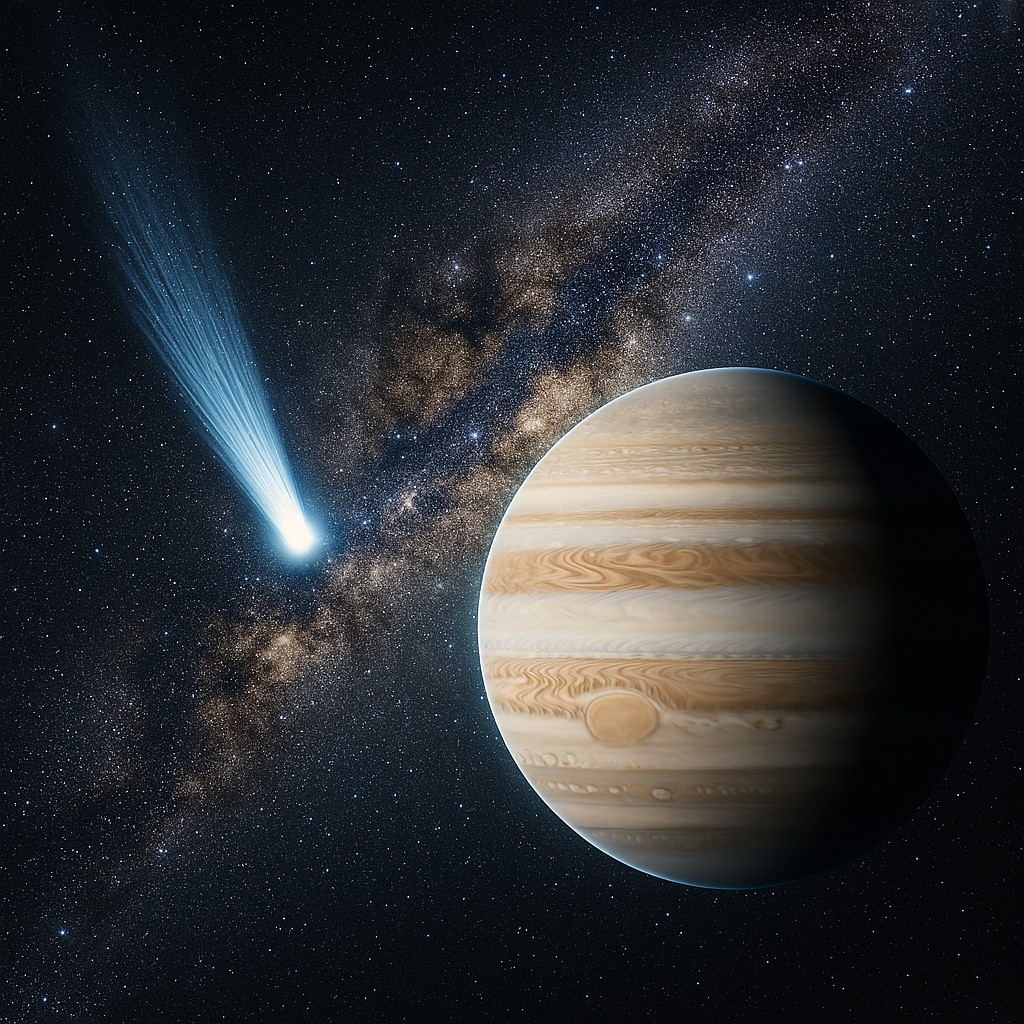
In August 2025, NASA’s SPHEREx space observatory conducted a series of observations of the interstellar object 3I/ATLAS. At that moment, the interstellar comet was more than three AU from the Sun and was moving at a speed of 58 km/s along a hyperbolic trajectory with an eccentricity of 6.2. The new data brought unexpected results challenging scientists’ previous ideas about the origin of this alien.
Unexpectedly low water content
Spectral analysis revealed the presence of a symmetrical cloud of carbon dioxide (CO2) around the object. The rate of mass loss is estimated at approximately 70 kg/sec. However, another fact is much more important: no water in a gaseous state was found. This contradicts earlier hypotheses, according to which 3I/ATLAS was considered a water-rich comet.
Scientists note that the absence of a bright coma of water gas is puzzling, since the object was not far from the so-called “water ice line,” where temperatures were low enough to cause CO₂ condensation, but not water. Probably, the comet could have been exposed to intense high doses of radiation, which led to the evaporation of water relative to CO₂, or it could have preserved internal structures that prevented heat penetration, thereby limiting water sublimation.
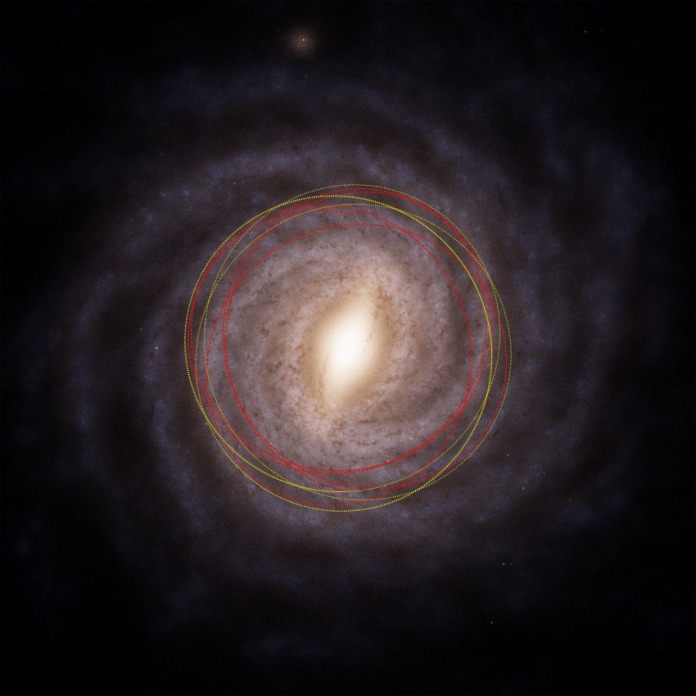
Using Monte Carlo simulations and the GalPot galactic potential model, researchers traced the object’s trajectory back a billion years, determining its average age to be 4.6 billion years and its origin to be in the thick disk region of the Milky Way. The high approach speed and hyperbolic orbit indicate that the object was ejected due to gravitational interactions, probably with a giant planet, which gave it enough momentum to escape beyond its home star system.
Huge dimensions and bold hypotheses
One of the most surprising findings was that, according to radiation data at a wavelength of 1 μm, the diameter of the 3I/ATLAS core can reach 46 km. This makes it millions of times more massive than the first known interstellar traveler, comet 2I/Borisov. This anomaly, along with the fact that the object’s trajectory is aligned with the plane of the solar system, has raised a number of questions. Could this object be something other than an ordinary comet? Some scientists do not rule out even the most daring hypotheses, such as that it has an artificial extraterrestrial origin.
The scientific community is now eagerly awaiting the publication of data from another powerful instrument, the James Webb Space Telescope, which also observed 3I/ATLAS. Its unique capabilities may shed light on what is actually hidden beneath the outer layer of this silent interstellar visitor. The final conclusions remain beyond the scope of the data obtained, leaving room for scientific debate and the most daring assumptions.
Earlier, we talked about what interstellar objects are: natural bodies or alien spacecraft.
According to avi-loeb.medium.com

